A Complete Guide for Everest Base Camp Trek
Trek at a Glance
| Trek Duration | 14 Days (12 days trekking + 2 days Kathmandu) + 2 recommended contingency days |
| Trek Region | Khumbu, Solukhumbu District, Sagarmatha Zone, Nepal |
| Start / End | Kathmandu / Kathmandu |
| Trekking Route | Lukla → Phakding → Namche Bazaar → Tengboche → Dingboche → Lobuche → Gorak Shep → EBC → Kala Patthar → Return |
| Max. Altitude | Kala Patthar: 5,545m / 18,192ft | Everest Base Camp: 5,364m / 17,598ft |
| Total Distance | 130 km round trip |
| Daily Walking | 5–8 hours per day, 10–20 km |
| Trek Grade | Strenuous — requires good physical fitness, no technical climbing |
| Accommodation | Teahouses and guesthouses along the trail; 3-star hotel in Kathmandu |
| Transport | Kathmandu–Lukla–Kathmandu by domestic flight (35 min) |
| Best Season | Spring: March–May | Autumn: September–November |
| Standard Package Cost | USD $1,400 – $1,600 per person (all-inclusive, guided) |
Overview
The Everest Base Camp Trek is one of the world’s most iconic trekking journeys. It takes you through the heart of Nepal’s Khumbu region through ancient Sherpa villages, Buddhist monasteries, rhododendron forests, and glaciated high-altitude terrain to the foot of the planet’s tallest mountain, Mount Everest at 8,848m.
You won’t summit Everest. Very few people ever do. But from Kala Patthar at 5,545m, you’ll get the most spectacular, unobstructed view of the Everest massif available without technical climbing. The South Face, the Khumbu Icefall, Lhotse (8,516m), Nuptse (7,861m), and Ama Dablam (6,814m) fill the horizon in every direction.
This is not a luxury trip. You sleep in teahouses run by Sherpa families where rooms are basic, walls are thin, and mornings are cold. The food is simple, hearty, and surprisingly good. The people are exceptional. The landscape is like nowhere else on Earth.
A good fitness base, mental resilience, and respect for acclimatization are what this trek demands. In return it gives back something most people describe as life-changing.
Major Highlights
- Stand at Everest Base Camp (5,364m) — the launch pad of every Everest summit attempt
- Summit Kala Patthar (5,545m) for the finest panoramic view of Mount Everest
- Fly the legendary Tenzing-Hillary Airport (Lukla) — one of the world’s most dramatic airstrips
- Walk through Namche Bazaar, the cultural and commercial capital of the Khumbu Sherpa community
- Visit Tengboche Monastery, the most sacred and scenic monastery in the Everest region
- Acclimatization hike to Everest View Hotel — first view of Everest from 3,880m
- Cross dozens of iconic suspension bridges draped in prayer flags over the Dudh Koshi River
- Walk past Ama Dablam — consistently ranked among the world’s most beautiful mountains
- Encounter Sherpa culture, Buddhist traditions, mani walls, chortens, and prayer wheels
- Witness the Khumbu Glacier and Khumbu Icefall from EBC — the most dangerous section of any Everest climb
- Trek through Sagarmatha National Park — a UNESCO World Heritage Site
- Possible wildlife sightings: Himalayan tahr, musk deer, snow leopard (rare), red panda, Danphe pheasant
Detailed Day-by-Day Itinerary
Day 01: Arrival in Kathmandu (1,400m)
You arrive at Tribhuvan International Airport in Kathmandu, where you are met and transferred to your hotel in Thamel. The rest of the day is free to rest or explore the area. In the evening, you attend a trip briefing covering the trek route, permits, and final preparations.
Day 02: Fly to Lukla (2,840m) and Trek to Phakding (2,610m)
You take an early morning flight to Lukla, followed by a short trek to Phakding through forests and along the Dudh Koshi River, crossing suspension bridges and passing small villages.
Day 03: Trek to Namche Bazaar (3,440m)
The trail continues along the river with multiple bridge crossings before entering Sagarmatha National Park. A steady climb brings you to Namche Bazaar, the main trading hub of the Everest region, with your first distant views of Everest.
Day 04: Acclimatization in Namche Bazaar (3,440m)
A rest day for acclimatization includes a hike to Everest View Hotel for panoramic mountain views. The afternoon is free to explore Namche, visit museums, or relax.
Day 05: Trek to Tengboche (3,860m)
You follow a scenic trail with mountain views before descending and climbing again to reach Tengboche, home to the region’s largest monastery with stunning Himalayan backdrops.
Day 06: Trek to Dingboche (4,410m)
The trail descends through forest and passes Pangboche village before entering a more open alpine landscape. Dingboche offers wide valley views surrounded by high peaks.
Day 07: Acclimatization in Dingboche (4,410m)
Another acclimatization day with a short hike to higher elevation for better adaptation. The rest of the day is spent resting and preparing for higher altitude.
Day 08: Trek to Lobuche (4,940m)
You continue through the valley, passing the memorial site at Thukla before reaching Lobuche near the Khumbu Glacier. The altitude becomes more noticeable here.
Day 09: Trek to Everest Base Camp (5,364m) via Gorak Shep (5,164m)
You trek to Gorak Shep and continue to Everest Base Camp, walking along the glacier moraine. After reaching base camp, you return to Gorak Shep for the night.
Day 10: Kala Patthar (5,545m) and Trek to Pheriche (4,371m)
An early morning hike to Kala Patthar offers the best views of Mount Everest at sunrise. After descending, you trek down to Pheriche.
Day 11: Trek to Namche Bazaar (3,440m)
You descend through valleys and forests, passing Tengboche and continuing down to Namche Bazaar, where you can relax after the long day.
Day 12: Trek to Lukla (2,840m)
The final trekking day follows the same route back along the river, crossing bridges and passing villages before reaching Lukla. A farewell dinner marks the end of the trek.
Day 13: Fly to Kathmandu (1,400m)
You fly back to Kathmandu in the morning. The rest of the day is free for rest, shopping, or optional sightseeing.
Day 14: Departure
You are transferred to the airport for your international departure, marking the end of your Everest Base Camp journey.
Altitude Profile — Day-by-Day
| Day 1 | Kathmandu — 1,400m |
| Day 2 | Lukla 2,840m → Phakding 2,610m |
| Day 3 | Namche Bazaar — 3,440m |
| Day 4 | Namche Bazaar (acclimatization) — 3,440m | Day hike to 3,880m |
| Day 5 | Tengboche — 3,860m |
| Day 6 | Dingboche — 4,410m |
| Day 7 | Dingboche (acclimatization) — 4,410m | Day hike to ~4,800m |
| Day 8 | Lobuche — 4,940m |
| Day 9 | Gorak Shep 5,164m → Everest Base Camp 5,364m → Gorak Shep |
| Day 10 | Kala Patthar 5,545m → Pheriche 4,371m |
| Day 11 | Namche Bazaar — 3,440m |
| Day 12 | Lukla — 2,840m |
| Day 13 | Kathmandu — 1,400m |
| Day 14 | Departure |
Trek Cost & Pricing (2025 / 2026)
Pricing varies by agency type (local vs. international), group size, and comfort level. The table below reflects market rates for 2025 and 2026 for a 14-day guided EBC trek package.
| Package Type | Group Size | Price Per Person |
| Budget | Solo | USD $950 – $1,200 |
| Standard (Recommended) | 2–6 people | USD $1,400 – $1,600 |
| Private / Small Group | 1–4 people | USD $1,600 – $2,000 |
| Luxury / Helicopter Return | Any | USD $2,500 – $5,000+ |
Most trekkers booking with a reputable local Nepal-based agency settle on the standard package at USD $1,400–$1,600 per person, which covers all essential logistics end-to-end.
What Affects the Price
- Agency type: Local Nepal agencies are typically 20–40% cheaper than international operators offering the same quality
- Group size: Larger groups reduce per-person cost — solo travelers pay a premium
- Accommodation: Budget teahouses vs. premium teahouses (Namche, Tengboche) can double accommodation costs
- Helicopter option: Adding a helicopter return from Gorak Shep or Lukla adds USD $800–$1,200 per person
- Season: Peak season (Oct–Nov, Mar–May) may carry a small premium
- Trip duration: Longer itineraries with extra acclimatization days cost more but significantly reduce altitude sickness risk
What’s Included (Standard Package)
- Airport transfers in Kathmandu (arrival and departure)
- 2 nights hotel accommodation in Kathmandu (3-star, bed & breakfast)
- Domestic return flights: Kathmandu–Lukla–Kathmandu (including airport taxes)
- 11 nights teahouse accommodation on the trek (twin-share basis)
- All meals during the trek: 3 Breakfasts, 3 Lunches, 3 Dinners per day
- Tea/coffee with meals (3 cups per day)
- English-speaking government-licensed lead trekking guide
- Porter service (1 porter per 2 trekkers, carrying up to 12–15 kg)
- Guide and porter salaries, food, accommodation, insurance, and equipment
- Sagarmatha National Park Entry Permit
- Khumbu Pasang Lhamu Rural Municipality Permit
- TIMS Card (Trekkers’ Information Management System)
- Comprehensive first-aid medical kit
- Oxygen can and pulse oximeter (for emergency use)
- Company duffel bag (80L) for porter transport
- Sleeping bag rated to -20°C (provided on request or loan)
- Trekking poles (provided if required)
- All government and local taxes, VAT, and service charges
- Trip completion certificate
What’s Not Included
- International airfares to/from Kathmandu
- Nepal entry visa fee (USD $25–$100 depending on duration)
- Travel insurance with emergency helicopter evacuation cover — MANDATORY
- Personal trekking gear and clothing
- Extra meals, snacks, and drinks in Kathmandu
- Hot showers, WiFi, battery charging, and bottled water at teahouses (charged separately)
- Personal expenses: laundry, phone calls, souvenirs
- Altitude sickness medication (Diamox / Acetazolamide) — consult your doctor
- Tips for guides and porters (customary and expected — see Tipping section)
- Costs arising from flight delays, cancellations, or natural disasters
- Helicopter evacuation costs (covered by travel insurance)
Required Permits
Three permits are required to trek in the Everest region. Your agency handles all paperwork if booked as part of a package.
| Permit | Fee (USD approx.) | Where to Get |
| Sagarmatha National Park Entry | ~USD 30 | Monjo checkpoint or Kathmandu |
| Khumbu Pasang Lhamu Rural Municipality Permit | ~USD 20 | Lukla or Monjo |
| TIMS Card (Trekkers Information Management System) | ~USD 10–20 | TAAN/NTB, Kathmandu |
All permits are checked at multiple checkpoints on the trail — carry them with you at all times.
Practical Information
Best Time to Trek — Seasons
There are two ideal trekking windows. Both deliver very different but equally memorable experiences.
| Spring (March–May) | Most popular season. Rhododendrons in full bloom below 4,000m. Mild temperatures. Busy trails. Everest climbing season — you may see expedition teams at Base Camp. March is quieter than April/May. |
| Autumn (September–November) | Peak season. Crystal-clear skies after monsoon. Best mountain visibility. October and November are the most popular months. Trails are at their busiest. |
| Winter (December–February) | Cold but possible for experienced trekkers. Far fewer tourists. Clear skies but extremely cold nights above 4,000m. Some teahouses close. |
| Monsoon (June–August) | Not recommended. Heavy rain, leeches below treeline, muddy trails, poor visibility. Some trekkers do it — it demands full waterproof gear and adjusted expectations. |
Altitude Sickness (AMS) — Critical Information
Acute Mountain Sickness is the single biggest risk on the EBC trek. It affects people regardless of age, fitness, or prior high-altitude experience. There is no reliable way to predict susceptibility.
- Symptoms: Headache, nausea, dizziness, fatigue, loss of appetite, disturbed sleep
- Key rule: Never ascend to sleep at a higher altitude if symptoms are present
- The two acclimatization days (Namche and Dingboche) are non-negotiable — do not skip them
- Drink 3–4 litres of water per day. Avoid alcohol, especially above 3,500m
- Diamox (Acetazolamide) is commonly used as a prophylactic — consult your doctor before departure
- If symptoms worsen, immediate descent is the only cure — your guide is trained to make this call
- Comprehensive travel insurance with helicopter evacuation cover is not optional — evacuation from above 4,000m costs USD $3,000–$8,000 without it
Accommodation
Teahouses (also called lodges or guesthouses) line the entire EBC route. Rooms are basic — typically a small wooden room with two beds, a mattress, pillow, and blanket. Private rooms are standard; dormitories exist at the budget end. Facilities include a common dining room with a stove, squat or Western toilets (not always inside the room), and occasional hot showers (charged extra, USD $2–$5). WiFi is available at most teahouses but is slow and charged per hour or day. Power sockets for charging devices are available in the dining room, usually for a small fee.
Food and Water
Teahouse menus are remarkably consistent along the entire route. Dal Bhat (lentil soup, rice, vegetable curry) is the trekker’s staple — hearty, nutritious, and always the best value. Other common items include Tibetan bread, pasta, noodle soups, pancakes, porridge, fried rice, and momos (dumplings). Prices increase significantly with altitude — a basic meal at Lobuche or Gorak Shep costs roughly 3–4 times the same meal in Phakding.
- Never drink tap water directly — use water purification tablets or a filter bottle (strongly recommended over buying plastic bottles at altitude)
- Boiled water is available at teahouses — ask for it
- Bottled water costs USD $1–$3 at lower altitude and USD $3–$6 near EBC
Connectivity and Communication
- WiFi is available at most teahouses — slow, unstable, and charged (NPR 100–500 per session)
- Buy a Ncell or Nepal Telecom SIM card in Kathmandu for mobile data coverage (limited but available up to Namche and sometimes Dingboche)
- Satellite communication devices (Garmin inReach) are recommended for serious trekkers
- Emergency rescue can be coordinated through your guide, teahouse owners, or the Himalayan Rescue Association clinic in Pheriche
Money and Expenses
- Carry Nepali Rupees (NPR) in cash — there are ATMs in Namche Bazaar but nowhere else on the trail
- Withdraw enough cash in Kathmandu before departure as a backup
- USD is accepted in some larger teahouses but at a poor exchange rate
- Budget USD $20–$40 per day for personal expenses (hot showers, WiFi, extra drinks, snacks)
- Tips: Guide USD $15–$20/day, Porter USD $10–$15/day — settled at the end of the trek in cash
Packing List
Thamel, Kathmandu has excellent gear shops, both original brands and high-quality replicas at a fraction of Western retail prices. First-timers can buy or rent almost everything needed before departure.
Clothing (Layering is Essential)
- Moisture-wicking base layers (top and bottom) — merino wool or synthetic
- Insulating mid-layer: fleece jacket or down sweater
- Outer shell: waterproof and windproof hard-shell jacket and trousers
- Down jacket (rated to at least -10°C) — critical above 4,000m
- Lightweight trekking trousers — 2 pairs minimum
- Trekking shirts — 2–3 quick-dry
- Thermal underwear for sleeping above 4,500m
- Warm hat covering ears, sun hat, balaclava
- Gloves: lightweight inner gloves + waterproof outer mitts
- Wool or trekking socks — minimum 4–5 pairs
- Gaiters (optional but useful in snow above 5,000m)
Footwear
- Trekking boots: waterproof, ankle support, broken in before departure — non-negotiable
- Camp sandals or flip-flops for teahouse evenings
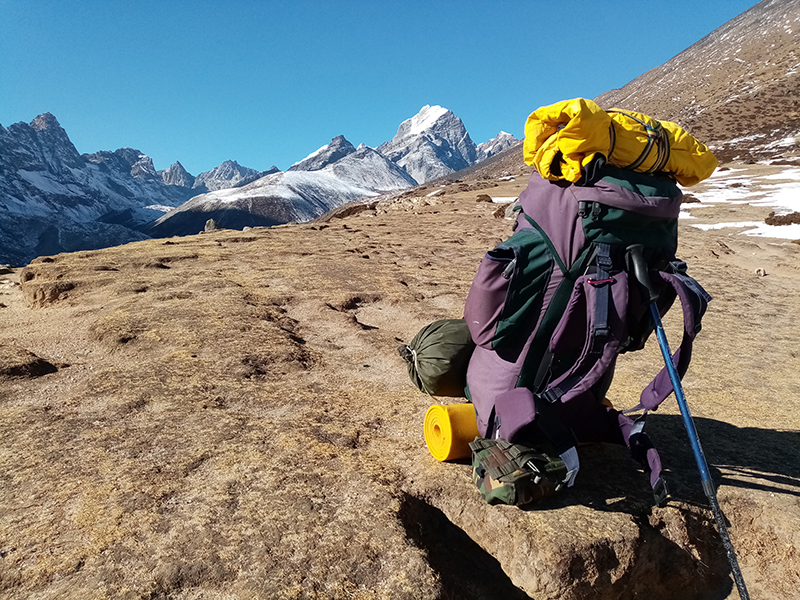
- Trekking poles — highly recommended for descents and above 4,000m
Equipment & Gear
- Daypack (25–35L) for daily trekking — the porter carries your duffel
- Main duffel bag (70–80L) for porter — provided by agency on request
- Sleeping bag rated to -20°C — provided by agency on request
- Headlamp with spare batteries
- Sunglasses (Category 3–4 UV protection — essential above treeline)
- Sunscreen SPF 50+ and lip balm with SPF
- Water bottles (1L x 2) or hydration bladder
- Water purification tablets or Steripen / Sawyer filter
- Camera with extra batteries (cold kills battery life rapidly)
- Portable power bank (10,000–20,000mAh)
- Trekking map of the Everest region
Health & First Aid
- Personal first-aid kit: blister plasters, bandages, antiseptic, painkillers
- Altitude sickness medication: Diamox (consult your doctor before departure)
- Anti-diarrhoea medication, antihistamine, throat lozenges
- Rehydration sachets (ORS)
- Hand sanitizer and wet wipes
- Personal prescription medications — carry more than you think you need
Documents
- Valid passport (minimum 6 months validity)
- Nepal visa (available on arrival at Kathmandu airport)
- Travel insurance documents with 24-hour emergency helpline number
- Trekking permit copies (your agency provides these)
- Emergency contacts — written on paper, not just in your phone
Physical Preparation & Fitness
The EBC trek is graded strenuous. You don’t need mountaineering experience, but you do need a solid aerobic fitness base before arrival. Trekkers who prepare properly have a dramatically better experience — and a lower risk of altitude sickness.
Recommended Training — 8 to 12 Weeks Before Departure
- Cardiovascular: Running, cycling, swimming, or stair climbing — 3–4 sessions per week
- Hiking: Weekend hikes with a loaded pack on uneven terrain — build up to 15–20 km
- Strength: Leg strength and core stability training — squats, lunges, step-ups
- Stair climbing with a 10–15kg pack is one of the most effective specific preparations
- If possible, spend time at altitude before the trek — even a weekend at 2,500–3,000m helps
The trek itself does the rest. The itinerary is designed with two acclimatization days specifically to allow your body to adapt. Fitness gets you to those acclimatization days comfortably — the acclimatization days get you to Base Camp safely.
Environment, Wildlife & Conservation
The EBC route passes through Sagarmatha National Park, a UNESCO World Heritage Site established in 1976. The park covers 1,148 sq. km and protects one of the most dramatic high-altitude ecosystems on Earth.
Wildlife You May Encounter
- Himalayan Tahr (wild mountain goat) — commonly seen on rocky slopes
- Musk Deer — occasionally spotted in forested lower sections
- Snow Leopard — extremely rare but present; tracks occasionally found
- Red Panda — possible in rhododendron forests below 3,500m
- Danphe Pheasant (Impeyan Pheasant) — Nepal’s national bird, seen regularly
- Yellow-billed Chough, Himalayan Griffon Vulture, and various alpine bird species
Leave No Trace
- Never leave rubbish on the trail — pack it down or deposit at designated points
- Avoid single-use plastic bottles — use a filter or purification tablets
- Stay on marked trails — shortcutting erodes the mountain slope
- Do not pick flowers or disturb wildlife
- Respect Buddhist religious sites — walk clockwise around chortens and mani walls
- Do not remove rocks, prayer flags, or religious objects
Frequently Asked Questions
Q1. Do I need prior trekking experience to do the EBC trek?
No technical mountaineering experience is required. But this is a strenuous, high-altitude trek. You should be comfortable walking 5–8 hours per day, 6 days in a row, on uneven terrain while carrying a daypack. Prior hiking experience is strongly recommended. Complete beginners can do it with adequate physical preparation and a good guide.
Q2. Is a guide mandatory for the EBC trek?
As of recent Nepal Government regulations, solo trekking without a licensed guide is restricted for foreign nationals on many routes. In the Everest region, individual trekkers are still technically permitted to trek independently, but hiring a licensed guide is strongly recommended for safety, logistics, and altitude management. Your agency handles all permits and formalities.
Q3. What is the best month to trek to Everest Base Camp?
October and November are the most popular months — post-monsoon skies are clear and the mountains are stunning. March and April are excellent in spring — rhododendrons bloom below 4,000m and the days are warmer. April and May coincide with Everest climbing season, meaning you may encounter expedition teams at Base Camp.
Q4. How fit do I need to be?
You should be able to walk 6–7 hours comfortably at a steady pace before you arrive. Start training 8–12 weeks in advance with regular cardio, hiking with a loaded pack, and leg strength work. The itinerary includes acclimatization days to manage altitude — your fitness gets you to those days without exhausting your body before the hard sections begin.
Q5. What happens if my Lukla flight is cancelled?
Lukla is notorious for weather-related flight delays and cancellations — plan at least 1–2 contingency days into your schedule. If flights are cancelled for multiple consecutive days, an alternative is a helicopter to/from Lukla (higher cost, usually possible when fixed-wing aircraft cannot operate). Your agency monitors flights and manages rebooking.
Q6. Can I get altitude sickness even if I’m very fit?
Yes. Altitude sickness (AMS) has no reliable correlation with physical fitness. Very fit athletes get it; less fit trekkers sometimes acclimatize easily. The best prevention is a slow, gradual ascent with proper acclimatization days, staying hydrated, avoiding alcohol at altitude, and never ascending if symptoms are present. Your guide is trained to recognize symptoms and will make the call to descend if needed.
Q7. Is travel insurance mandatory?
It is not legally mandatory but is practically essential. Emergency helicopter evacuation from above 4,000m costs USD $3,000–$8,000 without insurance. No reputable agency will send you on this trek without strongly urging you to have comprehensive coverage that includes high-altitude trekking (to at least 6,000m) and emergency medical evacuation.
Q8. How much cash should I carry?
Budget USD $20–$40 per day for personal expenses (hot showers, WiFi, extra drinks, charging, snacks). Namche Bazaar has ATMs — the only ATMs on the route. Withdraw enough in Kathmandu as a backup. Carry NPR (Nepali Rupees) — USD is accepted at some larger teahouses but at a poor rate.
Q9. What is the tipping etiquette?
Tipping is customary and forms a significant part of your guide and porter’s income. Standard rates: Guide USD $15–$20 per day, Porter USD $10–$15 per day. Tips are usually pooled and distributed at the end of the trek in Lukla or Kathmandu. Your agency can advise on exact protocol.
Q10. Can the itinerary be extended or customized?
Yes. The standard 14-day itinerary can be extended with extra acclimatization days, a side trip to Gokyo Lakes, the Chola Pass crossing, Island Peak climbing, or a helicopter return from Kala Patthar or Gorak Shep. Shorter versions (7–10 days with helicopter return) are also available. Contact your agency to design a tailored itinerary.
Recent Posts