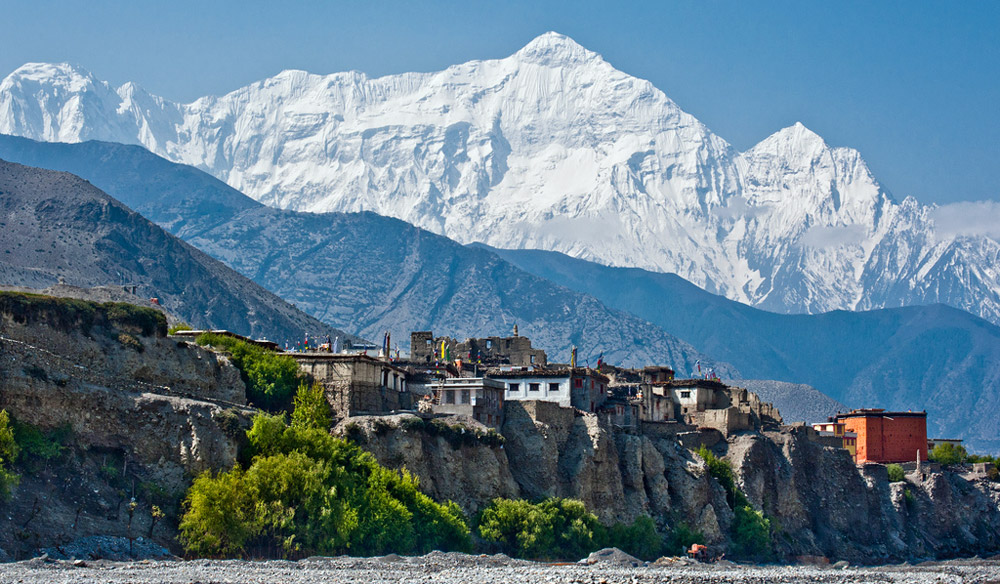
Nepal Trekking in September: The Underdog Month That Serious Trekkers Are Starting to Notice
Ask ten experienced Nepal trekkers which month surprised them most and a disproportionate number will say September. Not because it’s perfect. It isn’t. But because the gap between what people expect from it and what it actually delivers is wider than for any other month in the trekking calendar.
September sits at the tail end of monsoon season. That reputation keeps most trekkers away. The ones who go anyway, prepared for what the month genuinely involves rather than what the worst-case description implies, often come back calling it their favorite Nepal experience.
Here’s why, and how to do it right.
What September Actually Is in Nepal
Nepal’s monsoon runs from June through September. June, July, and August are the heavy months, with daily rainfall, leeches on lower trails, cloud-obscured peaks, and genuine landslide risk on unstable terrain. Most serious trekking agencies advise against these months on standard routes for good reason.
September is categorically different from its monsoon predecessors. The rain is still present, but the pattern shifts. Heavy overnight and early morning rain clears to partly cloudy or clear conditions by mid-morning on many days. The peaks that were buried in cloud through July and August begin showing themselves again. The trails, still green and saturated from four months of rain, carry a visual richness that the dry season never achieves.
By the second half of September, large sections of the trekking corridor are functionally in early autumn condition. The monsoon exit is not a switch that flips on October 1. It’s a gradual retreat that begins in mid-September and completes by early October. Trekkers who time their trips to the second half of September frequently encounter conditions that are indistinguishable from early October, with a fraction of the crowds and significantly lower costs.
This is what experienced September trekkers are booking into. Not the peak of monsoon. The end of it.
September Weather: Honest Expectations by Week
First Week of September
This is still late monsoon territory. Rain is frequent, often arriving in the afternoon after morning clearings. Trails at lower elevations carry leech risk. Visibility is variable. Mountain views are possible but not reliable. This week suits trekkers who have done Nepal before and approach trail conditions with flexibility rather than rigid expectation.
Second Week of September
The monsoon begins its retreat northward. Rainfall frequency drops noticeably. Morning clearings extend further into the afternoon on more days. Higher-altitude routes, particularly those above 3,500 meters, start seeing genuine clear-sky windows. The Everest high camps and Annapurna’s upper valleys begin to look like early autumn.
Third and Fourth Week of September
This is the version of September that experienced trekkers specifically target. Average daily temperature at 1,400 meters runs around 27 degrees Celsius, with average nightly temperature around 18 degrees. The trails are drying rapidly. The atmosphere is clearing. Mountain views become consistent rather than occasional. Tea houses that were quiet through July and August are reopening fully. The October crowds haven’t arrived yet. Everything is operational, nothing is congested.
Trekkers who leave Kathmandu in the third week of September for a 14 or 15-day route frequently complete their trek in early October conditions throughout. The monsoon clears ahead of them as they move through the itinerary.
The September Advantage: What You Actually Get
The Trail Is Yours
The fall season is when Nepal receives the bulk of trekkers. The most popular trails including Everest Base Camp, Annapurna Base Camp, Langtang Valley, Manaslu Circuit, and the Annapurna Circuit are completely packed in October and November, and this is felt from the trails to the tea houses.
September is the photographic negative of that. The Tengboche monastery approach that has 200 trekkers on it in October has 12 in September. The Poon Hill viewpoint at 3,210 meters that requires headlamp queue management in October has room to breathe in September. If the experience of genuinely walking in the mountains rather than through a managed crowd matters to you, September delivers it.
Landscapes at Their Most Alive
The monsoon does something to Nepal’s lower and mid-altitude trails that no other season replicates. The rhododendron forests are at maximum density. Waterfalls that are trickles in April are thundering columns in September. The terraced rice fields below the Annapurna foothills are a deep, saturated green, weeks away from the golden harvest color of October but visually extraordinary in their own right. Rivers run full and loud. The air smells of wet earth and vegetation rather than dust.
Trekkers who only know Nepal in the dry season often describe their first September trek as seeing an entirely different country on the same trails.
Cost Advantage Across the Board
September is shoulder season pricing with near-peak-season conditions in the second half of the month. International flights to Kathmandu run cheaper than October fares. Domestic flights to Lukla and Pokhara have better availability. Lodge rates on the trail are lower. Guide and porter day rates don’t carry the October premium. Trekking packages through local operators reflect the reduced demand.
For budget-conscious trekkers, a well-timed September trip covering the same route as an October trip can come in 20 to 30 percent cheaper across all cost categories combined.
Festivals Begin in September
Indra Jatra, one of Kathmandu’s most visually dramatic festivals, runs in September. The eight-day celebration in the old city involves the chariot procession of Kumari, the living goddess, through the narrow streets of Basantapur. If your trip begins with a day or two in Kathmandu before heading to the trailhead, September offers a cultural entry point that October doesn’t.
Dashain, Nepal’s largest festival, begins its build in late September with preparatory rituals that are visible in villages along trekking routes weeks before the main celebration. The social atmosphere in trail communities carries a particular energy in late September that is distinct from the commercial buzz of peak October.
The September Challenges: Unfiltered
Honesty about September requires acknowledging what the month genuinely involves.
Rain Is Still Possible
Even in the third and fourth weeks, rainfall can occur. It’s usually overnight or early morning, but multi-day overcast periods happen. Trekkers who need guaranteed clear views every single day should wait for October. Trekkers who can embrace a variable weather pattern, enjoying the clarity when it comes without spiraling when clouds move in, find September completely manageable.
Waterproof everything. Gaiters for lower trail sections. A rain cover for the daypack. These aren’t optional extras in September; they’re baseline kit.
Leeches on Lower Trails
Below 2,000 meters in September, leeches are present on trail vegetation, particularly after rain. This is specific to lower sections and disappears above 2,500 meters. Leech socks or gaiters, salt in a small container, and checking boots and lower legs after walking through wet vegetation handles it without drama. It’s a nuisance, not a danger, but worth knowing before encountering it unprepared on a forested section of trail.
Some High Passes Require Assessment
Thorong La on the Annapurna Circuit and the Everest Three Passes can carry residual snow from late-monsoon snowfall events in early September. By the third week, conditions on these passes are typically manageable for well-equipped trekkers with a guide who has current ground conditions. Attempting high passes in September without current, on-the-ground information is the one area where the month genuinely requires more due diligence than October.
This is precisely where a relationship with a reliable local trekking operator becomes the difference between a confident decision and a guess.
Why Trek with Getaway Nepal Adventure in September
September is the month where the quality of your trekking operator matters most. When weather is stable and trails are busy, almost any agency can execute a straightforward itinerary. When conditions are variable, forecasts are shifting, and route decisions require real-time ground knowledge, the difference between an experienced local operator and a booking platform that subcontracts its Nepal trips becomes immediately apparent.
Getaway Nepal Adventure is a Kathmandu-registered, Nepal Tourism Board-licensed trekking agency based in Thamel, with direct operational presence across all major trekking regions in Nepal. They hold membership with TAAN, the Trekking Agencies Association of Nepal, and the Nepal Mountaineering Association, placing them within the professional and regulatory framework that matters when things need to go right quickly on the mountain.
For September trekking specifically, what Getaway Nepal Adventure brings is something no travel app or foreign booking platform can replicate: current, ground-level trail intelligence built from years of actually running treks in September. Their guides are locals who live near these routes, maintain direct relationships with lodge owners and checkpoint staff year-round, and carry real-time information on conditions that no satellite weather service can provide from a desk in Kathmandu, let alone from abroad.
When a September weather window opens on the Annapurna Circuit or the Langtang Valley, the trekkers who move quickly and confidently through it are the ones whose agency already knew the window was coming. That’s the operational advantage Getaway Nepal Adventure delivers, and it’s specific to September in a way that October’s predictable conditions don’t require.
Their guide team holds government-issued licenses with wilderness first aid training. Their porter arrangements follow responsible trekking standards on load limits, appropriate wet-weather gear, and insurance coverage. In September, when a lower trail section turns slippery and afternoon cloud drops the temperature at 4,000 meters unexpectedly, having a guide who has navigated that specific situation on that specific trail in that specific month is not a luxury. It’s the difference between a well-managed day and a dangerous one.
Getaway Nepal Adventure builds September itineraries that are specifically calibrated for the month rather than simply copying the October template with a weather disclaimer added. Acclimatization schedules account for September’s temperature profiles and variable weather days. Route choices factor in which sections perform best in mid-September versus late September. Lodge bookings confirm which tea houses are fully operational and which are still on reduced staffing. This level of calibration only comes from years of actually running September treks, not merely listing them on a website.
For first-time Nepal trekkers choosing September, Getaway Nepal Adventure removes the uncertainty that the month carries for those approaching it without local knowledge. For experienced trekkers who know exactly what September in Nepal involves and want an operator who matches that experience, Getaway Nepal Adventure operates at the level where those conversations are genuinely productive.
Reach them directly in Thamel, Kathmandu. The team is available to discuss specific September itineraries, current trail conditions, and package structures that fit the actual trip you want to take, not the standard itinerary that happens to be available.
Best Treks for September
Everest Base Camp Trek — 14 to 15 Days
Timing matters significantly for September EBC. Trekkers departing Kathmandu in the first week will encounter the heaviest residual monsoon conditions on the lower sections between Lukla and Namche. Trekkers departing in the third week will find conditions that look and feel like early October from Namche upward.
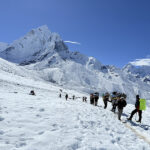
The Khumbu region above 3,500 meters clears earlier than lower sections. By mid-September, Namche Bazaar, Tengboche, and the upper Khumbu are frequently experiencing clear mornings with unobstructed mountain views. The Ama Dablam south face, arguably the most photographed mountain in the Khumbu, shows itself in September light with a particular quality that the crisper, drier air of October doesn’t produce.
Lodge availability is excellent throughout September. Advance booking is not the urgent necessity it becomes in October, though confirming accommodation through Getaway Nepal Adventure before departure removes any remaining uncertainty.
Langtang Valley Trek — 7 to 10 Days
September’s single most overlooked trekking opportunity in Nepal. The Langtang Valley, sitting directly north of Kathmandu, reaches elevations where the monsoon clears earlier than the lower Annapurna foothills. By mid-September the valley is in near-autumn condition while remaining completely uncrowded.
The trail through Tamang villages to Kyanjin Gompa at 3,870 meters runs alongside the Langtang River, which in September is running at its fullest and most dramatic. The high meadows above Kyanjin are saturated green from four months of rain. Langtang Lirung at 7,227 meters appears through clearing cloud in a way that feels more earned than it does when the sky is predictably clear all day in October.
For a first-time Nepal trekker choosing September, Langtang is the route to consider. Manageable altitude profile, genuine mountain access, real cultural depth in the Tamang villages, and conditions that are far more reliable in September than the lower Annapurna routes.
Ghorepani Poon Hill Trek — 5 to 9 Days
The lower sections of this route, particularly the rhododendron forest between Ulleri and Ghorepani, are at their most spectacular in September. These forests, which draw spring trekkers for the March and April bloom, reach their full canopy density by September. Walking through them in a morning clearing after overnight rain, with the forest floor carrying mushrooms and light filtering through an improbably green overhead cover, is a different aesthetic from the same route in October.
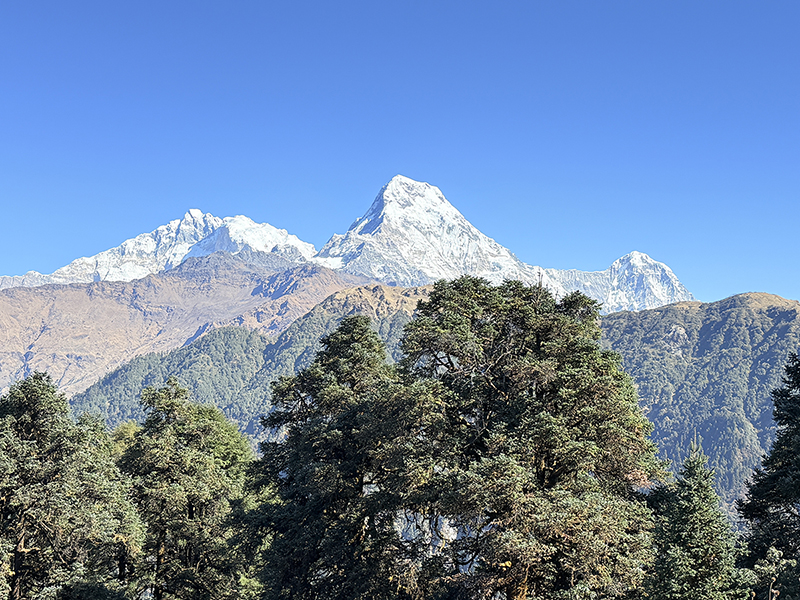
The Poon Hill viewpoint delivers its Dhaulagiri and Annapurna panorama when September mornings clear, which they do with increasing frequency through the month. In late September, clear mornings at Poon Hill are more common than overcast ones. The crowd element that defines October on this route is essentially absent.
Manaslu Circuit Trek — 13 to 16 Days
September is one of the better-kept secrets for this route, for a specific geographic reason. The Manaslu region sits in a transition zone where the monsoon exits earlier than the Annapurna main corridor. By mid-September, the upper Manaslu valley and the approach to Larkya La at 5,106 meters are frequently in clear-sky conditions while the Annapurna foothills are still managing afternoon rain.
The restricted area permit structure limits daily trekker numbers year-round. In September, that limitation is largely academic because demand is low regardless. Trekkers on the Manaslu Circuit in September can expect to have significant sections of trail, and entire lodge dining rooms, to themselves in a way that is simply not possible in October even with the permit restriction.
The Larkya La crossing requires current condition assessment in early September. By the third week, with a guide carrying current information from checkpoint contacts at Samdo, it is typically passable for properly equipped trekkers. Getaway Nepal Adventure’s guides maintain direct contact with their Manaslu corridor network year-round, which makes their real-time pass condition information as reliable as it gets.
Nar Phu Valley Trek — 14 to 18 Days
One of Nepal’s most genuinely remote trekking routes, the Nar Phu Valley branches off the Annapurna Circuit north of Koto and enters a restricted zone that sees limited trekker numbers even in October. In September, it operates in near-complete solitude.
The valley sits in a partial rain shadow that makes it more accessible in September than monsoon-affected lower routes. The Tibetan-influenced villages of Nar and Phu, the high-altitude landscapes that predate the agricultural terracing of the lower valleys, and the approach to the Kangla Pass at 5,320 meters all deliver a trekking experience that most people who have done Nepal multiple times haven’t encountered.
This is not a beginner September trek. It requires fitness, proper acclimatization, solid gear, and a guide with specific Nar Phu experience. Getaway Nepal Adventure runs this route with guides who know its September-specific conditions, which is the only responsible way to approach it in this month.
Rolwaling Valley and Tsho Rolpa Trek — 7 to 10 Days
The Rolwaling Valley, reaching Tsho Rolpa Glacial Lake at 4,580 meters, receives almost no attention in standard trekking literature but is a genuine September opportunity. The valley is protected from the worst of the monsoon by its east-west orientation and high surrounding ridgelines. By mid-September, conditions here are frequently excellent while more popular routes are still dealing with residual monsoon weather.
Tsho Rolpa, Nepal’s deepest glacial lake, sits below Gaurishankar at 7,145 meters and Melungtse at 7,181 meters. In September, with fresh snow from late-monsoon events still white on the surrounding peaks and the glacial lake at its fullest, the visual experience is unlike anything the established trekking regions offer at this time of year. The Tamang-managed tea houses throughout the Rolwaling Valley have been built and run by local families for decades, giving the route a cultural authenticity that the heavily commercialized corridors have moved away from.
Permits for September Trekking
Standard routes:
- TIMS Card: NPR 2,000 for non-SAARC nationals, through a registered agency only
- Sagarmatha National Park Permit: USD 30 for the Everest region
- Annapurna Conservation Area Permit: approximately USD 30
- Langtang National Park Permit: approximately USD 25
- Gaurishankar Conservation Area Permit: required for Rolwaling Valley
Restricted area routes:
- Manaslu Restricted Area Permit: USD 75 per week in September, lower than the October peak-season rate of USD 100
- Upper Mustang Restricted Area Permit: USD 500 for the first ten days
- Nar Phu Valley Permit: USD 75 per week in September
The Manaslu permit pricing difference between September and October is worth noting. The same route, substantially the same conditions in the second half of September, at a meaningfully lower restricted-area permit cost. Getaway Nepal Adventure handles all permit arrangements as part of their package structure, which removes the logistical overhead of sourcing permits independently in Kathmandu.
Gear for September Trekking
September requires rain-specific additions to the standard trekking kit. The layering system remains similar to October, but waterproofing moves from optional to mandatory at every level.
Clothing:
- Moisture-wicking base layer, long-sleeved
- Mid-layer fleece
- Waterproof hardshell jacket, a quality one, not a light wind shell
- Down jacket for high camps and evenings above 4,000 meters
- Waterproof trekking trousers or shell over-trousers for wet lower sections
- Warm hat and gloves for high-altitude sections
- Sun hat for midday clearings at lower elevation
Footwear:
- Waterproof trekking boots, fully broken in before arrival
- Gaiters for lower trail sections where wet vegetation and mud are present
- Leech socks for forest sections in early September
Sleeping:
- Sleeping bag rated to -10°C. September nights above 4,000 meters are cold regardless of daytime warmth.
Rain protection:
- Daypack rain cover, mandatory not optional
- Dry bags for electronics, documents, and anything that cannot get wet
- Quick-dry towel
- Waterproof stuff sacks for sleeping bag and clothing
Other essentials:
- Trekking poles for stability on wet and muddy sections
- Headlamp with spare batteries
- Water purification tablets or filter. Rivers and streams run high and clean-looking in September but require treatment regardless.
- Insect repellent for lower elevations in early September
Altitude and Health in September
September’s altitude sickness risk profile is similar to other months with one additional variable: hydration management in the heat. Average daily temperatures at lower elevations sit around 27 degrees Celsius. The lower sections of trekking routes are warm and humid, and trekkers moving through forest terrain sweat considerably more than they do in October. Dehydration sets in faster and compounds any altitude-related symptoms above 3,000 meters.
Drink consistently through September’s lower sections, more than feels necessary. By the time thirst registers, dehydration is already underway.
The standard acclimatization protocol applies regardless of month: no more than 300 to 500 meters of net altitude gain per day above 3,000 meters, mandatory rest days at key acclimatization villages, no ascending while symptomatic. September’s variable weather adds one element October doesn’t: the possibility of spending a rest day in a lodge because trail conditions have closed the route rather than by schedule. Build a day or two of flexibility into any September itinerary. Getaway Nepal Adventure builds this buffer into their September packages as standard, not as an upsell.
Travel insurance must cover high-altitude trekking and emergency helicopter evacuation above 5,000 meters. Confirm this before leaving home, not at a tea house in Namche Bazaar.
Practical Logistics for September
International flights: September fares to Kathmandu are measurably lower than October. The pricing difference can be significant on routes from Europe, North America, and Australia. Book early for the best options, though even late September bookings carry better pricing than equivalent October flights.
Domestic flights: Lukla flights are weather-dependent and September’s variable conditions create a tighter operational window for small aircraft than October’s stable skies. Book the earliest available morning departure. Build a contingency day into the itinerary for potential delays. Getaway Nepal Adventure monitors Lukla flight conditions and manages rebooking as part of their operational support for in-country trekkers.
Lodge availability: September booking pressure is minimal compared to October. That said, some remote lodges may be on reduced staffing in early September. Getaway Nepal Adventure confirms which lodges are fully operational on the specific route and dates before departure, removing the risk of arriving at a tea house running at minimal capacity after a long day on the trail.
Kathmandu timing: If your itinerary includes pre-trek time in Kathmandu, the third week of September overlaps with Indra Jatra. The festival runs through the streets of the old city and involves genuine community participation rather than tourist-facing performance. Timing the Kathmandu arrival to catch even one evening of Indra Jatra adds a dimension to the Nepal experience that complements rather than competes with what the trek delivers.
September vs October vs November: The Practical Summary
Choose September if: You want solitude on trails that are otherwise heavily trafficked in autumn peak season. You have flexibility about weather and can embrace variable conditions without it derailing the enjoyment of the trip. You are budget-conscious and want the most favorable conditions available, specifically targeting the second half of the month. You have trekked Nepal before and want a different version of routes you already know.
Choose October if: You need reliable clear weather as the primary requirement. You are doing a high-pass crossing and want the most favorable conditions of the year. It is your first Nepal trek and managing variable weather alongside new terrain adds too many variables simultaneously.
Choose November if: You want October’s weather profile with fewer people on the trail and can handle colder nights. The second week of November in particular delivers consistently excellent conditions with noticeably reduced crowd volume compared to October.
All three months work. The difference is in which trade-offs suit the specific trekker and the specific trip they want to take.
The Honest Assessment of September
September rewards trekkers who approach Nepal with enough experience or enough trust in their operator to navigate a month that doesn’t come with guaranteed perfect conditions printed on the label. What it gives back is access to a version of the Himalayan landscape that the peak-season crowd never sees, on trails that feel like they belong to you rather than to the hundred other people walking the same itinerary.
The second half of September is as close to a genuinely hidden trekking season as Nepal has left. October’s conditions at a fraction of October’s prices and crowds, in landscapes that carry the full weight of four months of monsoon rain in every waterfall, every saturated forest, every river running loud through the valley floor.
Getaway Nepal Adventure has been running September treks long enough to know which routes, which departure weeks, and which itinerary structures make the most of what the month genuinely offers. That accumulated ground knowledge is the most valuable piece of September trekking logistics, more important than any gear list or permit guide.
The mountains are there in September. The trails are open. The tea houses are ready. The question is whether you’re willing to share the journey with some rain on the way up, knowing the view from the top will very likely be yours alone.
Recent Posts