Nepal Trekking in October: The Peak Season Done Right
Everyone says October is the best month to trek in Nepal. They’re not wrong. But “best” comes with conditions most trekking guides don’t mention, and understanding what October actually delivers, versus what the peak-season marketing promises, is the difference between a trip that meets expectations and one that exceeds them.
Here’s the full picture.
What Makes October Different from Every Other Month
Nepal runs on two trekking seasons. Spring covers March through May. Autumn runs September through November. October sits dead center of the autumn window, and it earns its reputation for specific, verifiable reasons.
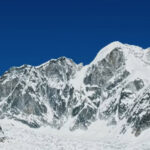
The monsoon exits Nepal in stages. The lowlands clear first, the high Himalayas last. By the time October opens, the entire country has shed the monsoon’s weight. The atmosphere is scrubbed clean by four months of heavy rain. Particulate matter that builds up in the dry season is gone. The result is visibility that experienced Himalayan trekkers describe as almost unreasonable — peaks 8,000 meters high looking close enough to reach before lunch.
Trails that were muddy river channels in August are dry, firm, and well-defined. Leeches that plagued the monsoon forest walks have retreated. Rivers are full from the rains but crossable. The rhododendron forests, oak woodlands, and bamboo groves are a saturated green that won’t appear again until the following monsoon.
Daytime temperatures at lower elevations hover between 15°C and 25°C. At mid-altitude, roughly 2,500 to 3,500 meters, days run 10°C to 20°C with cool nights. Above 4,000 meters, days are cold and clear and nights require a proper sleeping bag. The walking conditions across all of this are as close to ideal as mountain trekking gets.
The Crowd Reality: What Peak Season Actually Means
October is Nepal’s highest-traffic trekking month. That sentence needs unpacking because the implications run deeper than most first-time visitors anticipate.
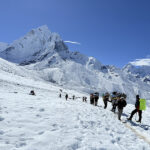
On the Everest Base Camp route, October days see hundreds of trekkers moving along the Khumbu trail simultaneously. The tea house at Dingboche that holds 40 people comfortably may have 70 competing for dinner. The trail between Namche Bazaar and Tengboche on a clear October morning can feel like a busy urban footpath rather than a remote Himalayan route.
The Annapurna Circuit runs similarly. Thorong La Pass crossing days in October see queues forming at Thorong Phedi before 4 am, trekkers moving in a slow procession across the high traverse with headlamps stretched out in a line visible from the lodges below.
None of this ruins the experience. The mountains are still extraordinary. The culture is still genuine. But it recalibrates what you should realistically expect from a wilderness trekking trip.
The practical solutions are straightforward:
Choose less-trafficked routes within the same region. The Everest Three Passes Trek sees a fraction of the EBC traffic. The Nar Phu Valley off the Annapurna Circuit is restricted-area and quiet by design. The Mardi Himal route in the Annapurna region delivers close-range views of Machhapuchhre and Annapurna South without the Poon Hill crowds.
Start early every day. October’s best trail experience happens before 8 am, when the previous night’s lodges are still waking up and the day’s walkers haven’t yet compressed onto the same section of trail.
Book accommodation before arrival. On the EBC route and Annapurna Circuit, October is the one month where showing up without advance reservations is genuinely risky. Your trekking agency should confirm lodges before you leave Kathmandu.
October Weather: The Full Breakdown
Temperature
Lower elevations, including Lukla at 2,860 meters, Pokhara at 827 meters, and the lower Annapurna foothills, sit at comfortable walking temperatures through October. Mornings are crisp, afternoons warm, and evenings cool without being cold.
Mid-altitude villages, Namche Bazaar at 3,440 meters, Manang at 3,519 meters, Kyanjin Gompa at 3,870 meters, bring noticeably cooler nights. A fleece and light down jacket handle evenings comfortably.
Above 4,000 meters, nights require a sleeping bag rated to at least -10°C. The tea house rooms are unheated. The dining room has the stove. Plan your evenings accordingly.
High passes, Thorong La at 5,416 meters, Cho La at 5,420 meters, Renjo La at 5,340 meters, are cold in the pre-dawn hours of crossing day. Temperatures at these elevations in October typically run -5°C to -10°C at 4 am. Wind chill adds to this considerably.
Precipitation
Essentially zero on established trekking routes in October. The rain shadow routes like Upper Mustang were dry through the monsoon. The main Himalayan corridor routes cleared in September. October rain events are rare enough to be genuinely surprising when they occur.
The exception is the occasional brief afternoon cloud buildup on some lower-altitude sections. This rarely produces significant rain and clears by evening.
Visibility
October visibility is the best of any month in the trekking calendar. The post-monsoon atmosphere is at its clearest, and the winter dust that accumulates through spring hasn’t begun building yet. Views from Kala Patthar, Poon Hill, Thorong La, and every other standard viewpoint are reliably excellent on the majority of October days.
Morning is consistently the clearest window. High-altitude viewpoints should be reached before 8 am when possible. Cloud often builds from the valleys in the afternoon but rarely obscures mountain views at elevation.
The Mandatory Guide Regulation
Since April 1, 2023, all foreign trekkers are legally required to hire a licensed guide or porter-guide through a government-registered trekking agency when trekking in Nepal’s national parks, conservation areas, and restricted zones. This covers every major trekking corridor in the country: Everest, Annapurna, Langtang, Manaslu, Mustang, Dolpo, and beyond.
The independent Green TIMS card no longer exists. TIMS cards are issued only through the Trekking Agencies Association of Nepal to trekkers booked through a registered agency. The cost is NPR 2,000 for non-SAARC nationals.
In practical terms, this means booking your trek through a Nepal-registered agency before arriving in Kathmandu. The agency handles permits, assigns a licensed guide, and manages logistics. October is the peak enforcement month, with permit checkpoints staffed and active on all major routes. Attempting to walk without documentation during the month when checkpoint personnel are most alert is not a risk worth taking.
The regulation came from documented safety failures. Between 10 and 15 foreign trekkers go missing on Nepal’s trails annually, predominantly independent walkers. A licensed guide with route knowledge, emergency contacts, and first aid training collapses the response time in remote terrain where mobile coverage is unreliable or nonexistent.
Best Treks for October
Everest Base Camp Trek — 14 to 15 Days
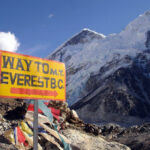
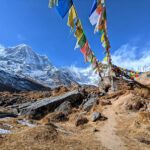
The signature October trek. EBC is what most people picture when they think Nepal trekking, and October delivers it at full resolution. The Khumbu Glacier, the jagged Ama Dablam silhouette above Dingboche, the prayer flags at Gorak Shep, Everest’s south face viewed from Kala Patthar at 5,545 meters. All of it in air so clear it feels artificial.
The route runs from Lukla through Phakding, Namche Bazaar, Tengboche, Dingboche, Lobuche, and Gorak Shep to Base Camp. The acclimatization profile is well-established, with rest days built in at Namche and Dingboche. Most trekkers who get in trouble on EBC do so by compressing the itinerary, which is more tempting when the weather is consistently fine. Don’t. Altitude sickness responds to ascent rate, not ambition.
The crowds on this route in October are real. Accept them as part of the experience or plan around them by starting each day earlier than feels strictly necessary.
Everest Three Passes Trek — 18 to 20 Days
Same Khumbu region, dramatically different crowd profile. The Three Passes route, crossing Kongma La at 5,535 meters, Cho La at 5,420 meters, and Renjo La at 5,340 meters, requires more fitness, more acclimatization time, and better technical preparation than the standard EBC route. Most trekkers who attempt it in October have done EBC before and want more mountain and less queue.
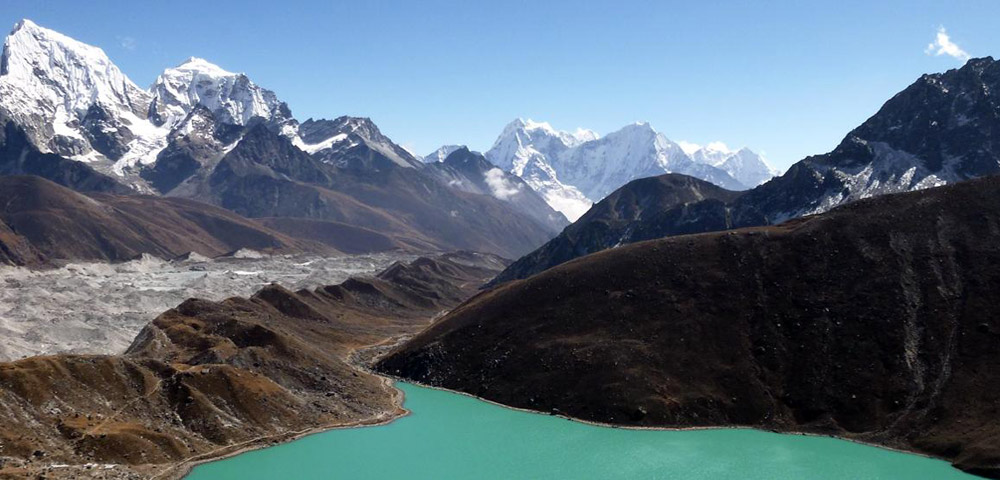
The reward is access to the Gokyo Lakes, the Ngozumpa Glacier, and viewpoints like Gokyo Ri that rival Kala Patthar for panoramic scope with a fraction of the foot traffic. October is the ideal month for this route because all three passes are reliably snow-free and the days are long enough to complete long crossing stages safely.
Annapurna Circuit Trek — 15 to 18 Days
The route that circles the entire Annapurna massif, starting in subtropical lowlands near Besisahar and emerging in the Mustang rain shadow on the far side of Thorong La, is one of the most geographically diverse long-distance treks on earth. In a single trip you walk through terraced rice paddies, oak and rhododendron forest, high alpine meadows, and a near-desert plateau that looks like it belongs in another country entirely.
October is the peak month for this route. Thorong La is reliably crossable, the villages are lively with festival activity, and the Kali Gandaki Gorge in the post-monsoon light is extraordinary. The crowding on crossing day at Thorong La is significant. Spend the acclimatization day in Manang productively, sleep at Thorong Phedi High Camp the night before, and leave for the pass no later than 4 am.
Permits: Annapurna Conservation Area Permit (approximately USD 30) and TIMS card (USD 20, through a registered agency).
Annapurna Base Camp Trek — 10 to 12 Days
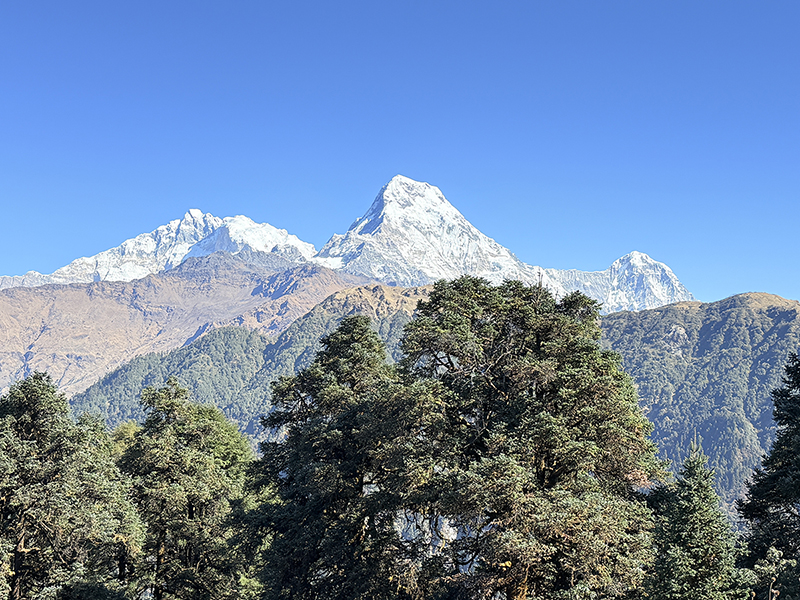
The sanctuary approach. Rather than circling the massif, the ABC route walks directly into the glacial amphitheater at 4,130 meters, ringed by Annapurna I, Annapurna South, Machhapuchhre, Hiunchuli, and Gangapurna. On a clear October morning at Base Camp, the surrounding walls of ice and rock absorb the light in a way that doesn’t photograph well and stays with you for years.
The route is shorter and less technically demanding than the Circuit, making it accessible to trekkers without prior Himalayan experience. It’s also popular in October, particularly the Ghorepani section that overlaps with the Poon Hill trekking circuit. Starting from Siwai or Jhinu Danda rather than the more common Nayapul trailhead avoids the most congested lower sections.
Mardi Himal Trek — 7 to 10 Days
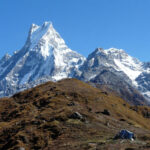
Relatively new as a designated route, fully operational since around 2012, and still substantially quieter than its Annapurna neighbors. The trail approaches Mardi Himal at 5,587 meters from the Pokhara side, moving through high forest camps and rhododendron ridgelines to a viewpoint high camp that puts Machhapuchhre’s unclimbed south face at arm’s length.
October is the optimal month for this route. The ridge walking between Low Camp and High Camp in clear autumn air, with Annapurna South and Hiunchuli filling the western sky, is the kind of trekking experience that doesn’t require an 8,000-meter peak for the altitude to feel genuinely significant. And the trail has not yet absorbed October’s crowd volume in the way the Circuit and ABC routes have.
Langtang Valley Trek — 7 to 10 Days
An hour’s drive from Kathmandu opens into a valley that operates on its own quiet schedule. The Langtang route moves north through Tamang villages to Kyanjin Gompa at 3,870 meters, with the option to climb Kyanjin Ri or Tsergo Ri for views deep into the Tibet border range.
October in the Langtang Valley means the monsoon-fed grass has turned gold, the Buddhist monasteries are active, and the yak herds that move to lower pastures in winter are still grazing the high meadows. The valley saw significant damage in the 2015 earthquake and has rebuilt. The trail infrastructure is solid and the lodge community is welcoming in a way that feels less commercially polished than the Everest and Annapurna corridors, which is a quality worth something.
Manaslu Circuit Trek — 13 to 16 Days
The restricted-area alternative to the Annapurna Circuit and the argument that Nepal’s best trekking isn’t necessarily on its most famous trails. The Manaslu Circuit circumnavigates the world’s eighth-highest mountain through the Nubri and Tsum valleys, crossing the Larkya La Pass at 5,106 meters on the final high section.
October delivers this route at its peak. The restricted area permit significantly limits daily trekker numbers. The villages through which the trail passes, Samagaon at 3,520 meters and Samdo near the Tibet border, are Tibetan-influenced communities that have maintained their character precisely because access is controlled. The permit costs more and requires a registered agency, but the ratio of effort to reward shifts noticeably on a route where you might share a lodge dining room with six other trekkers rather than sixty.
Ghorepani Poon Hill Trek — 5 to 9 Days
The entry route for first-time Nepal trekkers and the go-to recommendation for those with limited time or lower fitness baselines. The trail maxes out at Poon Hill at 3,210 meters, making acclimatization issues minimal, while delivering Dhaulagiri and the Annapurna range on a viewpoint that earns its reputation.
The October sunrise at Poon Hill, with the Annapurna massif catching alpenglow from east to west, is one of those views that people describe before they’ve finished packing for home. It is crowded in October. The path to the tower before dawn becomes a headlamp procession. That’s the honest trade-off for a trek that delivers this level of scenery at this level of accessibility. If the crowd element bothers you, the Mardi Himal route achieves comparable views on a quieter trail.
October Festivals: The Cultural Layer
October sits inside Nepal’s major festival season. Dashain and Tihar both fall within the September-to-November window depending on the lunar calendar, and both have a visible effect on the trekking experience.
Dashain is Nepal’s largest festival, running for fifteen days around the new moon of October. It celebrates the victory of the goddess Durga and involves family gatherings, animal sacrifices at major temples, kite flying, and the blessing of tools, vehicles, and equipment. Walking through villages during Dashain means seeing marigold garlands over doorways, the smell of incense from household shrines, and families who have returned from Kathmandu and abroad to be home. Some lodge owners briefly close to spend time with family. Build a day of flexibility into your itinerary for the Dashain peak period.
Tihar, the festival of lights, runs five days in late October or early November. Oil lamps line every window and roofline in participating villages. The second day worships crows, the third day worships dogs with marigold garlands and red tika marks on their foreheads, the fourth day Laxmi, goddess of wealth. Walking through a Tamang or Gurung village in the Annapurna foothills during Tihar evening is genuinely one of the more surprising and beautiful things a trekker encounters in Nepal. It’s not on the route map. It just happens around you.
Permits for October Trekking
The permit structure is the same year-round, but October is the month when checkpoint personnel are most active and documentation checks are most thorough.
Standard routes:
- TIMS Card: NPR 2,000 for non-SAARC nationals, obtained through a registered agency only
- Sagarmatha National Park Permit: USD 30 (Everest region)
- Annapurna Conservation Area Permit: approximately USD 30
- Langtang National Park Permit: approximately USD 25
Restricted area routes:
- Manaslu Restricted Area Permit: USD 100 per week in September and October (peak season premium applies)
- Upper Mustang Restricted Area Permit: USD 500 for the first ten days
- Nar Phu Valley Permit: USD 90 per week in peak season
- All restricted routes require a registered agency and licensed guide
Note that Manaslu’s restricted area permit pricing increases specifically for the October peak season compared to other months. Factor this into budget planning if the Manaslu Circuit is on the list.
Gear for October Trekking
October requires a layering system rather than a single fixed approach. The temperature range across a single October trekking day, from a cold 4 am high-camp start to a warm midday valley walk, can span 25 degrees Celsius.
Clothing:
- Moisture-wicking base layer, long-sleeved for mornings and evenings
- Mid-layer fleece or light down jacket
- Hardshell outer layer for wind and unexpected weather
- Down jacket for high camps and evenings above 4,000 meters
- Lightweight trekking trousers with zip-off option for mid-altitude flexibility
- Warm hat and gloves for mornings and high passes
- Sun hat for midday walking at lower elevations
Footwear:
- Waterproof, ankle-supporting trekking boots, broken in before arrival — not negotiable
- Trekking sandals or camp shoes for lodge evenings
- Microspikes are optional for early October but worth carrying for Three Passes and high traverse routes
Sleeping:
- Sleeping bag rated to -10°C minimum. October nights above 4,000 meters are genuinely cold and lodge rooms are unheated.
Other:
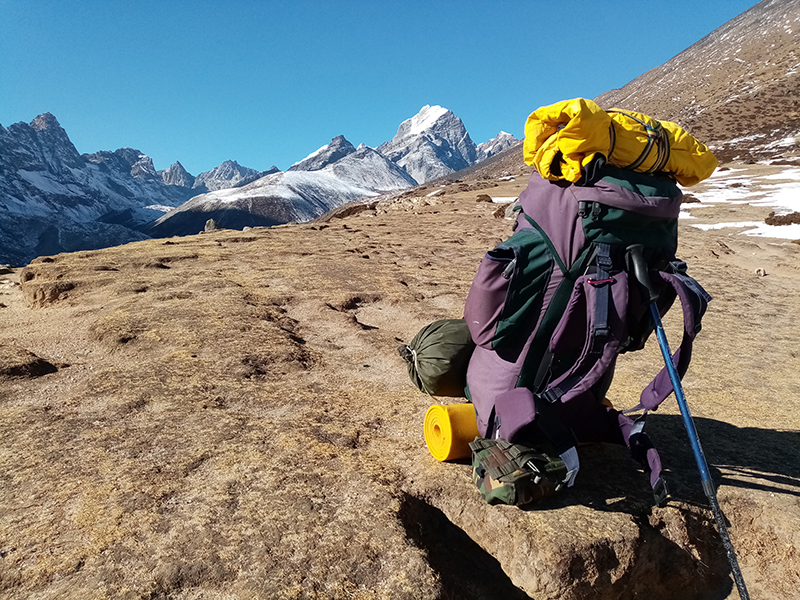
- Trekking poles: essential for descent stability on long downhill sections
- Headlamp with spare batteries: pre-dawn pass crossings are the norm on high routes
- High-SPF sunscreen and UV-blocking glacier glasses: October sun at altitude is intense regardless of temperature
- Water purification: tablets or a filter eliminate dependence on expensive, wasteful bottled water above base camps
Altitude Sickness in October
October’s reliable good weather creates a specific risk: overconfidence. The trail looks manageable. The sky is clear. Other trekkers are moving quickly. The temptation to compress the itinerary is real and well-documented.
Altitude sickness doesn’t respond to weather conditions or fitness levels in the way people expect. A marathon runner in peak condition can develop acute mountain sickness above 3,500 meters. An older trekker with no athletic background can acclimatize perfectly on a properly paced schedule. The variable is ascent rate, not personal capability.
The standard protocols hold regardless of month: no more than 300 to 500 meters of net altitude gain per day above 3,000 meters, mandatory rest days at key acclimatization villages, consistent hydration, and a strict policy of not ascending while symptomatic.
Helicopter evacuation is available from all major trekking regions. Ensure travel insurance covers high-altitude trekking and helicopter evacuation above 5,000 meters before departure. October is the month when evacuation helicopters are busiest, which indicates both that the service is well-established and that altitude emergencies are a genuine and regular occurrence.
Practical Logistics for October
International flights: October is Nepal’s highest-demand month. Book flights to Kathmandu significantly in advance, three to six months for the first two weeks of October. Prices peak in late September and early October and begin softening by late month.
Domestic flights: The Kathmandu to Lukla flight for EBC-bound trekkers requires early booking. October seats fill fast. Pokhara-bound trekkers for Annapurna routes have more options including road transfer, which takes longer but removes flight delay risk.
Accommodation: Book in advance through your trekking agency for all October travel. The EBC route and Annapurna Circuit lodges at key stops like Namche Bazaar, Tengboche, Dingboche, and Thorong Phedi fill completely during the first three weeks of October. Showing up unbooked on a peak October weekend is the one scenario where an otherwise well-planned trek can unravel.
Daily timing: Start walking by 7 am at the latest. The best trail experience in October happens in the morning hours before the day’s full trekker volume is in motion. Popular viewpoints and landmarks should be reached early. The crowding that defines October trekking on major routes is most intense between 9 am and 3 pm.
October vs November: The Honest Comparison
The standard advice positions October as the peak and November as the slower, colder alternative. The reality is more nuanced.
October delivers the best weather and the highest crowd volume simultaneously. The views are extraordinary. The trails are also at their most congested. For trekkers who prioritize mountain visibility above everything else and don’t mind sharing the experience, October is the right choice.
November delivers essentially identical mountain views with substantially fewer people on the trail, at the cost of colder nights and a shorter daily window before temperatures drop. For trekkers who want solitude alongside the scenery, November often produces the better overall experience.
The one area where October holds a clear advantage is high-pass safety. Thorong La, Larkya La, and the Everest Three Passes are all more reliably snow and ice-free in October than in late November. Trekkers with high-pass crossings as the primary objective should prioritize October.
The Honest Assessment
October in Nepal earns its reputation. The conditions are genuinely exceptional, the festival culture adds a layer that no other trekking month offers, and the post-monsoon landscape at its greenest and the Himalayas at their clearest is a combination that justifies the peak-season planning effort.
Go in knowing what it is. It’s Nepal trekking at maximum intensity, in terms of scenery, logistics, crowds, and cultural activity all running simultaneously. Manage the crowd element with early starts, strategic route choices, and advance planning. Accept the rest as the baseline for the best trekking season in the Himalayas.
The mountains don’t need October to look extraordinary. But October does make them look it most reliably.
Recent Posts