Nepal Trekking in November: The Complete Guide
October gets the fame. The glossy magazine shots, the crowd reports, the sold-out tea houses. But experienced trekkers increasingly schedule their Nepal trips for November, and the reasons stack up quickly once you look at what the month actually delivers versus what the hype says.
This is a month trekking calendars would call transitional. In practice, it’s the sweet spot.
Why November Works Better Than You’d Expect
The monsoon wraps up by late September. October clears the skies and sends trekker numbers surging. By the time November opens, two things have happened: the post-monsoon atmosphere has fully stabilized, and the October crowd has gone home.
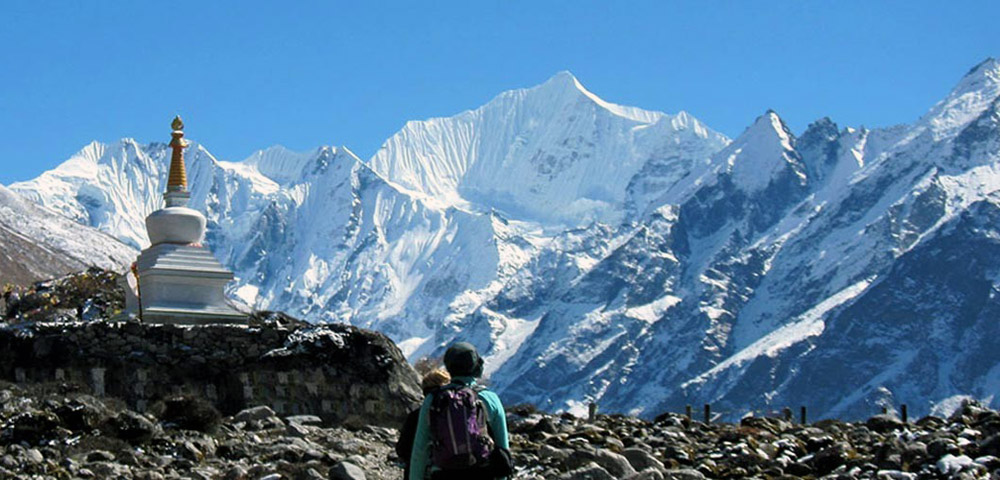
November offers the same panoramic mountain views as October without the queues. That’s not a small thing on routes like Everest Base Camp, where October can feel like a slow-moving procession of matching down jackets. In November, the dining rooms thin out. Guides have more time. Lodge owners aren’t running at capacity. The mountains are identical. The experience around them is measurably better.
Heavy rain is essentially gone. Trails are dry and firm. The post-monsoon haze that lingers into early October has cleared completely, and the low sun angle of late autumn produces the kind of morning light that makes Himalayan photography look effortless.
Temperature by Altitude: What to Actually Expect
Daytime temperatures in lower elevations like the Annapurna foothills and Everest’s middle reaches typically sit between 10°C and 15°C. That’s comfortable walking weather, not a survival exercise.
Down in Pokhara at 827 meters, days can push 15°C to 20°C. It’s pleasant enough to be wearing just a base layer by mid-morning. Get above 3,000 meters and the nights change the calculation entirely. Namche Bazaar at 3,440 meters and Dingboche at 4,410 meters both get genuinely cold after sundown, with temperatures regularly dropping below zero.
Above 4,000 meters, nights become something you plan around. A sleeping bag rated to -10°C is not overkill at high camps in late November. The lodge room will not be heated. The blanket on the bed is a courtesy gesture, not insulation.
The critical threshold most trekkers miss: early November and late November are different trips. Early November is the tail end of the autumn peak, with manageable cold and dry trails at all elevations. Late November starts showing winter’s hand, with shorter daylight hours, rapidly dropping temperatures at altitude, and the first snow appearing on the higher passes. If crossing major passes like Thorong La or Larkya La is on the itinerary, earlier in the month gives you more margin.
Thorong La Pass in November: The Fine Print
The Annapurna Circuit’s defining challenge sits at 5,416 meters. In October, the pass is typically snow-free and straightforward. November changes the calculus slightly. Snow and ice can appear at Thorong La in early November or after a cold spell. Trekkers crossing it this month should carry microspikes or crampons and wear insulated layers for the pre-dawn ascent.
Temperatures at the pass can drop to -5°C to -15°C in the early morning, with wind chill pushing it considerably colder. Strong afternoon winds batter the pass reliably by midday. Experienced guides always start the crossing before sunrise, reaching the summit and beginning the long descent to Muktinath before the wind builds.
This is not a reason to avoid the pass in November. It’s a reason to cross it with a guide who has done it in these exact conditions before, and to respect the 4 am departure that every experienced guide will push for.
The Mandatory Guide Rule: What Every Trekker Needs to Know
Nepal changed its trekking regulations on April 1, 2023. Every foreign trekker is now legally required to hire a licensed guide or porter-guide through a government-registered trekking agency when trekking in any National Park, Conservation Area, or Restricted Area. This covers 44 designated trails including all major corridors in the Everest, Annapurna, Langtang, Manaslu, and Ganesh Himal regions.
The Green TIMS card that independent trekkers previously bought directly no longer exists. TIMS cards are now issued only through the Trekking Agencies Association of Nepal, and only to trekkers booked through a registered agency. The cost is NPR 2,000 for non-SAARC nationals.
Practically, this means arranging your trek through a Nepal-based registered agency before you arrive. The agency handles permits, assigns a licensed guide, coordinates logistics. On well-traveled routes the enforcement varies, but the legal requirement is unambiguous, and the consequences for non-compliance include removal from the trail.
The rationale was direct: between 10 and 15 foreign trekkers go missing on Nepal’s trails every year, all traveling independently. A guide with local knowledge, route familiarity, and emergency contacts is the difference between a rescue taking hours versus days on routes where mobile coverage disappears entirely above certain elevations.
Best Treks for November
Everest Base Camp Trek — 14 to 15 Days
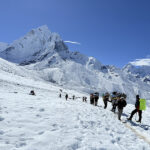
November is arguably the best month for this route. October fills the trail to capacity. By early November, that wave has receded. Lodges from Lukla to Gorak Shep are still fully operational. The views from Kala Patthar at 5,545 meters, the standard high point for EBC trekkers, are crystalline. The Khumbu Icefall crackles in the cold morning air in a way that it doesn’t in the relative warmth of October.
Flights into Lukla are weather-dependent year-round, but November’s stable, dry conditions make delays less common than during monsoon or mid-winter.
Ghorepani Poon Hill Trek — 5 to 9 Days
The entry point for trekkers who want genuine Himalayan views without a two-week commitment or high-altitude pass risk. The trail reaches its highest point at Poon Hill, 3,210 meters, well below the elevation where November temperatures become seriously challenging.
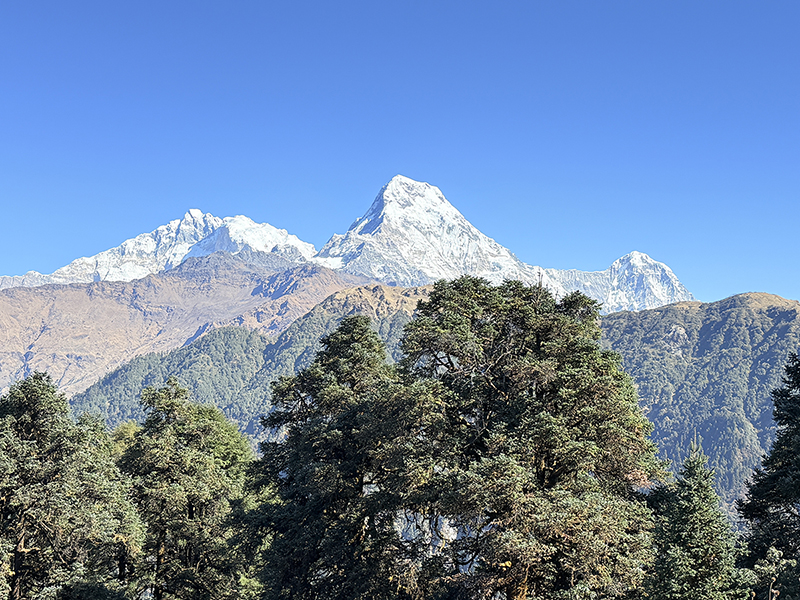
The pre-dawn walk to the Poon Hill viewpoint, looking west at Dhaulagiri and north at the Annapurna range catching the first light, is what people build entire trips around. In November, clear mornings run consecutively. The rhododendron forests below Ghorepani have turned deep red and amber by this point in the season, which adds something the spring crowds come specifically to see but in a different form.
Annapurna Circuit Trek — 15 to 18 Days
The circuit’s lower valleys, through Chame, Pisang, and Manang, walk beautifully in November’s cool, dry weather. The Manang valley at 3,500 meters is one of the most striking landscapes in Nepal, a high-altitude bowl ringed by Annapurna III, Gangapurna, and the Tilicho massif, and in November it’s reached without October’s crowds.
The challenge concentrates at Thorong La. Go in the first two weeks of November, start the crossing before 4 am, carry microspikes, and don’t improvise the timing regardless of how good you feel at Thorong Phedi the night before.
Permits needed: Annapurna Conservation Area Permit (approximately USD 30) and TIMS card (USD 20, through a registered agency).
Langtang Valley Trek — 7 to 10 Days
Langtang sits directly north of Kathmandu, closer in and less visited than either the Everest or Annapurna corridors. The valley opens into high alpine terrain above Kyanjin Gompa, where Langtang Lirung at 7,227 meters dominates the northern wall. In November the valley is quiet in the way the major routes never quite are. Tamang villages along the route still host the lodge culture that characterizes Nepal trekking without the volume of trekkers that dilutes it elsewhere.
The forest between Lama Hotel and Langtang Village carries deciduous trees that have turned gold and orange by November. It’s one of the better autumn forest walks in the Himalayas, and it’s almost never mentioned in the standard trekking literature.
Manaslu Circuit Trek — 13 to 16 Days
A restricted area trek requiring a Manaslu Conservation Area Permit and a separate Restricted Area Permit in addition to TIMS. The guide requirement is strictly enforced here with permit checks at multiple points.
What the restriction buys you is a circuit around Manaslu, the world’s eighth-highest mountain at 8,163 meters, through villages that see a fraction of the Annapurna Circuit’s foot traffic. The Larkya La Pass at 5,106 meters is the high point. In November, crossing it requires proper layering and an early start but remains achievable for well-acclimatized trekkers with the right gear.
Upper Mustang Trek — 14 to 16 Days
Upper Mustang operates in an Annapurna and Dhaulagiri rain shadow that makes it genuinely different from every other trekking region in Nepal. The monsoon barely touches it, and November’s dropping temperatures don’t dramatically alter the high-desert plateau landscape the way they affect forested lower-altitude routes.
The ancient walled city of Lo Manthang, the cliffside cave monasteries carved into eroding red-rock formations, the landscape that looks more like the Tibetan plateau than the Nepal most trekkers picture. All of this operates on a different calendar. The restricted area permit runs USD 500 for the first ten days, which makes this a premium option. It earns that designation.
Permits Required for November Trekking
The permit structure follows the region, not the season. November doesn’t add or remove requirements.
Standard routes:
- TIMS Card: NPR 2,000 for non-SAARC nationals, through a registered agency only
- National Park or Conservation Area Permit: varies by region, typically USD 20 to 35 (Sagarmatha National Park, ACAP, Langtang National Park)
Restricted area routes (Manaslu, Upper Mustang, Dolpo, Nar Phu Valley):
- Restricted Area Permit: USD 50 to 500 depending on region and duration
- Requires a registered agency and licensed guide, strictly enforced at checkpoints
Your agency arranges everything before the trek begins. Your guide carries copies on the trail. Checkpoint inspections happen at route entry points and periodically along the way.
Gear for November Trekking
The difference between October and November gear is roughly one layer. The difference between early and late November is another.
Clothing:
- Moisture-wicking base layer, long-sleeved
- Mid-layer fleece or light down jacket
- Hardshell outer layer, wind and waterproof
- Heavy down jacket for evenings, mornings, and high camps — this is not optional above 4,000 meters
- Thermal trekking trousers
- Warm hat and balaclava for high passes
- Insulated gloves with liner gloves underneath
- Wool or synthetic trekking socks, at least four pairs
Footwear:
- Waterproof, ankle-supporting trekking boots, broken in before arrival
- Microspikes or crampons if crossing Thorong La or Larkya La, especially in late November
Sleeping:
- Sleeping bag rated to -10°C minimum. The blanket on the lodge bed is not a substitute.
Other essentials:
- Trekking poles, worth their weight on long descents and icy sections
- Headlamp with spare batteries — pre-dawn starts for high passes are standard
- High-SPF sunscreen and glacier glasses — UV radiation at altitude is severe regardless of cloud cover
- Water purification tablets or filter, eliminates the cost and waste of buying bottled water at inflated altitude prices
Altitude Sickness: What November Changes
Altitude sickness responds to ascent rate and individual physiology. November doesn’t change either. What it changes is the consequence of needing to descend. If symptoms appear at 4,500 meters in October, dropping to 3,500 meters is uncomfortable. In late November, that same descent in deteriorating afternoon weather on an icy trail is a more serious undertaking.
The prevention protocol is unchanged by season: no more than 300 to 500 meters of net altitude gain per day above 3,000 meters, mandatory rest days at Namche Bazaar on the EBC route and Manang on the Annapurna Circuit, consistent hydration, and a non-negotiable policy of not ascending while symptomatic.
Diamox (acetazolamide) is used prophylactically by many November trekkers. It requires a prescription. Get a consultation with a physician familiar with altitude medicine before departure, not from a pharmacist in Kathmandu.
Helicopter evacuation is available from all major trekking regions. Confirm that your travel insurance covers high-altitude trekking and emergency evacuation above 5,000 meters before you leave home. This is the one item on the checklist that people skip until they need it.
Practical Logistics
Flights: November is shoulder season for international arrivals. October drives peak demand and peak prices. By early November, availability improves and fares soften. Book domestic flights, particularly Kathmandu to Lukla, as early as possible regardless. Lukla is weather-dependent year-round, and delays cascade through itineraries.
Daylight hours: November days run approximately 6 am to 5:30 pm at trekking elevations. This is 45 minutes shorter than October and shortens further through the month. Structure daily stages to reach the next lodge by 3:30 to 4 pm. Post-sunset temperature drops at altitude are steep and rapid.
Tea house availability: Unlike October when advance booking on the EBC and Annapurna routes is essentially mandatory, November allows more flexibility. Early November still carries residual peak-season demand, so booking accommodation through your agency before arrival is still the right approach. Mid to late November, you’ll rarely find yourself without options.
Tihar Festival: Tihar, Nepal’s festival of lights, falls in late October to early November depending on the lunar calendar. Villages along all major trekking routes participate. If your timing intersects with it, you’ll walk through settlements lit with oil lamps and marigold garlands at dusk, a genuinely unexpected thing to encounter on a mountain trail and one of the more memorable overlaps of Nepal trekking and Nepali cultural life.
The Honest Assessment
November is not what you choose when October is fully booked and you need a backup. It’s what you choose when you’ve thought carefully about the actual experience: clear skies that last for weeks, stable trails on routes that are still fully operational, sub-zero nights that make the tea house wood stove feel like the best thing on earth, and a trail population thin enough that you can actually talk to your guide without competing with noise from the next group.
The mountains are not smaller. The permits are not harder. The tea houses are not worse. What changes are the crowd dynamics, the light quality, the temperature profile at altitude, and the sense of having the trail to yourself in a way that October simply doesn’t offer.
For most trekkers, those changes are improvements.
Recent Posts