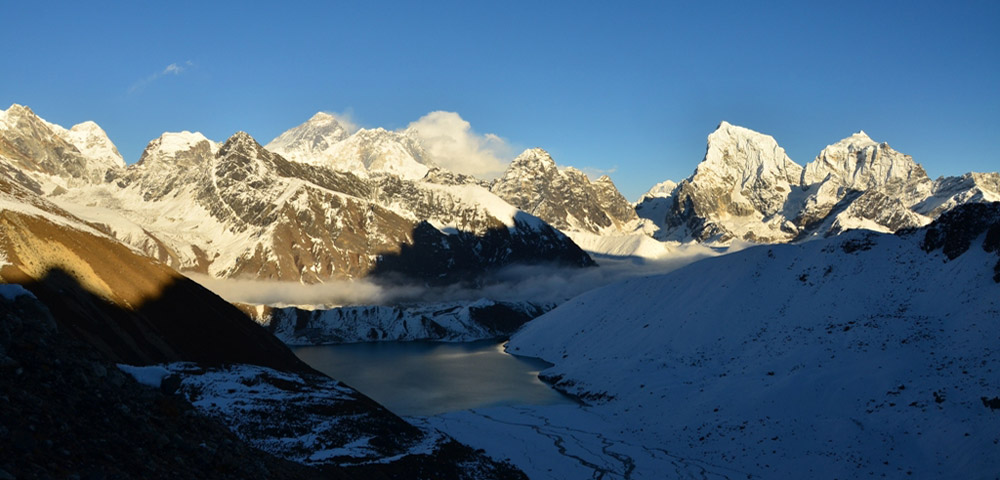
10 Top Lessons for Trekking Tough Trails in Nepal
Nepal’s trekking trails are not gentle paths through manicured parks. They’re raw, relentless, and humbling. The stone staircases of the Everest region seem to go on forever. The Thorong La Pass at 5,416 meters stops even experienced hikers in their tracks. The Manaslu Circuit pushes you through terrain where facilities are sparse and the weather does not negotiate. These trails demand something real from you — physically, mentally, and emotionally.
But here’s what every trekker who has come out the other side will tell you: what Nepal’s tough trails take from you, they return threefold. The lessons learned on these paths go far beyond navigating switchbacks and timing acclimatization days. They reshape how you think about effort, discomfort, patience, and the present moment.
Whether you’re planning your first trek to Poon Hill or preparing for the Three Passes route, these ten lessons — drawn from the trails, the guides, the weather, and the many trekkers who have walked these routes before you — will prepare you for what Nepal actually is, not just what the photographs show.
Lesson 1: Slow Down Before the Mountain Slows You Down
Speed is the enemy on Nepal’s tough trails. This is the single most repeated lesson from experienced trekkers, local guides, and altitude medicine specialists alike, and still one of the most commonly ignored. On the Everest Base Camp route, on the Annapurna Circuit, on the Manaslu Circuit — the trekkers who move too fast are the ones who turn back.
There’s a deceptive logic to pushing hard at the start of a trek. You feel good, the altitude hasn’t hit yet, and the trail looks manageable. But Nepal’s trails are cumulative. The effort compounds daily. What feels like a comfortable pace on day one becomes unsustainable exhaustion by day four when you’re sleeping above 4,000 meters and your body is working twice as hard to process the same amount of oxygen.
Experienced Himalayan guides follow a principle called ‘pole pole’ — a Swahili phrase meaning ‘slowly slowly’ that has found its way into mountain culture worldwide. On Nepal’s tough trails, this isn’t metaphor. It’s survival strategy. Keep your pace conversational. If you can’t hold a sentence without gasping, you’re moving too fast for the altitude. The summit, the pass, the viewpoint — they’re not going anywhere. You need to still be upright when you arrive.
This lesson applies with double force on descents. Downhill sections on rocky, uneven terrain after days of accumulated fatigue are where most injuries happen. Knees give way. Ankles roll. Moving carefully and deliberately on the way down is not weakness — it’s the difference between completing the trek and being evacuated from it.
Lesson 2: The Destination Is Not the Point — The Trail Is
Most people book a Nepal trek for a destination: Everest Base Camp, Annapurna Base Camp, the summit of Kala Patthar, the crossing of Thorong La. And those destinations are extraordinary. But trekkers who fixate exclusively on the endpoint tend to miss the majority of what makes Nepal’s trails transformative.
Between Lukla and Base Camp, there are ancient monasteries draped in prayer flags, children herding yaks across high-altitude pastures, rhododendron forests that explode into colour in spring, and suspension bridges swinging above glacial rivers. In the Annapurna region, the trail passes through villages where Gurung, Magar, and Tibetan communities maintain ways of life that have remained essentially unchanged for centuries. The Langtang Valley still carries the haunting memory of the 2015 earthquake that buried an entire village, and yet the people who rebuilt have done so with a resilience that no photograph can fully capture.
If you walk through all of this with your eyes locked on the horizon and your mind only on the day’s endpoint, you’ve paid for a trek in one of the most remarkable places on earth and spent it staring at your boots. The Nepali concept of ‘bistari bistari’ — take it easy, take it slow — isn’t just physical advice. It’s an invitation to be present. Take it.
Lesson 3: When There’s No Way Back, You Find What You’re Made Of
One of the most profound lessons Nepal’s tough trails deliver is this: you don’t fully know your own capacity until retreat is not an option. On a treadmill at the gym, there’s a red button. On the trail between Dingboche and Lobuche, four days from the nearest road, there is no red button. You keep moving because stopping is not a viable choice.
This forced commitment changes the psychological game entirely. The mental negotiation that happens in comfort — ‘I could stop if I really wanted to’ — disappears. In its place, something steadier emerges. Trekkers who have struggled through multi-day routes in Nepal consistently report the same thing: the hardest days produced the clearest sense of self they’ve ever experienced.
This doesn’t mean ignoring genuine distress signals. Altitude sickness, injury, and extreme weather are all legitimate reasons to turn back, and knowing the difference between discomfort and danger is a critical skill. But the ordinary suffering of tired legs, a heavy pack, and another long climb ahead? That’s not a reason to stop. That’s the trail doing its work on you. Push through it, and something shifts that doesn’t shift back when you return home.
Lesson 4: Read the Trail — Every Marker, Every Sign Matters
Nepal’s mountain trails are not always obvious. Routes split, cairns disappear under snow, and paths that look well-worn can lead to dead ends or off-route traverses that cost you hours and elevation. Trekkers who assume the trail is self-evident are the ones who end up lost above the snowline as daylight fades.
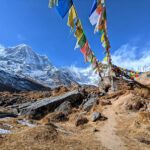
Trail markers in Nepal take multiple forms — painted rocks, stone cairns, prayer flags strung across ridgelines, and the worn groove of footfall through glacial debris. Your TIMS card and permits get checked at multiple points along major routes, and those checkpoints are also natural reference points for confirming you’re on the correct path. A good local guide reads all of these signs instinctively, which is one of the strongest arguments for hiring experienced local expertise on any serious Nepal route.
The broader lesson applies far beyond navigation. Nepal rewards attention. The trekker who watches the sky at 3pm learns to read incoming weather before it arrives. The trekker who notices a porter adjusting their load technique picks up efficiency tips worth more than any gear upgrade. The trekker who pays attention to their own body catches the early symptoms of altitude sickness — mild headache, unusual fatigue, slight nausea — before they become an emergency. Nepal’s trails reward vigilance. Inattention costs.
Lesson 5: Your Body Knows Things Your Mind Refuses to Admit
The single most dangerous personality trait on Nepal’s high-altitude trails is stubbornness. Not the productive stubbornness of pushing through discomfort, but the ego-driven refusal to acknowledge what your body is clearly communicating. Acute Mountain Sickness does not care about your schedule, your training history, or how much you paid for this trek. It affects fit people and unfit people with equal indifference.
Above 3,500 meters, the standard acclimatization rule is simple: if symptoms get worse on the same day or overnight, descend. Not tomorrow. Not after one more night to see if it improves. Descend. The symptoms of AMS — persistent headache, nausea, dizziness, unusual fatigue, and loss of coordination — are your body telling you it needs lower altitude. Ignoring these signals in pursuit of the summit is how AMS progresses to High Altitude Pulmonary Edema or High Altitude Cerebral Edema, both of which can be fatal within hours.
The lesson here extends to smaller signals too. A hot spot on your heel that you ignore becomes a blister that slows you for three days. Dehydration that you push through becomes dizziness on a narrow ridgeline. Fatigue you override with adrenaline leads to the stumble that turns into the ankle sprain that ends your trek. Nepal’s tough trails teach you to listen to your body not because it’s weak, but because it carries information that your ambition tends to filter out. Start listening early.
Lesson 6: Comfort Is Relative — Embrace the Discomfort Honestly
You will not look good on Nepal’s tough trails. You will not smell good. By day four of the Annapurna Circuit or Everest Base Camp trek, the concept of a hot shower will feel like a distant myth, and you’ll be wearing the same base layer for the third day in a row because everything else is damp from yesterday’s rain. The teahouse bathroom might be a cold cement room with a squat toilet. The sleeping bag you’ve borrowed might smell like everyone who borrowed it before you.
This is not a flaw of Nepal trekking. This is part of it. The trekkers who spend energy being distressed by physical discomfort — the cold, the basic food, the shared dormitories, the aching muscles — are diverting mental resources that they need for the trail itself. The trekkers who normalize it quickly, who treat a hot bowl of dal bhat after a nine-hour day as the finest meal they’ve ever eaten, are the ones who enjoy the experience rather than endure it.
There’s also something genuinely clarifying about stripping life back to this level of simplicity. By the time most trekkers reach the halfway point of a serious Nepal route, the things that felt essential at home — phone signal, comfortable beds, food options, temperature control — have receded into irrelevance. What remains is movement, landscape, conversation, effort, and rest. For many people, this reduction is the most unexpected and lasting gift the trail gives them.
Lesson 7: Nepal’s Weather Sets the Agenda — Not You
Nepal has six distinct seasons, and the Himalayas generate their own weather patterns that bear no resemblance to what any forecast app will tell you at 5am. A clear morning in Namche Bazaar can turn into a whiteout on the trail to Tengboche by noon. The Thorong La Pass — the highest point on the Annapurna Circuit at 5,416 meters — closes without notice after fresh snowfall and has trapped and killed trekkers who pushed on despite warning signs.
The optimal trekking seasons in Nepal are spring (March to May) and autumn (October to November). These windows offer the most stable weather and the clearest mountain views, though both are also the busiest periods on the trail. Winter trekking is possible at lower elevations but demands proper cold-weather preparation, including a sleeping bag rated to at least minus 20 degrees Celsius, crampons for icy sections, and a clear understanding that high passes may be inaccessible.
The lesson is not to avoid Nepal outside perfect conditions — it’s to respect what the weather can do and to build flexibility into your itinerary. The trekkers who treat their schedule as fixed and the weather as an obstacle to power through are the ones who make dangerous decisions. The trekkers who treat an extra acclimatization day in a storm-bound teahouse as part of the experience — playing cards, talking to other trekkers, drinking butter tea — often remember those days as highlights.
Lesson 8: Pack Light, But Pack Right — Every Gram Has a Consequence
Every kilogram in your pack is a kilogram your knees carry down 1,000 meters of stone steps at the end of a nine-hour day. This is not abstract. After three days on trail, even experienced trekkers start mentally auditing their gear and questioning every item they packed. The extra pair of jeans, the full-size shampoo bottle, the three books — all of it feels like a mistake when your shoulders are burning at altitude.
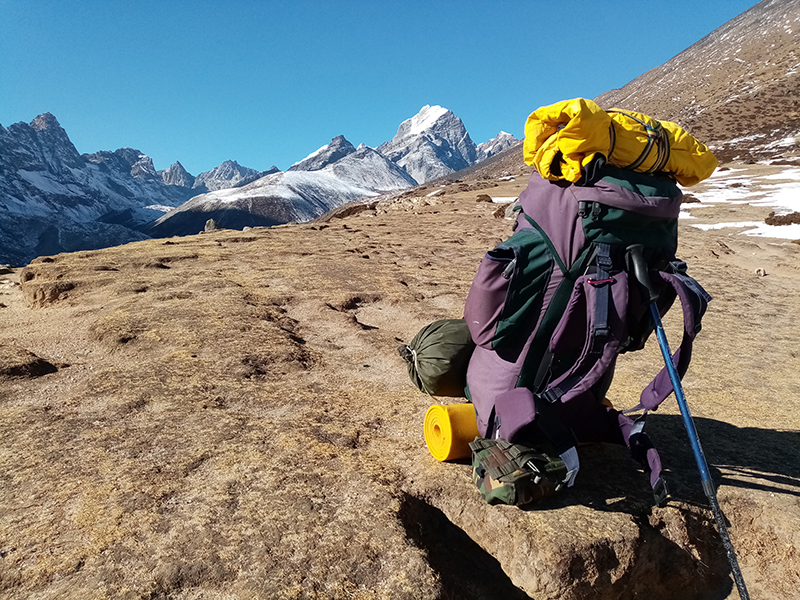
The Nepal trekking packing principle is simple: bring everything you need, and nothing that you don’t. The distinction between those two categories requires honest self-assessment and research, not optimism. Nepal’s tough trails require waterproof layers, insulation for high-altitude nights (temperatures below 3,500 meters regularly drop below freezing even in October), broken-in boots, trekking poles, a first aid kit, water purification, and a sleeping bag appropriate to the altitude you’re reaching.
What Nepal doesn’t require: heavy cameras with multiple lenses (your phone will do more than you think), excessive clothing changes (merino wool base layers worn multiple days straight are standard practice), comfort items that replicate what teahouses already provide (most supply blankets, pillows, and basic toiletries), or any piece of gear you haven’t tested before the trailhead. The trekker who arrives with a 7-kilogram pack will thank themselves on every descent. The trekker with 15 kilograms will be grateful for porters and increasingly resentful of their own pre-departure decisions.
Lesson 9: The People on the Trail Are Part of the Trail
Nepal’s tough trails are not solitary experiences, even on the more remote routes. They’re shared with porters carrying loads that put your pack weight to shame, yak herders moving livestock across high passes, local families running teahouses that represent their entire livelihood, other international trekkers at various stages of exhaustion and elation, and the guides whose knowledge of these routes spans years and generations.
The trekkers who treat these interactions as peripheral — who walk through villages without acknowledgment, who eat at teahouses without conversation, who hire guides and spend the trek ignoring them — miss something irreplaceable. Nepal is not just a landscape. It’s a living culture with 125 ethnic groups, dozens of languages, a history shaped by Hinduism and Buddhism in ways that are visible in every prayer wheel, every mani stone wall, every gompa perched improbably on a cliff face.
Learning a few Nepali words — ‘Namaste’ as a greeting, ‘Dhanyabad’ for thank you, ‘bistari bistari’ to tell your guide you need to slow down — changes the texture of your interactions immediately. Sitting with a teahouse family after dinner, asking your guide about the communities you’re walking through, or simply watching a local puja ceremony with genuine curiosity rather than a camera viewfinder: these moments cost nothing and return everything. Some trekkers report that the people they met on Nepal’s trails affected them more profoundly than the mountains themselves.
Lesson 10: Preparation Is the Foundation — Everything Else Is Built on It
There is a version of Nepal trekking where you book a last-minute trip, throw some gear in a bag, and assume the trail will sort itself out. Some people do this and survive. Very few of them thrive. Nepal’s tough trails punish inadequate preparation in consistent, predictable ways: blisters from unbroken boots, altitude sickness from compressed itineraries, hypothermia from insufficient insulation, financial panic from insufficient cash (there are no ATMs between Besisahar and Jomsom on the Annapurna Circuit), and dangerous situations from missing permits or misjudged route difficulty.
Preparation for a serious Nepal trek begins months before departure. Physical conditioning — especially leg strength, cardiovascular endurance, and loaded pack training — is the foundation. Gear research and acquisition comes next, with enough lead time to break everything in before the trailhead. Permits (TIMS card, National Park entry, restricted area permits for routes like Upper Mustang or Manaslu) require advance planning. Travel insurance that explicitly covers high-altitude trekking and helicopter evacuation is non-negotiable — helicopter rescue from the Everest region runs upward of five thousand dollars, and rescuers will not fly until they have payment confirmation.
The most important element of preparation, however, is choosing the right itinerary structure. The vast majority of altitude-related emergencies on Nepal’s trails come from compressed schedules — trekkers trying to do in ten days what a responsible operator would spread over fourteen. Proper acclimatization days are not optional rest days; they’re the mechanism by which your body adapts to reduced oxygen. Skip them to save time, and you’re not saving time — you’re gambling with your health and your entire investment in the trip.
Preparation is not the opposite of adventure. It’s what makes genuine adventure possible. The trekkers who arrive in Nepal well-prepared are the ones who can be fully present for the experience — who can absorb the landscape, engage with the culture, and push themselves to the edge of their capacity without tipping over it. That’s what tough trails in Nepal are really offering: not suffering, but the particular kind of freedom that comes from being genuinely ready for something hard.
Final Word: What Nepal’s Tough Trails Actually Teach You
Every one of these lessons points toward the same underlying truth: Nepal’s trails reward those who approach them with humility. Not timidity — there’s a difference. The trekker who plans thoroughly, moves deliberately, listens to their body, respects the weather, connects with the culture, and stays present for the journey rather than fixated on the endpoint is the trekker who comes home transformed.
Nepal has been humbling explorers, pilgrims, climbers, and trekkers for centuries. It will continue to do so long after the most popular trails have been walked by millions more. The mountains don’t change for the trekker. The trekker changes for the mountains. That’s not a slogan — it’s what everyone who has seriously walked Nepal’s tough trails comes back knowing in a way they didn’t before they left.
These lessons don’t stay on the trail. They come home with you.
Trek Nepal with Getaway Nepal Adventure
Getaway Nepal Adventure designs and operates trekking programs across all of Nepal’s major routes — from first-time friendly trails like Poon Hill and Langtang to serious multi-week routes including Everest Base Camp, Annapurna Circuit, and the Manaslu Circuit. Every itinerary is built with proper acclimatization schedules, expert local guides, and the specific expertise that comes from knowing these trails across seasons and conditions.
- Custom itineraries for individuals, groups, and academic or corporate teams
- Experienced local guides with deep route knowledge and altitude safety training
- All fitness levels — beginner-friendly options through advanced high-pass routes
- Full logistics support: permits, teahouse bookings, porter services, emergency protocols
- Pre-trek orientation on fitness, altitude management, gear, and cultural context
Nepal is ready. Start your preparation today.
Contact Getaway Nepal Adventure for customized trek design, itinerary planning, and expert guidance.
Recent Posts