How to Make the Most of Your Himalayan Trekking Adventure
Routes, regions, permits, seasons, safety, teahouses, and everything in between
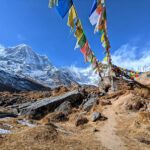
Somewhere between the first glimpse of Kathmandu’s chaotic streets and the moment the Himalayas appear above the clouds on a morning flight to Lukla, something shifts. Nepal does that. It gets under your skin quickly and deeply — not just because of the mountains, though the mountains are extraordinary, but because of everything that surrounds them: the villages clinging to impossible ridgelines, the prayer flags strung between peaks, the warmth of a teahouse fire after a nine-hour day on the trail, the quiet that settles over a high camp when the wind drops at dusk.
Nepal has been the world’s premier trekking destination for over four decades, and with good reason. Seven of the planet’s fourteen mountains above 8,000 meters stand within its borders. Its trail network spans from subtropical jungle in the south to glacial terrain in the north. Its cultures — Sherpa, Gurung, Tamang, Magar, Newari, Tharu, and dozens more — offer a depth of human experience that few other places on earth can match in such geographic concentration.
But Nepal trekking is not a single thing. It is a vast spectrum of experiences ranging from a four-day walk to Poon Hill — achievable by anyone with reasonable fitness and a decent pair of boots — to the Three Passes Trek, which demands weeks of effort across high-altitude terrain that challenges even seasoned Himalayan trekkers. Between those poles lies every level of adventure, every kind of landscape, and every style of travel you could want.
This guide covers the full picture: which regions to choose, which routes match which fitness levels, what the trail actually feels like day to day, how to handle altitude, what permits you need, what the teahouses are really like, what to pack, when to go, and how to get the most out of every hour you spend in these mountains. Whether you are planning your first Nepal trek or returning for the fifth time, everything you need is here.
Why Trek in Nepal? The Case That Makes Itself
You could trek in Patagonia. You could hike in the Alps or the Dolomites. You could walk sections of the Appalachian Trail or the Tour du Mont Blanc. All of these are extraordinary experiences. None of them are Nepal.
What Nepal offers that nowhere else can replicate is the specific combination of altitude, cultural density, trail accessibility, and sheer mountain scale. Standing on Kala Patthar at 5,545 meters with Everest filling your entire field of vision is categorically different from looking at a mountain from below. Crossing the Thorong La Pass at 5,416 meters on the Annapurna Circuit, with the Annapurna Massif and Dhaulagiri spread across the horizon in both directions, is an experience that stays with people for the rest of their lives. Walking through a Sherpa village where the culture has been shaped by centuries of life at altitude, where the monasteries are active and ancient, where the hospitality is real rather than performed — this is not a theme park version of mountain culture. It is the real thing.
Nepal is also remarkably accessible for the scale of what it offers. Its trail infrastructure — particularly the teahouse network across the Everest, Annapurna, and Langtang regions — means that people without camping or mountaineering experience can walk for two weeks through some of the most extraordinary terrain on earth, sleeping in local guesthouses and eating hot meals every night. The logistical barrier that makes high Himalayan adventure inaccessible in many parts of the world simply does not exist here in the same way.
And then there is the cost. Nepal remains one of the most affordable adventure destinations on the planet. A full day on the trail including accommodation, meals, and teahouse costs runs between thirty and sixty US dollars for independent trekkers. Even fully guided and supported programs with permits, porter services, and experienced guides come in far below comparable experiences in other mountain destinations. The value proposition is extraordinary — and it has not diminished as Nepal has developed. If anything, the infrastructure has improved while the cost advantage has held.
Choosing Your Region: Where Nepal’s Trails Begin
The first and most important decision in planning a Nepal trek is not which specific route to do — it is which region of Nepal to enter. The three major trekking regions each have distinct characters, and matching the right region to your interests, timeframe, and fitness level shapes everything that follows.
The Everest Region — Solukhumbu District
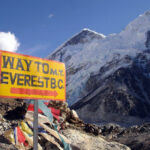
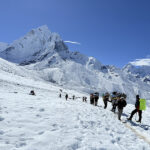
The Everest Region is where Nepal’s international trekking reputation was built, and it remains the most famous trekking area on earth. The Solukhumbu District, accessed via a twenty-five-minute flight from Kathmandu to Lukla’s legendary mountain airstrip, contains some of the most dramatic mountain scenery on the planet. Ama Dablam — widely considered one of the world’s most beautiful mountains — dominates the horizon for much of the EBC route. The Khumbu Icefall, visible from Everest Base Camp, is a visceral reminder of the scale of the forces at work in this landscape.
The Everest region also has the most developed trail infrastructure of any trekking area in Nepal. Teahouses along the main EBC route now offer reliable meals, Wi-Fi connectivity in most villages, and accommodation standards that have risen significantly over the past decade. This infrastructure makes the region accessible for first-time trekkers on the standard routes while still offering genuinely challenging options — the Three Passes Trek, the Gokyo Valley circuit, and Island Peak climbing — for experienced adventurers.
Key routes in the Everest region span a wide difficulty range. The five-day Everest View Trek provides a genuine high-altitude Himalayan experience without requiring the full commitment of the EBC route. The classic fourteen-day Everest Base Camp Trek is the benchmark against which all other Himalayan treks are measured. The Gokyo Valley route offers an alternative approach to the Everest panorama via a series of sacred glacier lakes, with significantly fewer trekkers than the main EBC corridor. And for those with mountaineering ambitions, Island Peak at 6,189 meters and Mera Peak at 6,476 meters represent the first rung on the Himalayan climbing ladder.
The Annapurna Region
The Annapurna Region was among the first trekking areas in Nepal to open to foreign visitors in the 1970s, when intrepid early trekkers began following the ancient trading routes between Nepal and Tibet. Today it remains one of the most diverse and rewarding trekking destinations in the world, encompassing terrain that shifts from the subtropical forests of the lower valleys to the high-altitude desert of the Mustang plateau within a single circuit.
The Annapurna Circuit is the great classic of Nepal trekking — a circumnavigation of the Annapurna Massif that covers roughly 160 to 230 kilometers depending on the section walked, climbing to its high point at the Thorong La Pass at 5,416 meters. The circuit is a genuinely transformative multi-week journey through extraordinary geographic and cultural diversity. Its greatest strength is precisely this variety: the same trek that passes through rhododendron forests and Hindu villages in the lower valleys crosses high-altitude Tibetan Buddhist communities and barren mountain passes in its upper sections. No two days look alike.
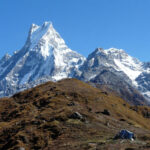
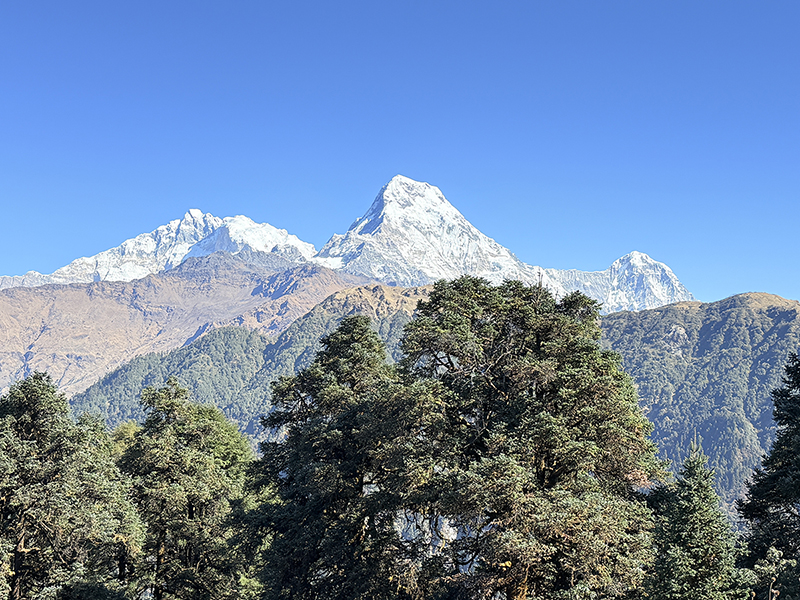
Annapurna Base Camp — also called the Annapurna Sanctuary — offers a different but equally compelling experience. The route passes through the famous viewpoint at Poon Hill before entering the sanctuary itself, a high plateau surrounded by an amphitheatre of peaks including Annapurna I, Hiunchuli, and Machhapuchhre. The guesthouse at ABC sits at 4,130 meters in one of the most spectacular mountain settings in the world. For trekkers with less time, the Ghorepani Poon Hill route delivers genuinely world-class mountain views in as few as four to five days. The Mardi Himal Trek, a quieter route through old-growth rhododendron forest, offers the kind of off-the-beaten-path experience that the Annapurna region’s more famous routes can no longer fully provide.
The Langtang Region
The Langtang region is Nepal’s underrated masterpiece. Just a hundred kilometers north of Kathmandu, closer to the capital than either the Everest or Annapurna regions, it offers everything that defines genuine Himalayan trekking — remote mountain villages, peaks above 7,000 meters, glaciers, wildlife, and some of the richest Tibetan Buddhist culture in Nepal — without the crowd density of its more famous neighbours.
The Langtang Valley Trek, the region’s signature route, reaches altitudes approaching 5,000 meters on the Tsergo Ri viewpoint while remaining logistically accessible and appropriate for trekkers without previous high-altitude experience. The village of Kyanjin Gompa, the route’s high-altitude hub, sits in a glacially-carved valley surrounded by peaks that exceed 7,000 meters, with a historic monastery that has served the Tamang community for centuries.
The region carries a particular poignancy since the 2015 Gorkha earthquake, which destroyed the village of Langtang entirely and claimed hundreds of lives, many of them trekkers and local community members. The rebuilt village and the resilience of the Tamang communities who returned to reconstruct their lives here make trekking in Langtang a quietly moving experience as well as a spectacular one. Every rupee spent in the region directly supports communities that are still on the long road to full recovery.
Beyond the Big Three — Nepal’s Hidden Regions
The Everest, Annapurna, and Langtang regions represent the accessible mainstream of Nepal trekking. Beyond them lies a more demanding and more rewarding world of restricted and remote routes. The Manaslu Circuit, circling the world’s eighth highest mountain through Tibetan-influenced villages on ancient trading routes, is increasingly recognized as one of Nepal’s finest long treks. Upper Mustang — the Forbidden Kingdom, a high-altitude Tibetan plateau accessible only by special permit — offers a landscape and culture that exists nowhere else on earth. The Kanchenjunga Base Camp route in far eastern Nepal and the Dolpo region in the west provide genuinely remote wilderness experiences for trekkers seeking solitude and challenge in equal measure.
How Difficult Is Trekking in Nepal?
This question does not have a single answer, because Nepal does not offer a single type of trekking experience. The difficulty spectrum runs from genuinely accessible — suitable for people with moderate fitness and no hiking background — to seriously demanding routes that require weeks of preparation, high-altitude experience, and technical skill.
On the easier end, routes like Ghorepani Poon Hill and the Everest View Trek operate at maximum altitudes below 3,500 meters, involve four to six hours of walking per day on well-maintained trails, and can be completed by anyone with a decent level of general fitness and appropriately broken-in boots. The Langtang Valley Trek falls into a moderate category — longer days, more significant elevation gain, and altitudes reaching nearly 5,000 meters on optional viewpoint climbs — but remains accessible to determined trekkers without specific high-altitude experience.
The classic multi-week routes — Everest Base Camp, Annapurna Circuit, Annapurna Base Camp — sit in an intermediate to challenging range. They involve consistent daily effort over extended periods at altitudes that significantly affect the body, and they demand both physical preparation and the mental resilience to sustain effort across two weeks or more of consecutive days. They are not technically difficult in the mountaineering sense — no ropes, no ice axes, no technical climbing — but they are genuinely demanding physical undertakings that should be approached with honest preparation.
At the harder end, routes like the Three Passes Trek in the Everest region and the Manaslu Circuit involve high passes above 5,000 meters, extended periods above 4,000 meters, and physical demands that require specific fitness preparation and a conservative acclimatization schedule. Peak climbing on Island Peak or Mera Peak introduces technical mountaineering elements — crampons, rope work, ice axes — that require additional preparation and expertise.
The honest assessment for most people planning their first Nepal trek: if you can walk uphill for four to five hours carrying a daypack, and you are willing to take the preparation seriously in the months before you go, the classic routes are within your reach. The goal is not to arrive fit enough to race — it is to arrive prepared enough to enjoy.
Why You Need a Guide — and What the Law Now Requires
Since April 2023, trekking in Nepal’s designated trekking areas without a licensed guide has been prohibited by law. This is not a bureaucratic technicality — it is a policy with genuine safety rationale behind it, shaped in part by a history of trekkers going missing or needing rescue on routes where local knowledge and communication capability would have prevented the situation entirely.
Beyond the legal requirement, the case for guided trekking in Nepal is strong on its own merits. A good Nepali trekking guide brings several layers of value that are difficult to replicate independently. They know the trails across seasons and conditions, including how routes change after monsoon rainfall, where the safe river crossings are in high water, and which teahouses represent reliable quality in a given area. They communicate with local communities, porters, and other guides in ways that open doors a solo trekker cannot easily open. They provide a real-time safety layer on altitude — monitoring symptoms in your group, knowing when acclimatization is not proceeding normally, and having the authority and judgment to recommend descent before a situation becomes an emergency.
Guides in Nepal are required to complete accredited training programs that cover safety procedures, first aid, route knowledge, and cultural orientation before they can operate on the more demanding routes. This is a profession that people in Nepal’s mountain communities have spent generations developing, and the level of expertise among the best guides — their knowledge of Himalayan ecology, Buddhist and Hindu religious traditions, village histories, and mountain weather — is genuinely remarkable.
Hiring a guide and, where appropriate, porters also has a direct economic dimension that matters. Trekking is one of the primary income sources for communities across Nepal’s mountain regions, many of which have very limited economic alternatives. Every rupee paid to local guides and porters stays in the community. This is not charity — it is fair payment for skilled, hard labour that makes the entire trek experience possible.
Teahouse Trekking: Life on the Trail
The teahouse system is what makes Nepal’s major trekking routes accessible to the broad range of trekkers who walk them every year. Rather than carrying camping gear and cooking supplies — which would add enormous weight and logistical complexity to multi-week mountain journeys — trekkers on established Nepal routes sleep and eat in locally owned mountain guesthouses, known as teahouses or bhattis, spaced at intervals along the trail.
The word teahouse undersells what many of these establishments actually offer. On the most popular routes — Everest Base Camp, Annapurna Circuit, Poon Hill — teahouses range from basic stone-walled rooms with shared facilities to comfortable lodges with private rooms, hot showers, dining rooms with wood stoves, and increasingly reliable Wi-Fi. At the higher-altitude sections of major routes, facilities simplify out of necessity — rooms are smaller, hot water may be available only by the bucket, and menu options narrow. But the hospitality, almost universally, remains warm.
Dal bhat is the staple of teahouse dining and the fuel of Himalayan trekking. Lentil soup served over rice with vegetable curry and pickles, often with a side of greens and pappadum, it is the most nutritionally appropriate trail food on offer — high in complex carbohydrates, adequate in protein, easy to digest at altitude, and typically refillable at no extra charge. Many experienced guides recommend ordering dal bhat over Western menu items at altitude, not because the Western options are necessarily bad, but because local food is fresher, prepared with local ingredients, and exactly calibrated to what Himalayan trail days require.
Beyond dal bhat, teahouse menus offer a remarkably varied range of options given their location. Tibetan bread, momos (dumplings), tsampa porridge, eggs in multiple preparations, noodle soups, pasta, and seasonal vegetable dishes all appear regularly. At lower elevations where supply chains are more reliable, menus expand considerably. Prices increase with altitude — a meal that costs three to four dollars in a lowland teahouse may cost eight to ten dollars above 4,000 meters, reflecting the genuine cost of getting supplies to that altitude by porter.
What to Expect in Your Room
Teahouse rooms are simple by any standard. Expect a bed with a foam or spring mattress, blankets or a quilt, and shared bathroom facilities in most cases. Private en-suite rooms exist on some routes but are not universal, and the definition of a private bathroom at high altitude may differ from what you’re used to at home. Bring your own sleeping bag — even where teahouses provide blankets, a sleeping bag adds warmth insurance at high-altitude camps and gives you control over your sleeping environment in a way that borrowed blankets cannot.
Electricity is available in most teahouses on major routes, but do not count on it being reliable or free. Charging devices typically costs one to three dollars per session, and power cuts are common above certain altitudes. A power bank is non-negotiable. Wi-Fi is available in many teahouses below 4,000 meters but speeds are slow, reliability is low, and costs are charged per session or per day. Budget for it but do not depend on it.
Showers — where available — are typically solar heated and charged separately. Above 3,500 meters, hot showers become less reliable as both solar collection and water supply vary with conditions. Many experienced trekkers bring baby wipes for higher-altitude hygiene management and save showers for rest days at lower elevation teahouses where facilities are more reliable.
Permits: What You Need and Where to Get Them
Nepal’s permit system can seem confusing at first glance, but the underlying logic is straightforward: different trekking areas require different permits, and the combination of permits you need depends entirely on where you are going. Your guide or trekking operator handles all permit logistics in practice, but understanding what is required helps you budget accurately and avoid surprises.
The TIMS Card — Trekkers Information Management System — is the baseline permit required for most trekking areas in Nepal. It functions as a registration and tracking system that helps authorities monitor trekker movements and respond to emergencies. As of recent updates, the TIMS requirement has been integrated into the broader permit structure for several major regions, so check current requirements with your operator, as these details evolve.
Beyond the TIMS Card, each major region requires a specific permit. The Annapurna Conservation Area Permit is required for all routes in the Annapurna region, including the Annapurna Circuit, Annapurna Base Camp, Poon Hill, and Mardi Himal. The Sagarmatha National Park Entry Permit covers the Everest region. The Langtang National Park Entry Permit applies to the Langtang Valley and surrounding area. Each of these permits costs between thirty and fifty US dollars.
Restricted area permits apply to routes in Upper Mustang, the Manaslu Conservation Area, Nar Phu Valley, and several other less-visited regions. These permits are more expensive — Upper Mustang’s restricted area permit costs five hundred US dollars for the first ten days — and require trekkers to travel in groups of at least two with a licensed guide. The higher cost reflects both the conservation management of these areas and a deliberate effort to limit visitor numbers and preserve the character of the regions involved.
Carry multiple passport-size photographs and copies of your passport for the permit application process. Permits are obtained in Kathmandu or Pokhara before departure, and your guide or operator will know exactly which combination of permits your specific route requires. Do not attempt to obtain restricted area permits independently — the process involves government licensing that only licensed operators can navigate correctly.
Best Time to Trek in Nepal: Seasons, Weather, and the Honest Reality
Nepal has two primary trekking seasons, and they are primary for good reason: spring (March to May) and autumn (October to November) offer the most stable weather, the clearest mountain views, and the best overall trail conditions across most trekking regions. Outside these windows, trekking is possible but requires more planning, more flexibility, and a realistic adjustment of expectations.
Autumn: October and November
Autumn is the golden season for Nepal trekking, and it shows in the visitor numbers. October and November bring post-monsoon clarity — the air is washed clean by the summer rains, the visibility is exceptional, and the temperatures at altitude are cold but manageable. The rhododendron forests are fading from their summer green toward the amber tones of early winter, and the high passes are clear of monsoon moisture.
The trade-off is crowds. October and November are the busiest months on Nepal’s popular routes, and busy on the Everest Base Camp route means genuinely congested. Namche Bazaar fills to capacity. Popular viewpoints have queues. Teahouses on the main EBC corridor require advance booking in peak weeks. For trekkers who value solitude, the shoulder periods of late September and early December offer most of the autumn advantages with significantly fewer fellow trekkers.
Spring: March to May
Spring is arguably Nepal’s most beautiful trekking season. The rhododendron forests of the Annapurna and Langtang regions bloom across March and April in extraordinary displays of red, pink, and white that transform the trail experience at lower and middle elevations. The weather is generally stable, temperatures are warmer than autumn at altitude, and the pre-monsoon atmosphere — though occasionally hazier than the post-monsoon clarity of autumn — provides reliable mountain views on most days.
Early March is particularly appealing for trekkers who want good conditions with lower crowd density before the peak spring rush. By late April and into May, the heat at lower elevations increases, humidity rises, and the first signs of the approaching monsoon occasionally interrupt what is otherwise a reliable trekking window.
Monsoon: June to September
Monsoon season runs from June through September, bringing sustained heavy rainfall, high humidity, landslide risk on steep mountain trails, and persistent cloud cover that obscures mountain views. Most international trekkers avoid Nepal during monsoon, and for the popular high-altitude routes, this is sensible advice.
However, monsoon has its advocates. The trails are quieter. The vegetation is extraordinarily lush. Several rain-shadow regions — Upper Mustang, the Dolpo plateau, and the Nar Phu Valley — lie in areas where the Himalayas block the monsoon precipitation, making them viable and genuinely remarkable trekking destinations during a period when the mainstream routes are saturated. For the adventurous trekker with flexibility, monsoon Nepal in these protected regions can be one of the most rewarding and uncrowded experiences the country offers.
Winter: December to February
Winter trekking in Nepal is a niche pursuit that rewards those who embrace it with something the busy seasons cannot provide: solitude. The popular routes empty of crowds, the teahouses become genuinely communal gathering places around their wood stoves, and the mountain views — on clear days — are spectacular with fresh snow on the peaks. But the cost is real. Temperatures above 4,000 meters drop well below minus ten degrees Celsius at night, and cold at altitude is a serious management challenge. High passes on routes like the Annapurna Circuit and the Three Passes Trek may close under deep snow. Teahouses at the highest elevations sometimes close entirely in the deepest winter months.
Lower-altitude winter trekking — Ghorepani Poon Hill, Langtang Valley at lower elevations, sections of the Annapurna foothills — is entirely feasible with the right gear and a willingness to embrace the cold. A sleeping bag rated to minus twenty degrees Celsius, thermal base layers, and proper insulated boots are not optional in winter — they are the minimum safety baseline.
Altitude Sickness: Understanding and Managing the Primary Risk
Altitude sickness — known medically as Acute Mountain Sickness or AMS — is the primary health risk for trekkers in Nepal, and it deserves more than a paragraph in a packing list. Understanding how altitude affects the human body, how to recognize symptoms early, and what to do when they appear is as important as any physical preparation you do in the months before you travel.
The mechanism is straightforward. As altitude increases, atmospheric pressure decreases, and with it the partial pressure of oxygen in the air. At 5,000 meters, each breath delivers roughly half the oxygen it would at sea level. The human body adapts to this through a process called acclimatization — increasing breathing rate, producing more red blood cells, and adjusting blood chemistry over days and weeks. When ascent is faster than the body can adapt, AMS results.
Symptoms typically begin with a persistent headache, often accompanied by nausea, fatigue, loss of appetite, and poor sleep. These symptoms are the body’s way of signalling that it needs more time before going higher. The correct response at this stage is to rest at the current altitude, hydrate aggressively, and not ascend until symptoms have fully resolved. Many people experience mild AMS symptoms that resolve with a rest day at the same altitude before continuing without further difficulty.
The danger comes when AMS is ignored or pushed through. High Altitude Pulmonary Edema (HAPE) — fluid accumulation in the lungs — and High Altitude Cerebral Edema (HACE) — fluid accumulation in the brain — are life-threatening complications that develop from unmanaged AMS. Both require immediate descent, which is the only reliable treatment. Oxygen can help manage symptoms while descent is being arranged but does not substitute for it. The absolute rule of high-altitude trekking is non-negotiable: if symptoms are worsening, descend immediately. Every experienced guide on Nepal’s trails knows this rule, and a good guide will not let ego or schedule pressure override it.
Prevention is the most effective strategy. The standard guideline for routes above 3,000 meters is to ascend no more than 300 to 500 meters in sleeping altitude per day, with a full rest day for every two to three days of ascent. Hydration of three to four litres per day is essential. Avoiding alcohol, heavy sedatives, and strenuous activity in the first days at a new elevation gives your body the best conditions for adaptation. Acetazolamide (Diamox) is a prescription medication that accelerates acclimatization for most people; consult your doctor about whether it is appropriate for you before departing.
Staying Healthy on the Trail
Altitude is the most dramatic health consideration in Nepal trekking, but it is far from the only one. Gastrointestinal illness is the most common health complaint among trekkers in Nepal, and it is almost entirely preventable with consistent habits.
Water safety is the foundation. Tap water in Nepal is not safe to drink, and this applies everywhere — in Kathmandu, in teahouse villages, and anywhere along the trail. Boiled water is available at teahouses and is safe. Carrying purification tablets or a quality water filter gives you independent control over your water safety and allows you to treat stream water when teahouse sources are not available. The slight smoky taste of teahouse-boiled water that some trekkers find off-putting is easily managed with a filter bottle, and is far preferable to the alternative.
Hand hygiene before eating is not optional — it is the single most effective barrier against the waterborne pathogens that cause most gastrointestinal illness in Nepal. Carry hand sanitizer and use it consistently before every meal, particularly after handling currency, trail surfaces, or teahouse furniture. Nail length matters too: trimmed nails carry significantly less microbial load under them than long nails, and this simple detail reduces infection risk.
Vaccinations are the other pre-departure health essential. Consult a travel medicine specialist or your GP at least six weeks before departure for advice on immunizations appropriate for Nepal. Hepatitis A and B, typhoid, tetanus, and rabies vaccinations are commonly recommended for Nepal travel. Your doctor can advise on your specific situation based on the routes you are taking and your medical history.
Blisters deserve mention as a practical health issue that affects a surprising number of otherwise well-prepared trekkers. Properly broken-in boots — worn across at least 40 to 50 kilometres of varied terrain before Nepal — are the primary prevention strategy. At the first sign of a hot spot on the trail, stop and address it before it develops into a full blister. Moleskin, medical tape, and blister plasters should be in your first aid kit and accessible without unpacking everything.
What to Pack: The Honest Essentials
Nepal trekking packing is one of those topics where advice expands to fill the space available, resulting in packing lists that bear no relationship to what people actually need on the trail. The following is an honest, practical summary of what matters.
Footwear
Waterproof, ankle-supporting trekking boots, broken in over at least six to eight weeks of regular hiking before departure. For shorter, lower-altitude routes like Poon Hill, trail runners are acceptable. For anything above 4,000 meters with snow and ice potential, category B boots with a stiff sole are the right choice. Do not compromise on footwear. It is the most important gear decision you make.
Clothing Layers
The layering system is the foundation of clothing strategy for Nepal trekking. A moisture-wicking base layer (merino wool is ideal — it manages odour across multiple days of wear in ways that synthetic fabrics do not), a mid-layer fleece or down jacket for warmth, and a waterproof outer shell for rain and wind. Add thermal long underwear for higher elevations and overnight temperatures below 3,500 meters. Trekking trousers rather than jeans — cotton becomes dangerously cold when wet and dries slowly. A warm hat and gloves are essential above 3,000 meters regardless of season.
Sleeping Bag
Bring your own, rated to at least minus ten degrees Celsius for routes reaching 4,000 meters, and minus fifteen to minus twenty for anything higher. Teahouses provide blankets but the warmth they offer varies widely, and having a sleeping bag you trust is the difference between genuine rest and a cold, sleepless night that compounds cumulative fatigue.
Trekking Poles
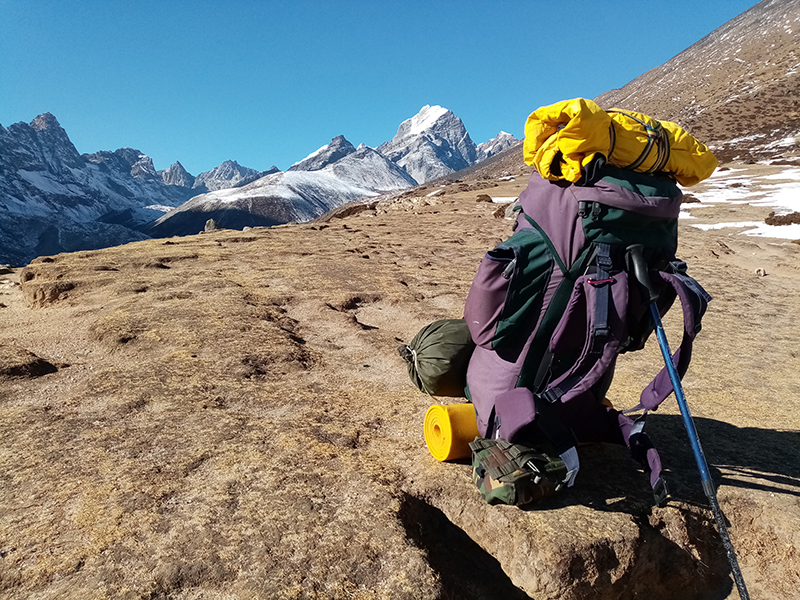
For any route with significant elevation gain and descent, trekking poles are not optional accessories. They reduce knee impact on descent by a measurable and meaningful amount, improve stability on uneven terrain, and become genuinely valuable tools at altitude where balance can be subtly compromised. Collapsible carbon or aluminium poles with carbide tips are the standard; pack them early and practice with them before you need them.
Essential Extras
- Headlamp with spare batteries — essential for early morning starts and power cut evenings
- Water purification tablets or filter bottle — non-negotiable
- Power bank with sufficient capacity for your devices between charge opportunities
- First aid kit including blister supplies, paracetamol, rehydration sachets, and any prescription medications
- Sun protection — the UV index at altitude is significantly higher than at sea level; sunscreen, sunglasses, and a sun hat are essential even in cool conditions
- Sufficient Nepali rupees — ATMs exist in Kathmandu, Pokhara, and some trail towns, but are unreliable above a certain elevation. Carry enough cash for the full trek.
- Multiple passport photos and passport copies for permit applications
- Travel insurance documentation confirming coverage for high-altitude trekking and helicopter evacuation
Kathmandu: Your Gateway to the Himalayas
Almost every Nepal trek begins and ends in Kathmandu, and the city deserves more than a transit stop treatment. Arriving in Kathmandu for the first time is genuinely overwhelming — the traffic, the noise, the density, the smells of incense and cooking and exhaust, the sudden appearance of a centuries-old temple in the middle of a busy intersection. Give it twenty-four hours and it begins to make sense. Give it two days and you’ll start to love it.
Thamel, the tourist quarter in central Kathmandu, is where most trekkers base themselves before and after their routes. Its narrow market streets contain an improbable density of trekking gear shops, restaurants serving everything from dal bhat to wood-fired pizza, guesthouses across a full range of price points, and bookshops with the kind of Himalayan literature that proper pre-trip reading is made from. It is also a sensible place to pick up any gear items you discover you’ve forgotten, to stock up on trail snacks, and to arrange last-minute permit logistics.
Beyond Thamel, Kathmandu rewards exploration. Pashupatinath Temple, on the banks of the Bagmati River, is one of the most significant Hindu sites in the world and one of the most viscerally memorable experiences Nepal offers — the daily cremation ceremonies on the river ghats are conducted openly and with a matter-of-fact dignity that is quite unlike anything most Western visitors have encountered before. Boudhanath Stupa, one of the largest Buddhist stupas in the world and the spiritual heart of Nepal’s Tibetan refugee community, offers a quieter but equally powerful atmosphere, particularly in the early morning when pilgrims circle the stupa in the first light. Swayambhunath — the Monkey Temple — sits on a hill above the city and provides both a panoramic view of the Kathmandu Valley and an introduction to the syncretistic blend of Hindu and Buddhist traditions that characterizes Nepali religious life.
Build at least one full day into your Kathmandu schedule before you depart for the trail. Two days is better. It allows time for acclimatization at the city’s elevation of 1,400 meters, for permit logistics, for gear checks, and for the kind of cultural orientation that makes everything you see on the trail richer when you understand even a little of the context.
Responsible Trekking: How to Travel in Nepal Well
Nepal’s trails carry tens of thousands of trekkers each year, and the collective impact of that volume on the environment, on local communities, and on the cultural integrity of the regions visited is real and cumulative. Trekking responsibly in Nepal is not an optional extra — it is part of the baseline obligation of visiting a place that depends on you for its economic survival while also bearing the consequences of your presence.
Plastic waste is a serious and visible problem on Nepal’s trails, particularly on the highest-use routes. The Khumbu Valley in the Everest region has ongoing cleanup operations that remove tons of waste from the trails and surroundings annually — waste that trekkers and climbing expeditions left behind. Bringing a reusable water bottle and purification system, refusing single-use plastic wherever possible, and carrying out everything you carry in are not idealistic positions. They are minimum standards for anyone who values the environment they have come to experience.
Supporting local economies means making choices that keep money within the communities you are visiting. Hiring local guides and porters through Nepali operators rather than booking exclusively through international platforms. Eating at teahouses rather than bringing imported food that bypasses local businesses. Buying local crafts and produce rather than imported goods. These choices are often also the better experience choices — local food is fresher, local guides have knowledge no imported expertise can replicate, and local craft is more interesting than mass-produced souvenirs.
Cultural sensitivity is the third dimension of responsible trekking. Nepal’s religious sites — the monasteries, the temples, the mani walls and chortens along the trails — are not backdrop for photographs. They are active places of worship and community meaning. Ask before photographing people, particularly at religious occasions. Dress modestly at religious sites. Walk clockwise around mani walls and chortens, as Tibetan Buddhist tradition requires. Learn a few words of Nepali — Namaste, Dhanyabad (thank you), bistari bistari (slowly slowly) — and use them. These small acts of respect cost nothing and matter more than most trekkers realize.
Nepal Trekking with Getaway Nepal Adventure
Getaway Nepal Adventure is a Kathmandu-based trekking operator with deep experience designing and leading programs across all of Nepal’s major regions — from first-time friendly routes in the Annapurna foothills to advanced multi-week circuits in the Everest region and beyond. Every itinerary we build reflects the same commitment: giving trekkers the best possible experience of what Nepal actually is, not a sanitized or oversimplified version of it.
We work with the most experienced local guides in the business — people who know these trails across seasons, who understand altitude and how to manage it, who can navigate a teahouse booking dispute in Nepali at the end of a hard day and do it with good humour, and who bring a knowledge of Himalayan culture, religion, and natural history that transforms a walk through extraordinary landscape into a genuinely educational experience.
What Getaway Nepal Adventure Offers
- Customized itineraries for every fitness level and timeframe — from four-day introductory routes to three-week advanced circuits
- Expert licensed local guides with certified altitude safety and first aid training
- Full permit logistics — TIMS, national park permits, restricted area permits all handled
- Quality teahouse bookings pre-arranged on popular routes, eliminating peak-season accommodation uncertainty
- Porter services with fair wages and proper equipment — we operate to ethical trekking standards
- Pre-trek orientation covering fitness, altitude management, gear, cultural protocols, and safety systems
- 24/7 on-ground support throughout your program
- Group programs for universities, corporations, and academic institutions
- Responsible trekking practices — sustainable, community-supporting, environmentally conscious
Nepal is waiting. The only question is where to start.
Contact Getaway Nepal Adventure to discuss your trek, your fitness level, and the right itinerary for your goals.
Recent Posts