Top 15 Best Short Treks in Nepal
Nepal in a Week or Less — Is It Worth It?
The standard answer to ‘how long should I trek in Nepal?’ is always two weeks minimum. That answer is wrong for a significant portion of the people asking the question. Not everyone has two weeks. And more importantly, Nepal’s trekking landscape is rich enough that a well-chosen 3-day route delivers something genuinely extraordinary — not a compromise, not a consolation prize, but the right trek for the time available.
Nepal has over 60 designated trekking routes of varying length, difficulty, and character. The 15 selected here represent the best short-form options across all the major trekking regions — Annapurna, Everest, Langtang, Kathmandu Valley, Mustang, and Solu Khumbu. Each entry covers what makes the trek worth doing, who it suits, what to expect, and the key practical details you need to plan it.
Short is defined here as 11 days or fewer. All 15 treks have been ordered by duration — shortest first — so you can find what fits your schedule immediately. Difficulty ratings, permit requirements, and best season information are standardised across all entries for easy comparison.
Quick Reference — All 15 Treks at a Glance
| # | Trek Name | Region | Days | Max Alt. |
| 01 | Chisapani Nagarkot Trek | Kathmandu Valley | 3 days | 2,175 m |
| 02 | Ghorepani Poon Hill Trek | Annapurna | 4–5 days | 3,210 m |
| 03 | Ghandruk Trek | Annapurna | 3–4 days | 1,940 m |
| 04 | Mardi Himal Trek | Annapurna | 5–7 days | 4,500 m |
| 05 | Annapurna Panorama Trek | Annapurna | 5–7 days | 3,210 m |
| 06 | Annapurna Base Camp Trek | Annapurna | 7–10 days | 4,130 m |
| 07 | Everest View Trek | Everest | 7 days | 3,880 m |
| 08 | Pikey Peak Trek | Solu Khumbu | 7–8 days | 4,065 m |
| 09 | Langtang Valley Trek | Langtang | 7–10 days | 3,870 m |
| 10 | Tamang Heritage Trail | Langtang | 8–9 days | 3,300 m |
| 11 | Khopra Ridge Trek | Annapurna | 8–9 days | 3,660 m |
| 12 | Nar Phu Valley Trek | Annapurna / Manaslu | 9–10 days | 4,150 m |
| 13 | Lower Mustang Trek | Mustang | 8–10 days | 3,800 m |
| 14 | Helambu Trek | Langtang | 9–10 days | 3,650 m |
| 15 | Gosaikunda Lake Trek | Langtang | 9–11 days | 4,380 m |
-
Chisapani Nagarkot Trek
Kathmandu Valley | 3 Days | Max: 2,175 m | Easy
Start / End: Sundarijal / Nagarkot
Daily Walk: 4–6 hrs
Cost (approx.): USD $150–$300
Best Season: Year-round
Nepal’s most accessible multi-day trek. The trailhead at Sundarijal is a 40-minute drive from the centre of Kathmandu — no domestic flights, no long road journeys, no permit complications. The trail follows the forested ridge of Shivapuri National Park to Chisapani (2,175 m), where on a clear morning you see the full arc of the Himalaya from Annapurna to Kanchenjunga stretching across the northern horizon, with Langtang Lirung directly ahead.
Day two continues east through pine and rhododendron forest along the Shivapuri-Nagarjun ridge, descending to Nagarkot — the hilltop village on the eastern rim of the Kathmandu Valley that has been Nepal’s classic sunrise viewpoint for decades. The Nagarkot sunrise over the Himalaya, with Everest visible on clear days, is the perfect conclusion to a short hike. Return to Kathmandu by bus or taxi on day three.
Who it suits
First-time Nepal visitors, families, trekkers with 3 days before or after a longer itinerary, anyone who wants Himalayan views without leaving the Kathmandu region. No altitude concerns — maximum elevation stays below 2,200 m.
Practical notes
- No Lukla flights needed. Drive directly to Sundarijal from Kathmandu.
- Shivapuri National Park entry fee: NPR 500 (~USD $4).
- Accommodation at Chisapani is basic but adequate. Nagarkot has excellent lodge options including some comfortable mid-range properties with mountain-view terraces.
- Can be done independently without a guide — the trail is well-marked within the national park.
-
Ghorepani Poon Hill Trek
Annapurna Region | 4–5 Days | Max: 3,210 m | Easy to Moderate
Start / End: Nayapul / Nayapul or Pokhara
Daily Walk: 4–7 hrs
Cost (approx.): USD $300–$600
Best Season: October to May
Nepal’s most popular short trek and, in terms of mountain views-per-effort-ratio, one of the best value trekking experiences in the world. The trail begins at Nayapul (90 minutes from Pokhara by road) and climbs through the Gurung villages of Tikhedhunga and Ulleri — the latter famous for a staircase section of over 3,000 stone steps — to Ghorepani (2,860 m) and the famous viewpoint of Poon Hill (3,210 m).
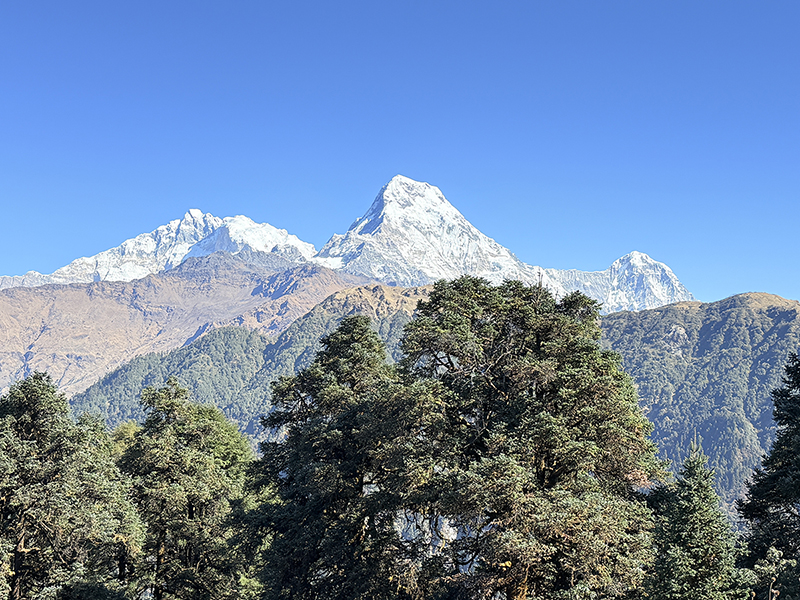
The sunrise from Poon Hill is the centrepiece: an almost circular panorama of Dhaulagiri (8,167 m), Annapurna I (8,091 m), Annapurna South, Hiunchuli, Nilgiri, Lamjung Himal, Machhapuchhre (Fishtail), and Manaslu — all lit gold in the first light. The rhododendron forests between Ghorepani and Ghandruk are among Nepal’s most spectacular, particularly in March and April when the forests bloom red, pink, and white.
The standard loop continues from Ghorepani through Tadapani to Ghandruk — the largest Gurung village in the Annapurna region, with excellent views of Annapurna South from the village — then descends to Birethanti and returns to Pokhara. Allow 5 days for the full loop; the 4-day version returns direct from Ghorepani.
Who it suits
Beginners, families with older children, trekkers looking for cultural immersion in Gurung villages, anyone wanting Nepal’s most iconic sunrise view. The Ulleri staircase is steep; otherwise the trail is well-maintained and manageable.
Practical notes
- ACAP (Annapurna Conservation Area Permit): NPR 3,000 (~USD $22). TIMS: NPR 2,000 (~USD $15).
- March–April: rhododendron bloom. October–November: clearest mountain views. December–February: cold but quiet and beautiful.
- Accommodation is excellent throughout — the Ghorepani and Ghandruk teahouses are well-run, with private rooms and good menus.
- Regularly done without a guide — trail is very well-marked and busy with other trekkers.
-
Ghandruk Trek
Annapurna Region | 3–4 Days | Max: 1,940 m | Easy
Start / End: Pokhara / Pokhara
Daily Walk: 3–5 hrs
Cost (approx.): USD $200–$450
Best Season: Year-round
The Ghandruk Trek is Nepal’s finest introduction to Gurung culture and one of the most visually rewarding short treks in the Annapurna foothills. The village of Ghandruk sits at 1,940 m with a direct front-row view of Annapurna South (7,219 m) and Hiunchuli — mountains that fill the northern horizon in a way that the more famous viewpoints further up the trail cannot match, because here you’re standing in a living village rather than on a windy hilltop.
The Ghandruk Gurung Museum documents the military and cultural history of Nepal’s famous Gurkha soldiers — the Gurung people of this region have contributed disproportionately to the British and Indian Gurkha regiments for over 200 years. The village itself has traditional stone houses, a working gompa, and a community life that continues largely on its own terms despite consistent trekking traffic.
The standard 3-day route goes Pokhara to Nayapul by road, then Birethanti to Ghandruk (day one), rest day at Ghandruk with village exploration (day two), and return to Pokhara (day three). A 4-day extension adds the Chomrong loop toward Annapurna Base Camp before returning.
Who it suits
Beginners, families with children of any age, cultural travellers, photographers. Maximum altitude of 1,940 m means no altitude concerns. Excellent year-round option with a manageable daily walk.
Practical notes
- One of the few Nepal treks feasible in all seasons including monsoon — the Gurung villages along the route are established and infrastructure is solid.
- Ghandruk has excellent teahouse accommodation with mountain-view dining rooms and reliable hot showers.
- Can be combined with Poon Hill (Trek 02) by taking the Ghorepani-Tadapani-Ghandruk loop direction.
-
Mardi Himal Trek
Annapurna Region | 5–7 Days | Max: 4,500 m | Moderate
Start / End: Pokhara / Pokhara
Daily Walk: 5–7 hrs
Cost (approx.): USD $350–$700
Best Season: March to May, October to November
The Mardi Himal Trek is the Annapurna region’s best-kept secret and one of the fastest-growing treks in Nepal — still quiet enough to feel genuinely off the beaten track, with mountain views that rival anything on the far busier Annapurna Base Camp route. The trail climbs the eastern ridge of Machhapuchhre (Fishtail Mountain) to the High Camp at 3,580 m and the viewpoint at Mardi Himal Base Camp at 4,500 m, with direct close-up views of Machhapuchhre, Annapurna I, Annapurna III, Mardi Himal, and Hiunchuli.
The route passes through a progression of landscapes that most trekkers find unexpectedly diverse: lush subtropical forest in the lower sections, rhododendron and oak at mid-elevation, and open ridgeline terrain above the treeline with expanding 360-degree views. The trail to Mardi Himal High Camp is exposed and occasionally snowy in early spring and autumn — a factor that adds drama without technical difficulty.
The 5-day itinerary is the fastest sensible pace. Seven days allows a rest day at Forest Camp and a day hike from Mardi Himal Base Camp to the Upper Viewpoint — strongly recommended for the best views.
Who it suits
Trekkers looking for something quieter than Poon Hill or ABC, with more dramatic mountain views than the lower Annapurna trails. Prior trekking experience is helpful above 3,500 m. The trail is less trafficked than other Annapurna routes, which means getting lost above Forest Camp is possible without a guide.
Practical notes
- Hire a guide above Forest Camp — the upper ridge trail is less marked than the main Annapurna routes.
- Crampons may be useful in early spring on the snow sections near High Camp and Mardi Himal Base Camp.
- Accommodation is limited and basic above Forest Camp — expect bunkrooms and simple food at High Camp.
- Can be combined with Ghorepani Poon Hill as a 10-day circuit.
-
Annapurna Panorama Trek
Annapurna Region | 5–7 Days | Max: 3,210 m | Easy to Moderate
Start / End: Nayapul / Pokhara
Daily Walk: 4–6 hrs
Cost (approx.): USD $300–$600
Best Season: October to May
Also known as the Ghorepani–Poon Hill–Ghandruk Loop, the Annapurna Panorama Trek is the extended version of the Poon Hill route (Trek 02) that adds the beautiful Chomrong and Jhinu Danda section on the return — including the natural hot springs at Jhinu Danda, one of the most satisfying post-trekking experiences in Nepal. The extra days add significant variety to the trail without substantially increasing the difficulty.
The route takes in the full Poon Hill sunrise, the rhododendron forests of the Ghorepani-Tadapani corridor, the Gurung cultural depth of Ghandruk, the dramatic Modi Khola gorge, and the hot spring pools at Jhinu Danda before descending to Nayapul. In terms of landscape variety per day, this is arguably the most well-rounded short trek in the Annapurna region.
Who it suits
Trekkers wanting the full Annapurna foothills experience in under a week. Excellent for groups with mixed abilities — the terrain is manageable throughout and the teahouse network is the best developed of any Nepal trekking region.
Practical notes
- The hot spring at Jhinu Danda (1,780 m) above the Modi Khola River is a mandatory stop. Natural rock pools fed by thermal springs — the perfect end to a five-day trek.
- The Ghorepani to Tadapani section can be difficult in heavy snow or fog — check conditions with your guide.
- Accommodation quality is consistently good throughout. This is one of the few Nepal routes where budget and mid-range trekkers get very similar experiences.
-
Annapurna Base Camp Trek
Annapurna Region | 7–10 Days | Max: 4,130 m | Moderate
Start / End: Nayapul / Pokhara
Daily Walk: 5–7 hrs
Cost (approx.): USD $500–$1,100
Best Season: October to May
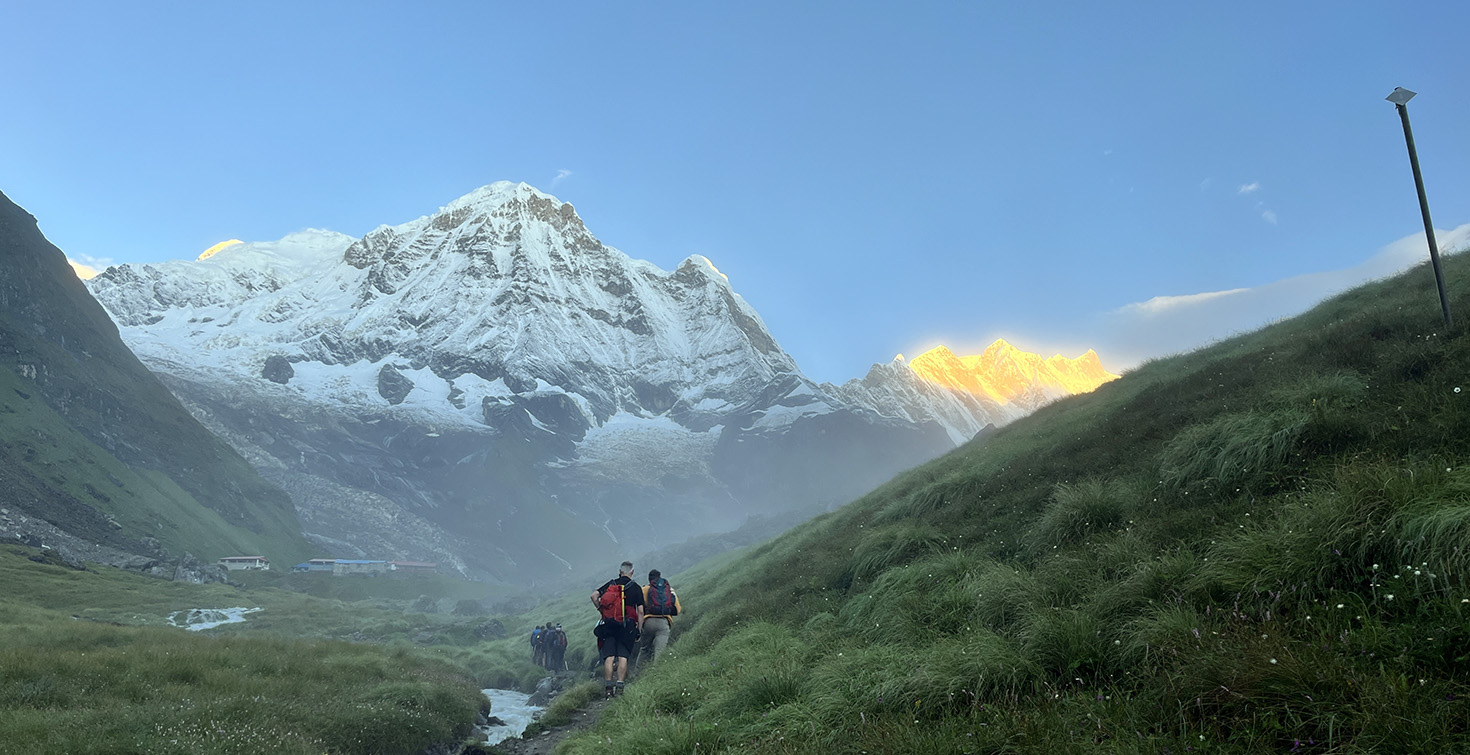
Annapurna Base Camp (ABC) at 4,130 m sits inside one of the most dramatic mountain cirques on earth. The sanctuary is a natural amphitheatre ringed by thirteen peaks, all above 6,000 m, including Annapurna I (8,091 m) — the world’s tenth highest — Annapurna South, Machhapuchhre (Fishtail), and Gangapurna. When you step into the sanctuary clearing after the final push through the Modi Khola gorge, the view that opens above you is genuinely overwhelming.
The trail to ABC follows the Modi Khola valley from Nayapul through Chhomrong — a large Gurung village with excellent accommodation and the trek’s logistical hub — through bamboo and rhododendron forest, past several smaller teahouse settlements, through the Machhapuchhre Base Camp clearing at 3,700 m, and finally into the sanctuary. The famous Machhapuchhre (Fishtail Mountain) — sacred and legally unclimbed — towers over the approach corridor.
The 7-day version is achievable for fit trekkers moving at pace. Ten days allows a more comfortable ascent with a rest day at Chhomrong and better acclimatisation before the final push to 4,130 m.
Who it suits
Trekkers wanting a base camp experience without committing to the Everest region’s longer timelines. ABC is Nepal’s most crowd-accessible high mountain cirque. Prior trekking experience above 3,000 m is recommended but not required for healthy, fit trekkers.
Practical notes
- Avalanche risk in the gorge between MBC and ABC — your guide will brief you on timing. Do not linger in the gorge in the afternoon.
- The sanctuary can be bitterly cold at night even in October. A sleeping bag rated to -10°C and a good down jacket are essential.
- Altitude symptoms (headache, nausea) are common at ABC. Acclimatise properly at Chhomrong before the final push.
- Can be combined with Poon Hill on the outward or return journey for a more varied 10–12 day itinerary.
-
Everest View Trek
Everest / Khumbu Region | 7 Days | Max: 3,880 m | Moderate
Start / End: Lukla / Lukla
Daily Walk: 4–6 hrs
Cost (approx.): USD $500–$1,200
Best Season: March to May, October to November
The Everest View Trek delivers the Khumbu experience — Namche Bazaar, Tengboche Monastery, Ama Dablam, and Everest itself — in seven days without pushing above 3,880 m. It follows the classic EBC trail for the first two days from Lukla to Namche, branches off to the Hotel Everest View (the Guinness-record highest hotel), visits Khumjung village, then pushes to Tengboche Monastery before returning.
Tengboche Monastery sits at 3,860 m in arguably the finest mountain setting of any building in the world — the south face of Everest, Lhotse, Nuptse, and Ama Dablam all visible from the courtyard. The late-afternoon puja ceremony, if timed correctly, is one of the great cultural experiences available to any traveller in Nepal.
Who it suits
Trekkers wanting the authentic Khumbu experience without the full EBC commitment. The 7-day format requires a Lukla flight and an acclimatisation day at Namche, making it one of the more logistically compact Everest region options. Suitable for fit beginners.
Practical notes
- Lukla flights are weather-dependent. Budget one buffer day on each end of the itinerary.
- Sagarmatha National Park permit: NPR 3,000 (~USD $22). Khumbu Pasang Lhamu permit: NPR 2,000 (~USD $15).
- Hotel Everest View serves food and drinks — the view from the terrace alone justifies the detour.
- A full standalone guide for this trek is available earlier in this content series.
-
Pikey Peak Trek
Solu Khumbu Region | 7–8 Days | Max: 4,065 m | Moderate
Start / End: Dhap / Phaplu
Daily Walk: 4–7 hrs
Cost (approx.): USD $350–$900
Best Season: March to May, October to November
Sir Edmund Hillary called the view of Everest from Pikey Peak the best he had ever seen. The summit at 4,065 m delivers a panoramic arc of seven 8,000-metre peaks — Everest, Lhotse, Makalu, Cho Oyu, Kanchenjunga, Dhaulagiri, and Manaslu — in a single sweep from east to west. No other viewpoint in Nepal at this altitude offers this breadth of visibility.
The trek requires no Lukla flight — the trailhead at Dhap is reached by jeep from Kathmandu (8–9 hours). This single fact makes it one of the most weather-reliable Everest-region treks available. The route passes through the culturally rich Solu valley, visiting Thupten Chholing Monastery above Junbesi — a significant Tibetan Buddhist monastic community founded by His Holiness Trulshik Rinpoche.
Who it suits
Trekkers who want Everest views without Lukla flight dependency. Budget-conscious trekkers — total costs are substantially lower than EBC equivalents. Families and first-timers comfortable with 4,000 m altitude.
Practical notes
- No Lukla flight required. Drive Kathmandu to Dhap; return from Phaplu by jeep or short domestic flight.
- Gaurishankar Conservation Area Permit: NPR 3,000 (~USD $22). TIMS: NPR 2,000 (~USD $15).
- The summit pre-dawn start is essential for the best sunrise panorama. Start no later than 4:30 AM from base camp.
- A full standalone guide for this trek is available earlier in this content series.
-
Langtang Valley Trek
Langtang Region | 7–10 Days | Max: 3,870 m | Easy to Moderate
Start / End: Syabrubesi / Syabrubesi
Daily Walk: 5–7 hrs
Cost (approx.): USD $400–$900
Best Season: March to May, October to November
The Langtang Valley Trek is Nepal’s most accessible mountain valley trek from Kathmandu — the trailhead at Syabrubesi is just 7–8 hours by road, no flights required. The valley offers a complete Himalayan experience: glaciated peaks (Langtang Lirung at 7,227 m dominates the northern skyline), Tamang Buddhist culture in villages like Langtang and Kyanjin Gompa, high yak pastures, and a genuine sense of mountain wilderness within a short drive of the capital.
Kyanjin Gompa (3,870 m) is the trail’s destination — a cluster of lodges and an ancient monastery at the head of the valley, with the Langtang Glacier visible to the north. From here, the day hike to Tserko Ri (4,984 m) or Kyanjin Ri (4,773 m) delivers outstanding panoramic views of the entire Langtang range and, on clear days, glimpses of peaks in Tibet.
The 2015 earthquake caused devastating damage to Langtang village and killed over 200 people. The rebuilt village is a tangible demonstration of community resilience and international solidarity — trekking here directly supports the local economy and its continued recovery.
Who it suits
Trekkers wanting a full mountain valley experience without domestic flights. Families with fit older children. Cultural travellers interested in Tamang Buddhism and traditional village life. The trail is well-established and the teahouse network is good throughout.
Practical notes
- Langtang National Park entry: NPR 3,000 (~USD $22). TIMS: NPR 2,000 (~USD $15).
- Road access from Kathmandu: Syabrubesi is approximately 7–8 hours via Trishuli Bazar. Roads can be affected by seasonal landslides — check conditions before departure.
- Kyanjin Gompa cheese factory produces local yak cheese — a Langtang institution. The dried cheese (‘chhurpi’) is sold at lodges throughout the valley.
- The acclimatisation day hike to Kyanjin Ri or Tserko Ri is essential and highly rewarding — do not skip it.
-
Tamang Heritage Trail
Langtang Region | 8–9 Days | Max: 3,300 m | Easy to Moderate
Start / End: Syabrubesi / Syabrubesi or Kathmandu
Daily Walk: 4–6 hrs
Cost (approx.): USD $400–$800
Best Season: October to May
Nepal’s most culturally immersive short trek and one of the least-visited routes in the Langtang region despite its exceptional quality. The Tamang Heritage Trail circles the northern rim of the Langtang massif through a string of traditional Tamang villages — Gatlang, Tatopani, Nagthali, Briddim — that have maintained their cultural identity and architectural character more completely than almost anywhere else accessible to short-stay trekkers.
The Tamang people are among Nepal’s most distinctive ethnic groups — with strong ties to Tibetan Buddhism, unique artistic traditions, and a history of relative isolation in these northern hills. Gatlang (2,238 m) is the most visited village on the route and a revelation: stone-paved lanes, ancient chortens, a working gompa with active monks, and farmhouses whose design has remained essentially unchanged for centuries.
The natural hot springs at Tatopani are a highlight — a series of thermal pools fed by mineral springs in a forested gorge. Nagthali Ghyang (3,165 m) offers sweeping Himalayan views including Langtang Lirung, Ganesh Himal, and Jugal Himal. The circuit can be combined with the Langtang Valley Trek for a longer 15–17 day itinerary.
Who it suits
Cultural travellers, slow trekkers, photographers interested in traditional village life. The maximum altitude of 3,300 m means altitude concerns are minimal. One of the best choices for trekkers who prioritise authentic human experience over summit views.
Practical notes
- The route passes through several remote villages with limited accommodation. A guide is strongly recommended — the cultural engagement is substantially richer with local interpretation.
- Tatopani hot springs: a natural thermal pool in the forest. Bring a towel and plan an afternoon stop.
- Village homestays are available in Gatlang and Briddim for trekkers who prefer authentic local accommodation over teahouses.
-
Khopra Ridge Trek
Annapurna Region | 8–9 Days | Max: 3,660 m | Moderate
Start / End: Nayapul / Pokhara
Daily Walk: 5–7 hrs
Cost (approx.): USD $450–$900
Best Season: October to May
The Khopra Ridge Trek is the Annapurna region’s finest alternative to the Poon Hill route and remains genuinely quiet by comparison. The trail climbs from the Modi Khola valley through Ghorepani and Chhomrong to the high ridge of Khopra Danda (3,660 m) and the sacred Khayer Lake (4,700 m) — a glacial lake of deep religious significance for both Hindu and Buddhist communities.
The mountain views from Khopra Ridge are extraordinary: Dhaulagiri (8,167 m) and its satellite peaks fill the western skyline, while Annapurna South, Hiunchuli, and Machhapuchhre rise directly to the north. The combination of high alpine terrain, glacial lake, and cultural sites makes this one of the most complete short treks in the Annapurna region — and because it remains less marketed than Poon Hill and ABC, the trail retains a quality of solitude that those routes have largely lost.
The extension to Khayer Lake adds 2 days and 1,000 metres of additional altitude gain. This upper section should only be attempted in good weather by properly equipped trekkers — it is exposed and occasionally icy.
Who it suits
Trekkers who have done Poon Hill and want something more challenging and quieter. Those seeking a high alpine lake experience without committing to the full Khumbu itinerary. Prior trekking experience is helpful above 3,000 m.
Practical notes
- Khayer Lake (4,700 m) is sacred — no overnight camping at the lake, no meat consumption near the lake. Follow local guidelines.
- A community lodge system operates on the Khopra Ridge section — book ahead in peak season as capacity is limited.
- The combination of Poon Hill sunrise and Khopra Ridge views makes this the single best value mountain-view circuit in the Annapurna region.
-
Nar Phu Valley Trek
Annapurna / Manaslu Border | 9–10 Days | Max: 4,150 m | Challenging
Start / End: Besisahar / Chame
Daily Walk: 6–8 hrs
Cost (approx.): USD $800–$1,800
Best Season: March to May, October to November
The Nar Phu Valley Trek is the most authentic and least-visited restricted area trek in Nepal accessible in under 10 days. The twin valleys of Nar and Phu sit tucked between the Annapurna and Manaslu ranges in the northern Marsyangdi watershed — high, arid, Tibetan-plateau landscapes that feel completely separate from the Nepal most trekkers see. The villages of Nar (4,150 m) and Phu (4,080 m) are inhabited by Tibetan Buddhist communities that have maintained their culture with remarkable continuity.
The approach follows the Annapurna Circuit road to Koto, where a restricted area checkpoint marks the entry to the valley. From there the trail enters territory that receives perhaps 500 trekkers per year — extraordinary for a route of this quality. The landscapes transition from subtropical river valley at Besisahar to high mountain desert at Phu in a matter of three days, passing through rhododendron and pine forests, crossing glacial streams, and arriving at a valley that resembles nothing so much as a miniature version of Ladakh or Mustang.
Who it suits
Experienced trekkers looking for genuine off-the-beaten-track wilderness with cultural depth. The restricted area permit requirement, mandatory guide, and challenging terrain make this unsuitable for beginners. Those who have done Langtang or Poon Hill and want something completely different.
Practical notes
- Restricted Area Permit: USD $100 per week. Mandatory guide required. Minimum 2 trekkers. Permits must be arranged in Kathmandu.
- The valley is typically combined with the Annapurna Circuit: enter via Koto, complete the Nar Phu circuit, exit at Chame, and continue the circuit.
- Accommodation in Nar and Phu is basic — stone guesthouses rather than teahouses. Bring supplementary food.
- Winter access (December to February) is blocked by snow. Only spring and autumn windows are reliable.
-
Lower Mustang / Jomsom Muktinath Trek
Mustang Region | 8–10 Days | Max: 3,800 m | Easy to Moderate
Start / End: Pokhara / Pokhara
Daily Walk: 4–6 hrs
Cost (approx.): USD $500–$1,000
Best Season: Year-round (rain shadow region)
The Lower Mustang Trek — also marketed as the Jomsom Muktinath Trek — is Nepal’s best-kept seasonal secret: because it sits in the rain shadow north of the Annapurna-Dhaulagiri massif, it receives minimal rainfall during the monsoon. June to August, when most other Nepal treks are wet and leech-infested, the Mustang region is dry, clear, and perfectly trekable. This is the primary reason to choose this route if your travel dates fall in an awkward seasonal window.
The trail begins with a short flight or jeep drive from Pokhara to Jomsom (2,720 m) — a wind-scoured town in the deep Kali Gandaki gorge, flanked by Dhaulagiri (8,167 m) to the west and Annapurna (8,091 m) to the east. From Jomsom the route follows the ancient trading corridor north through Kagbeni (a beautifully preserved medieval village at the confluence of the Kali Gandaki and Mustang rivers) to Muktinath (3,800 m) — one of the most sacred pilgrimage sites in the Himalayan Buddhist and Hindu traditions.
The landscape is dramatically different from other Nepal treks: dry, windy, stark, and extraordinarily dramatic. The Kali Gandaki gorge is the world’s deepest river gorge by some measurements. The rock formations, wind-carved cliffs, and desert plateau scenery are unique in Nepal.
Who it suits
Trekkers travelling in monsoon season. Pilgrims and spiritual travellers (Muktinath is sacred to both Hindus and Buddhists and draws enormous Indian pilgrimage traffic). Trekkers interested in high-altitude desert landscapes distinct from the green Himalayan foothills elsewhere.
Practical notes
- Jomsom is accessible by short flight from Pokhara (~20 min, subject to wind) or by jeep (8–10 hrs from Pokhara). Flights are cancelled frequently due to strong afternoon winds — book the first flight of the day.
- Muktinath Temple complex is significant — remove shoes, follow pilgrimage etiquette, and avoid photography inside the main shrine without permission.
- Upper Mustang (north of Kagbeni) requires a special restricted area permit (USD $500 for 10 days). The Lower Mustang route described here does not.
-
Helambu Trek
Langtang Region | 9–10 Days | Max: 3,650 m | Moderate
Start / End: Sundarijal / Melamchi Pul Bazar
Daily Walk: 5–7 hrs
Cost (approx.): USD $350–$750
Best Season: October to May
The Helambu Trek is Kathmandu’s local mountain circuit — starting within 40 minutes of the city at Sundarijal and completing a loop through the Helambu region north of the valley without requiring any domestic flights or long road journeys. It’s the most convenient full-length short trek in Nepal for trekkers staying in Kathmandu.
The route passes through several Hyolmo (Sherpa of Helambu) villages — Tarke Ghyang (2,590 m) and Sermathang (2,620 m) are the most significant, each with traditional Tibetan Buddhist gompas, ancient chortens, and a living cultural tradition distinct from both the Solu Khumbu Sherpas and the Langtang Tamangs. The high point of the ridge at Tharepati (3,650 m) gives views of Langtang, Jugal Himal, Dorje Lakpa, and Gaurishankar.
The Helambu is often dismissed as a lesser alternative to Langtang — an unfair characterisation. The cultural richness of the Hyolmo villages, the accessibility from Kathmandu, and the quality of the ridge walking above 3,000 m make this a genuinely excellent circuit in its own right.
Who it suits
Trekkers based in Kathmandu with 9–10 days and no appetite for domestic flight logistics. Cultural travellers interested in Hyolmo Buddhist communities. Strong walkers who appreciate ridge terrain and cultural depth over dramatic summit proximity.
Practical notes
- The trail can be combined with the Langtang Valley Trek for a longer 16–18 day circuit via Gosaikunda Lake.
- Accommodation in Helambu villages is simpler than Langtang or Annapurna — expect basic teahouses with limited menus. Village homestays are available.
- The Tharepati to Melamchi Pul Bazar descent is long and can be slippery in wet conditions. Allow a full day.
-
Gosaikunda Lake Trek
Langtang Region | 9–11 Days | Max: 4,380 m | Moderate
Start / End: Dhunche or Syabrubesi / Dhunche or Helambu
Daily Walk: 5–7 hrs
Cost (approx.): USD $400–$900
Best Season: May, October to November
Gosaikunda is among the most sacred lakes in the entire Hindu-Buddhist world. Sitting at 4,380 m in the high Laurebina massif north of Kathmandu, the lake is believed to have been created by Lord Shiva’s trident and draws thousands of Hindu pilgrims during the Janai Purnima festival each August — an extraordinary event to witness if your dates align. Outside the festival period, the approach to Gosaikunda is quiet, the trail through the Langtang National Park is well-established, and the lake itself — a deep blue-black body of water surrounded by prayer flags, ice, and snow — is one of the most atmospherically powerful places in Nepal.
The standard route ascends from Dhunche or Syabrubesi through Sing Gompa (3,330 m) — a small cheese factory settlement and monastery — to Laurebina Yak (3,921 m), then climbs to Gosaikunda Lake (4,380 m). From Gosaikunda the trail crosses the Laurebina La Pass (4,610 m) and descends into the Helambu region, completing a circuit that finishes at Melamchi Pul Bazar — one of Nepal’s finest point-to-point trek conclusions.
Who it suits
Trekkers comfortable with one significant altitude gain — the push from Laurebina Yak to Gosaikunda and then over Laurebina La involves 700+ metres of climbing above 4,000 m. Spiritual travellers and pilgrimage enthusiasts. Those wanting to combine a high-altitude lake with cultural richness in the Helambu villages on the descent.
Practical notes
- Gosaikunda is partially or fully frozen November through April. The lake is most accessible May to early November.
- Laurebina La Pass (4,610 m) can carry snow October to April. Crampons optional but useful in early season.
- The Janai Purnima festival (August full moon) brings thousands of pilgrims — extraordinary to witness but the trail is extremely crowded on approach days.
- Altitude at Gosaikunda is comparable to Everest Base Camp in terms of physiological impact — acclimatise carefully at Sing Gompa and Laurebina Yak before the final push.
- Can be combined with the Langtang Valley Trek for a 14–16 day circuit starting and ending at Syabrubesi.
Planning Your Short Trek — Everything You Need to Know
How to Choose the Right Trek
Five questions cut through the decision quickly. How many days do you have? What is your fitness level and prior trekking experience? Do you want cultural immersion, mountain views, or both? Are you flexible on domestic flights, or do you need road-accessible trailheads? And what is your budget?
| If you want… | Best options from this list |
| Minimum days (3–4) | Treks 01, 03 |
| No domestic flights | Treks 01, 02, 03, 04, 05, 09, 10, 11, 14 — all reachable by road |
| Beginner / first timer | Treks 01, 02, 03, 05, 09, 10, 13 |
| Best Everest views | Trek 07 (Everest View Trek), Trek 08 (Pikey Peak) |
| Best Annapurna views | Trek 02 (Poon Hill), Trek 06 (ABC), Trek 11 (Khopra Ridge) |
| Cultural immersion | Treks 03, 10, 12, 13, 14, 15 |
| Budget under USD $500 | Treks 01, 02, 03, 04, 05, 08, 09, 10, 14 |
| Monsoon-friendly | Trek 13 (Lower Mustang — rain shadow region) |
| Families with children | Treks 01, 02, 03, 09, 13 |
| High altitude experience | Treks 06, 08, 11, 12, 15 |
| Sacred lakes | Treks 11 (Khayer), 15 (Gosaikunda) |
Permits — What You Need and What It Costs
All 15 treks require at least one permit. Most require two. Only Trek 12 (Nar Phu) requires a Restricted Area Permit with a mandatory guide. The others are accessible independently — though hiring a guide always enhances the experience.
- TIMS Card (Trekkers’ Information Management System): NPR 2,000 (~USD $15). Required for all trekking routes.
- Annapurna Conservation Area Permit (ACAP): NPR 3,000 (~USD $22). Required for all Annapurna region treks (02, 03, 04, 05, 06, 11, 12, 13).
- Sagarmatha National Park Permit: NPR 3,000 (~USD $22). Required for Everest region treks (07).
- Langtang National Park Permit: NPR 3,000 (~USD $22). Required for Langtang region treks (09, 10, 14, 15).
- Gaurishankar Conservation Area Permit: NPR 3,000 (~USD $22). Required for Pikey Peak (08).
- Shivapuri National Park Entry: NPR 500 (~USD $4). Required for Chisapani Nagarkot (01).
- Khumbu Pasang Lhamu Municipality Permit: NPR 2,000 (~USD $15). Required for Everest View Trek (07).
- Nar Phu Restricted Area Permit: USD $100 per week. Mandatory guide and minimum 2 trekkers. Arranged in Kathmandu only.
Best Seasons at a Glance
Most of the 15 treks are best in spring (March to May) and autumn (October to November). A few have distinctive seasonal advantages.
- Year-round options: Treks 01 (Chisapani Nagarkot) and 03 (Ghandruk) are accessible in all seasons with minimal weather risk.
- Monsoon exception: Trek 13 (Lower Mustang) sits in the rain shadow and is excellent June through August when most other routes are wet.
- Winter trekking: Treks 01, 02, 03 remain accessible December through February. Treks 04, 06, 09 become cold and can be snow-affected but are possible for prepared trekkers.
- Rhododendron bloom: March to mid-April. Treks 02, 04, 05, 06, 09, 11 are particularly spectacular during this window.
- Clearest mountain views: October and early November. Post-monsoon clarity is the sharpest of any season.
Packing for a Short Nepal Trek
The same core kit applies across most of these 15 treks. Adjust layers and technical items based on maximum altitude.
- Moisture-wicking base layers (merino wool or synthetic) — essential regardless of season
- Fleece mid-layer and down jacket — needed above 3,000 m; essential above 3,500 m
- Waterproof jacket and trousers — afternoon rain possible in all seasons except deep winter
- Trekking trousers with zip-off legs for lower elevation sections
- Warm hat, sun hat, light gloves, neck gaiter
- Waterproof trekking boots — broken in before departure
- Trekking poles — especially valuable on descents above 3,000 m
- Sleeping bag rated to -5°C (or lower for treks above 4,000 m)
- UV400 sunglasses and SPF 50+ sunscreen — mountain UV intensity is high
- Water purification tablets or Steripen
- Personal first aid kit: blister pads, Ibuprofen, antihistamine, re-hydration salts
- Sufficient Nepali Rupee cash — ATMs are limited or absent above trailhead towns
- Portable power bank — electricity reliable in Kathmandu and Pokhara; patchy above
Altitude and Health
Only four of the 15 treks push above 4,000 m: Mardi Himal (4,500 m, Trek 04), Annapurna Base Camp (4,130 m, Trek 06), Pikey Peak (4,065 m, Trek 08), and Gosaikunda (4,380 m, Trek 15). At these altitudes, mild AMS symptoms — headache, nausea, disrupted sleep — are possible but manageable with correct pacing and hydration.
The key rule for all treks above 3,000 m: ascend slowly, drink 3–4 litres of water daily, and never push higher if you feel unwell. For Treks 04, 06, and 15, Diamox (Acetazolamide) is worth discussing with your GP before departure if you’ve had altitude symptoms on previous trips. Travel insurance covering trekking and basic evacuation is recommended for all 15 routes.
Final Word
Nepal’s short treks are not a compromise. The 15 routes in this guide represent some of the finest walking experiences in the world — genuinely transformative, culturally rich, and physically achievable within a standard annual leave allowance. The Himalayan range runs for over 800 kilometres across Nepal and can be accessed at dozens of points. The idea that you need three weeks and expedition-level fitness to experience it is a myth that has kept too many travellers from going at all.
Three days from Kathmandu gets you to Nagarkot with Himalayan views. Five days from Pokhara gets you to Poon Hill’s sunrise panorama. Eight days in the Solu region gets you to Sir Edmund Hillary’s favourite Everest viewpoint. Ten days in Langtang gets you to Gosaikunda’s sacred lake and the Laurebina La Pass.
Pick the trek that fits your time, your fitness, and what you want to feel at the end of it. Then book the flight.
Do you want to plan your Nepal Trip?
Get Instant Response +9779851038908
(Mobile/WhatsApp)
Recent Posts