10 Amazing Things to Do in Chitwan National Park
Most people arrive in Chitwan expecting a tick-box safari. They leave having reconsidered everything they thought they knew about what a jungle actually is.
Chitwan National Park sits in Nepal’s Terai lowlands, a subtropical belt wedged between the Churia Hills and the Himalayan foothills, carved into distinct worlds by the Rapti and Narayani rivers. It was here, in 1950, that more than 800 one-horned rhinoceroses roamed freely across 2,600 square kilometers of undisturbed sal forest. By 1969, 70 percent of that forest had been cleared and only 95 rhinos remained. What followed was one of conservation’s most dramatic reversals — Nepal’s first national park, gazetted in 1973, now shelters the world’s second-largest rhino population, 128 adult Bengal tigers, 643 bird species accounting for more than six percent of the world’s total, two species of crocodile, and the Gangetic river dolphin — a freshwater cetacean that most people don’t know exists until they see one surface in the Narayani.
Chitwan is a living conservation story that you walk into, float through, and sit inside at four in the morning when something large is moving through the grass below your watchtower and the jungle has no interest in explaining itself.
Here are the 10 best things to do — and why each one goes considerably deeper than the standard description suggests.
1. Jeep Safari into the Core Zone at First Light
Best for: Wildlife photography, first-time visitors, serious wildlife watchers
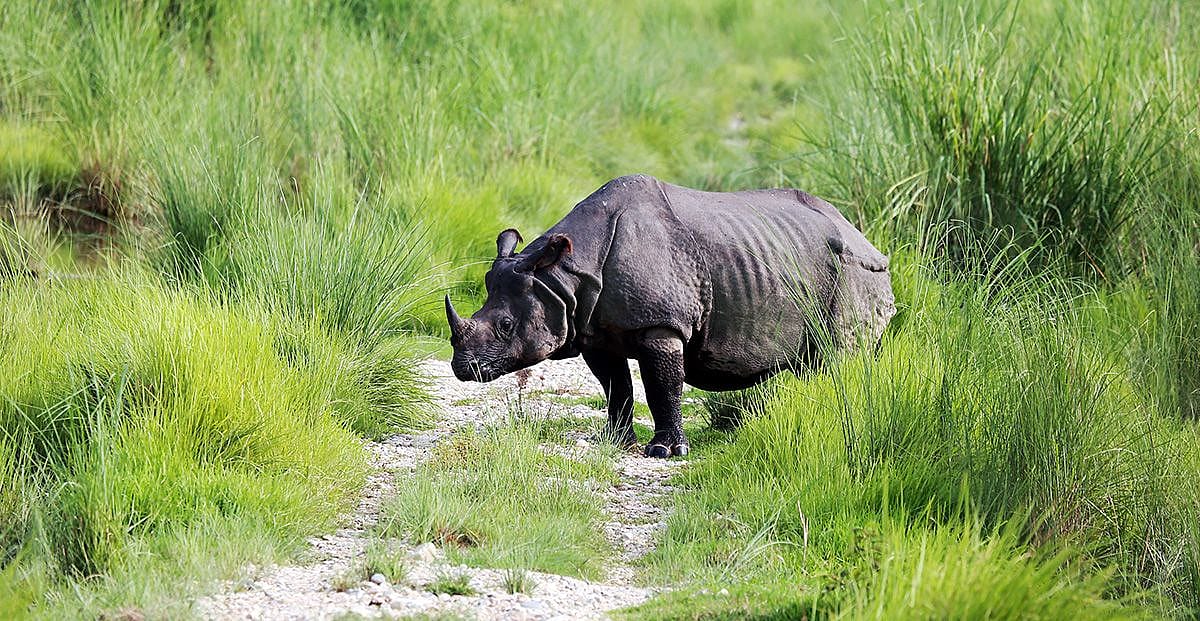
There’s a specific quality to Chitwan’s core zone at 5:30 AM that no photograph captures — the way mist clings to the elephant grass at exactly rhino height, and how a one-horned rhino materializes from it the way an optical illusion resolves, suddenly present and prehistoric. Private jeep safaris, where silence between you and the animals is actually maintained, consistently outperform shared ones. The park’s January to March grass-cutting season dramatically opens the grassland visibility, making these the highest-probability weeks for seeing the full cast: rhinos, sloth bears, gaur bison, spotted deer, and — on mornings that veterans talk about for years — a Bengal tiger at the treeline.
Go early, go private, go quiet.
2. Dugout Canoe Ride on the Rapti River
Best for: Anyone who wants wildlife without an engine between them and it
The traditional wooden canoe the Bote fishing community has used for generations on the Rapti is not a tourist vehicle. It’s the quietest possible entry into a river ecosystem where the animals have not yet calibrated their behavior around human presence the way they have around jeep engines. Gharials — the ancient, narrow-snouted crocodilians whose males develop a distinctive bulbous growth on the snout tip — bask on sandbanks three meters from the canoe without moving. Great hornbills cross overhead. Smooth-coated otters work the shallows. And along the elephant grass banks, where the tall stems press right to the water’s edge, a tiger at the shoreline is not a story someone else tells — it’s a documented possibility that experienced boatmen approach with genuine quiet.
Sunrise departures only. The river belongs to itself before 8 AM.
3. Guided Walking Safari Through Sal Forest and Grassland
Best for: Experiential trekkers, nature interpreters, those who want the jungle on its own terms
Walking Chitwan changes the sensory hierarchy entirely. In a jeep, you see. On foot, you hear first — the alarm bark of a spotted deer thirty seconds before the rhino appears, the sudden silence of birds that means something large and predatory is nearby, the specific crunch of your own footsteps that your guide is constantly calibrating against. Chitwan’s sal forest — which covers 70 percent of the park and produces leaves that Tharu families still use as festival plates — is densely layered, and the naturalists who guide walking safaris read it the way a musician reads a score. The elephant grass itself grows to eight meters in places, enclosing you in a tunnel of green that collapses your peripheral vision to a few feet in either direction. Walking through it is one of the most physically specific experiences Nepal offers.
Wear muted earth tones. Say less than you think is necessary.
4. Overnight Tower Stay Deep Inside the Park
Best for: The sleepless and curious, serious wildlife photographers, anyone who wants Chitwan’s actual darkness
Chitwan after the park gates close is a different country. The wooden towers positioned at prime wildlife corridors inside the park boundary offer no comfort amenities — a platform, a railing, a sleeping mat — and everything that matters: the sound of a rhino crossing the river at 2 AM, the distant contact call that identifies a tiger moving parallel to the grassland edge, the spectacle of dawn breaking over the Churia Hills while the mist lifts in slow columns from the grass below. Wildlife encounters from towers are not guaranteed in the way that jeep sightings are engineered. They’re witnessed. That distinction is everything.
Book months ahead. Tower permits are limited and October fills fast.
5. Birdwatching — Six Percent of the World’s Bird Species in One Park
Best for: Ornithologists, serious photographers, anyone who has ever looked at a kingfisher and wanted to see seventeen species of them
The numbers at Chitwan are genuinely staggering. Six hundred and forty-three recorded bird species. That figure represents more than six percent of all bird species on earth, concentrated in a park the size of a mid-sized county. Among them: the Bengal florican, one of the world’s most endangered bustards, which performs extraordinary vertical display flights in the breeding season that look like something between a magic trick and a malfunction. White-rumped and slender-billed vultures — both critically endangered globally, their populations decimated by a veterinary anti-inflammatory drug that contaminated cattle carcasses across South Asia. The giant hornbill, whose wingbeats sound like a slowly torn canvas. The sarus crane, the world’s tallest flying bird, which mates for life and whose paired calls carry across the grassland at dawn with an operatic specificity that stops conversation completely.
The canoe ride doubles as a birding session. Bring the proper binoculars.
6. Visit the Gharial Conservation and Breeding Centre at Kasara
Best for: Conservation advocates, families, anyone interested in extinction averted in real timeIn 1950, the Narayani River held approximately 235 wild gharials. By 2003, only 38 remained — animals that had been around since the Cretaceous, reduced to a remnant population by hunting, egg collection, dam construction, and fishing net entanglement. The Gharial Conservation and Breeding Centre, established at Kasara in 1978, collects eggs from the vulnerable sandy riverbanks, incubates them in controlled conditions, and raises hatchlings for six to nine years before releasing them into the Rapti and Narayani. The male gharial in the breeding pools, with the distinctive ghara — a bulbous nasal growth that amplifies vocalizations during courtship — is one of the most visually extraordinary animals you will encounter anywhere in Nepal. The conservation story here is ongoing and complicated: climate change is skewing egg sex ratios toward female, and the gharial’s future remains genuinely uncertain.
Ask your guide about the sex-ratio problem. It’s one of conservation biology’s current unsolved puzzles.
7. Beeshazar Lake: Nepal’s Only Ramsar Wetland Inside a National Park Buffer Zone
Best for: Birdwatchers, wetland ecologists, travelers who want Chitwan beyond the safari circuit
Beeshazar Tal — “the lake of 20,000” — is a 3,200-hectare oxbow lake system in Chitwan’s buffer zone that most itineraries skip entirely. Designated as a Ramsar Wetland of International Importance in 2003 and Nepal’s only Ramsar site inside a national park buffer zone, Beeshazar is a winter waterfowl concentration point of considerable significance — ruddy shelducks, bar-headed geese, and assorted diving ducks arrive from Central Asia in numbers that transform the lake’s surface into a working map of migration routes. The adjacent grasslands support swamp deer, and the wetland edges are one of Chitwan’s better locations for sighting the elusive Gangetic river dolphin in the channels that connect to the Narayani.
This requires a separate permit from Sauraha and is best arranged the day before.
8. Tharu Homestay at Barauli Village
Best for: Cultural immersion seekers, responsible tourism advocates, slow travelers
The Tharu people lived inside Chitwan’s forests for centuries, developing a genetic resistance to malaria that made this territory exclusively theirs until the 1950s. When the park was established and expanded, many Tharu communities were displaced — a history that makes the community-managed Barauli homestay, on the park’s western edge, something more than a cultural tourism offering. Staying with a Tharu family, eating meals cooked on a wood-fired chulo, waking to a courtyard painted with the geometric motifs that Tharu women have been applying to house walls for generations — it returns economic agency to a community that was removed from its land in the name of conservation. Your nightly fee goes directly to the household.
Ask your host about Chitwan before the park existed. The answer is a completely different history.
9. Jungle Tower Night Walk on the Buffer Zone Edge
Best for: Nocturnal wildlife hunters, the genuinely adventurous
Chitwan at night reveals the ecosystem that operates while the safari jeeps are parked. Indian flying foxes — megabats with one-meter wingspans — launch from roost trees in formations that momentarily block the stars. Indian civets move through the undergrowth with a specific sound your guide distinguishes from deer without slowing down. Nightjars call from the forest floor in a sound that ancient Terai communities associated with spirits, for entirely understandable acoustic reasons. And occasionally, at the edge of the torchlight, the paired yellow-green eyeshine of a leopard — an animal that uses the buffer zone edge with considerable regularity and has precisely zero interest in being identify
Long sleeves, repellent, close-toed shoes. No compromises.
10. Sunset at the Rapti-Narayani River Confluence
Best for: Photographers, couples, anyone willing to wait for a moment that earns the wait
Where the Rapti meets the Narayani at Amaltari Ghat, the scale of the water changes completely. The Narayani is Nepal’s third-largest river, originating in the high Himalayas and draining eventually into the Bay of Bengal, and at the confluence it moves with the weight of that entire journey. At sunset, the water turns copper and the Himalayan foothills in the north go pink in a sequence that reverses from what you expect — the distant peaks lighting before the foreground. Gangetic dolphins surface in the main channel. Egrets assemble on the sandbanks in numbers that suggest a meeting was called. The light lasts precisely long enough to understand why people travel specifically for it.
Arrange a canoe to the confluence rather than walking the bank. The perspective is entirely different from water.
What Chitwan Actually Requires From You
Staying two nights reveals Chitwan’s highlights. Staying three nights or four reveals its character — the morning a tiger crosses the road twenty meters ahead of the jeep, the afternoon when a gharial surfaces beside the canoe and you suddenly understand what prehistoric actually means applied to a living animal, the evening when the stick dance ends and the audience disperses into a village darkness lit only by cooking fires.
The difference between a Chitwan experience and a Chitwan memory is usually time. Give it more than the itinerary says you need. Plan Your Chitwan Visit with Getaway Nepal Adventure, Chitwan is one of those destinations where the quality of your guide determines whether you see the jungle or merely move through it. Getaway Nepal Adventure is a Kathmandu-based travel company registered with the Nepal Tourism Board, TAAN, and the Nepal Mountaineering Association, building Chitwan programs around specific traveler objectives — tiger tracking, ornithology, Tharu cultural immersion, or conservation-focused visits to the gharial and elephant breeding programs — rather than standard two-night packages that deliver the same experience to everyone. Accommodation selection, naturalist guide pairing, permit logistics, and transport from Kathmandu or Pokhara are handled entirely by the team. Your job is to show up ready to be surprised. Chitwan will take care of the rest.
Recent Posts