Everest Base Camp Trek Guide
Every year thousands of trekkers from over a hundred countries arrive at Lukla airport with a single destination in mind. Not the summit of Everest — that belongs to a different category of human ambition entirely — but the base camp at 5,364 metres, where the mountain fills the entire sky above you and the Khumbu Icefall grinds slowly downward in the silence and the air is so thin and so cold and so absolutely clear that every detail of the world around you seems to have been turned up to a resolution your eyes do not normally operate at.
This guide tells you everything you need to know before you get there. The real cost broken down line by line, an honest assessment of what the difficulty actually feels like on Day 8 when Gorak Shep is still ahead and your legs have been working for a week, the best season without the marketing language, and the day by day itinerary written by people who have walked this trail more times than they have counted.
What is the Everest Base Camp Trek
The Everest Base Camp trek is a 14 day journey through the Khumbu region of northeastern Nepal, beginning at Lukla airport at 2,860 metres and rising through the villages, forests, and high ridges of the Sagarmatha National Park to reach the base camp of the world’s highest mountain at 5,364 metres.
It is not a technical climb. There are no ropes, no crampons, no vertical faces to negotiate. It is a walk — a sustained, high altitude, physically demanding, visually extraordinary walk — through one of the most spectacular and culturally rich landscapes on the planet.
The trail passes through Sherpa villages where Buddhist monasteries have been conducting morning prayers since the 16th century. It crosses suspension bridges strung with prayer flags above roaring glacial rivers. It climbs to the ridge at Namche Bazaar where the first full view of Everest’s upper pyramid appears above the surrounding ridgeline and produces in almost every trekker the same involuntary response — a complete stopping of whatever thought was happening a moment before. It reaches Tengboche Monastery at 3,867 metres where the evening puja fills the prayer hall with chanting and the smell of butter lamps as the last light fades from Ama Dablam’s southwest face outside the window.
And it ends at base camp itself, on the lateral moraine of the Khumbu Glacier, where the mountain overhead is so large and so close and so real that the photographs you take there will spend the rest of their lives failing to communicate what standing in that place actually felt like.
The Khumbu Region
The Khumbu is not just a route to a mountain. It is a living cultural landscape where the Sherpa people have maintained a way of life shaped by high altitude Buddhism, seasonal yak herding, and a relationship with the mountains that predates Tenzing and Hillary’s 1953 ascent by centuries. Walking through it properly — slowly, with a guide who knows the villages and the monasteries and the families who run the tea houses — produces a depth of experience that no amount of pre-trek reading can substitute for.
Who Can Do the Everest Base Camp Trek
Any reasonably fit adult with good cardiovascular health and a genuine willingness to walk uphill for multiple days in succession. Previous trekking experience helps but is not a hard requirement. What matters more than fitness is pacing — the trekkers who struggle are almost always those who push too hard in the first four days and pay for it above 4,000 metres.
Everest Base Camp Trek Cost 2025
What Does the EBC Trek Cost
The Everest Base Camp trek costs between US$1,200 and US$2,500 per person for a fully guided package in 2025, depending on group size, service standard, flight costs, and inclusions.
Permit Costs
Sagarmatha National Park entry permit: NPR 3,000 (approximately US$22) per person
Khumbu Pasang Lhamu Rural Municipality entry fee: NPR 2,000 (approximately US$15) per person
TIMS card: NPR 2,000 (approximately US$15) per person
Total permit cost: approximately US$52 per person
Daily Costs on the Trail
Tea house accommodation per night: US$5 to US$20 depending on altitude
Meals per day: US$20 to US$35 above Namche
Hot shower: US$3 to US$5 per use
Device charging: US$2 to US$3 per charge
Wi-Fi (where available): US$5 to US$10 per day
Extra snacks and drinks: US$5 to US$15 per day
Flight Costs
Kathmandu to Lukla return flight: US$350 to US$450 per person
Helicopter alternative Kathmandu to Lukla: US$500 to US$700 per person one way
What a Standard Package Includes
A fully organized package from Getaway Nepal Adventure includes all domestic flights Kathmandu to Lukla and return, all tea house accommodation throughout the trek, three daily meals on trail, an experienced English speaking Sherpa guide, a porter shared between two trekkers, all permits and national park fees, a sleeping bag and duffle bag, comprehensive first aid kit, and welcome and farewell dinners in Kathmandu.
What Costs Extra
International flights to Kathmandu, Nepal visa fee (US$50 for 30 days), personal travel insurance with high altitude evacuation cover, alcoholic beverages, hot showers and charging fees, personal tips for guides and porters (US$10 to US$15 per day combined is standard), any activities outside the stated itinerary, and emergency helicopter evacuation if required.
Day by Day Itinerary
Day 1 — Arrival in Kathmandu (1,400m)
Land at Tribhuvan International Airport and transfer to your hotel in Thamel. Your guide meets you for an evening briefing — permits, gear check, altitude protocols, and what the next fourteen days will actually look like on the ground. Welcome dinner. Sleep early.
Day 2 — Fly Kathmandu to Lukla, Trek to Phakding (2,651m) | 3 to 4 hours
The flight to Lukla is 35 minutes of mountain scenery followed by one of the most discussed airport landings in the world — a short runway on a steep hillside that ends at a wall. The aircraft touches down, the engines reverse hard, and you are in the Khumbu. The first afternoon’s walk to Phakding is gentle and beautiful — pine forest, suspension bridges, the Dudh Koshi river loud in the gorge below.
Day 3 — Phakding to Namche Bazaar (3,440m) | 5 to 6 hours
The trail crosses and recrosses the river on suspension bridges hung with prayer flags, rises through Monjo and the national park entrance checkpoint, and then climbs steeply for two hours through pine forest to Namche Bazaar. The town appears around a corner in the hillside like something that was not supposed to be there — a full trading town built into a natural bowl in the mountain, brightly painted lodges and bakeries and gear shops arranged in tiers above the valley floor. And above the northeastern ridge, for the first time, the upper pyramid of Everest appears between the surrounding peaks. Most trekkers stop walking when they see it.
Day 4 — Acclimatisation Day in Namche Bazaar (3,440m)
Namche is where the trek teaches patience. The body needs time at this altitude before continuing upward and the standard protocol is a rest day that is not entirely a rest — a short hike to the Everest View Hotel at 3,880 metres for acclimatisation and the most photographed mountain view in the Khumbu, followed by an afternoon of proper rest. Visit the Sherpa Culture Museum. Eat at one of the Namche bakeries that has somehow mastered cinnamon rolls at altitude. Sleep low, acclimatise high.
Day 5 — Namche to Tengboche (3,867m) | 5 to 6 hours
The trail from Namche rises through rhododendron forest with Ama Dablam, Everest, Nuptse, and Lhotse all visible ahead — a mountain panorama that the trail reveals gradually over several hours of walking rather than all at once, which turns out to be considerably more effective than any single viewpoint. Tengboche Monastery at the top of the climb is the spiritual heart of the Khumbu — the evening puja, if your timing is right, puts you inside a prayer hall lit by butter lamps with the chanting of monks filling the room and the silhouette of Ama Dablam visible through the window outside.
Day 6 — Tengboche to Dingboche (4,410m) | 5 hours
The landscape changes above Tengboche. Trees disappear. The valley opens into a wider, more exposed terrain of juniper scrub and yak pasture and dry stone walls marking grazing boundaries that have been maintained since before anyone wrote anything down about them. Dingboche sits at the junction of two valleys with views of Makalu, Island Peak, and the east face of Lhotse that are impossible to look at casually.
Day 7 — Acclimatisation Day in Dingboche (4,410m)
Second acclimatisation day. A morning hike to the ridge above Dingboche at around 5,000 metres for altitude adjustment, followed by rest and hydration. The view from the ridge in clear conditions covers Makalu, Baruntse, Ama Dablam, Thamserku, and the entire Khumbu valley system — five of the world’s fourteen 8,000 metre peaks visible simultaneously.
Day 8 — Dingboche to Lobuche (4,940m) | 5 hours
The trail passes the Thukla memorials — a high ridge covered in stone cairns and memorial chortens built for climbers who died on Everest and the surrounding peaks. The names carved into the stones read like a who’s who of Himalayan mountaineering history. It is a sombre and important place to spend time with before continuing to Lobuche, where the altitude begins to make itself felt in the way that extra effort and thin air combine to produce a specific kind of tiredness that sleep does not completely resolve.
Day 9 — Lobuche to Gorak Shep, Trek to Everest Base Camp (5,364m) | 7 to 8 hours
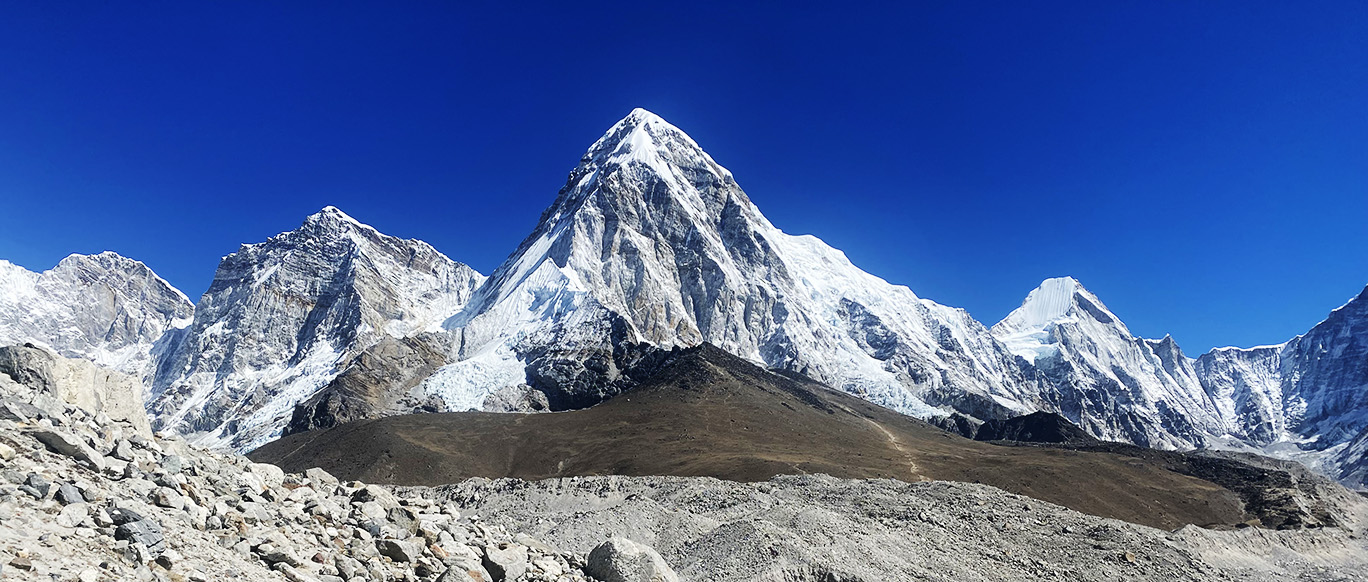
The longest and highest day of the trek. The trail from Lobuche crosses the lateral moraine of the Khumbu Glacier — a landscape of rock and ice that has no vegetation and very little oxygen and looks, in the flat grey light of early morning, like something assembled by geological forces rather than anything shaped for human use. Gorak Shep at 5,164 metres is the last tea house stop. Drop your pack and continue to base camp.
The base camp itself sits at the foot of the Khumbu Icefall — a frozen cascade of blue and white seracs and crevasses that the mountain sheds slowly downward at a rate of about a metre per day. The tents of the spring climbing season are visible in April and May, coloured dots against the ice and rock. The mountain overhead is so large that it stops being a mountain and becomes something closer to weather — a feature of the sky rather than a feature of the ground. Stand here for as long as the cold allows. Return to Gorak Shep for overnight.
Day 10 — Gorak Shep to Kalapathar, Descend to Pheriche (4,371m) | 6 to 7 hours
Rise before dawn for the climb to Kalapathar at 5,545 metres — the rocky viewpoint above Gorak Shep that delivers the single most famous view of Everest available anywhere without a rope. The mountain is close enough at this distance and this angle that the individual features of the upper face — the Hillary Step, the Southeast Ridge, the summit plume — are all distinguishable in clear conditions. Watch the sun hit the summit. Then descend all the way to Pheriche for overnight. The body will notice the drop in altitude within an hour and the appreciation will be immediate.
Day 11 — Pheriche to Namche Bazaar (3,440m) | 6 to 7 hours
A long descent through Tengboche and the rhododendron forest back to Namche. The legs that climbed this trail eight days ago are considerably more competent now and the pace reflects it. The bakeries of Namche have never looked more appealing.
Day 12 — Namche Bazaar to Lukla (2,860m) | 6 to 7 hours
Final day on the trail. The familiar suspension bridges and pine forest sections pass differently on the way down — faster, easier, and full of the particular warmth that comes from recognising places you struggled through on the way up and finding them effortless on the way back. Lukla arrival and farewell dinner with your guide and porter.
Day 13 — Fly Lukla to Kathmandu (1,400m)
Morning flight back to Kathmandu — 35 minutes during which the Khumbu shrinks beneath you and the city appears ahead and the whole fourteen days compresses into a series of images that will keep rearranging themselves in your memory for years. Farewell dinner in Thamel. Hot shower that runs properly. A bed that does not require a sleeping bag.
Day 14 — Departure from Nepal
Transfer to Tribhuvan International Airport for onward departure. The trek is over. The conversations about it are just beginning.
Best Time to Visit
Autumn — October and November
The best season for the Everest Base Camp trek. Skies are clear after the monsoon, visibility is exceptional, temperatures are cold but manageable, and the trail is dry and firm underfoot. October is the busiest month on the entire Khumbu trail network and the tea houses at Namche and above fill quickly — booking accommodation in advance is strongly recommended.
Pros: Best visibility, stable weather, dry trails, full mountain views
Cons: Busiest season, accommodation fills fast, slightly higher costs
Spring — March to May
The second best season and the one that produces the most dramatic photographs. Rhododendron forests below Namche bloom in red and white and pink from late March through April, the air has a freshness that autumn does not quite replicate, and the energy of the climbing season — dozens of expeditions moving through the Khumbu toward their respective base camps — adds a dimension to the atmosphere that the rest of the year lacks.
Pros: Stunning flowers, climbing season atmosphere, good visibility
Cons: Busier than winter, occasional afternoon cloud, pre-monsoon instability in May
Winter — December to February
Cold, quiet, and genuinely beautiful. Snow above 4,000 metres is consistent and the temperatures at Gorak Shep drop to minus 15 or below at night. The reward is near empty tea houses, considerably lower costs, and a quality of solitude on the trail that the peak seasons cannot offer. Experienced trekkers with proper cold weather gear often prefer this season.
Pros: Empty trails, lower costs, pristine snow landscape
Cons: Extreme cold at altitude, some tea houses closed, restricted visibility on cloudy days
Monsoon — June to August
Not recommended for the standard EBC route. Heavy rainfall, persistent low cloud, leeches on the lower trail sections, and a high probability of trail damage from landslides combine to make this the one season the Khumbu is best appreciated from a distance.
Difficulty Level
The Everest Base Camp trek is rated moderately difficult to strenuous.
The combination of altitude, daily walking hours, and the cumulative physical demand of fourteen days on the trail places this in a different category from the Annapurna Base Camp trek, which reaches a lower maximum altitude over fewer days. The primary challenge is not the individual day’s difficulty but the sustained effort required across two weeks at progressively higher altitude.
Daily walking hours range from three on the Lukla arrival day to eight on the base camp push from Gorak Shep. The trails are well marked and maintained throughout. The ascent is gradual enough to allow acclimatization with the built-in rest days, but pushing through altitude symptoms rather than responding to them appropriately is the single most common cause of premature trek endings.
Fitness preparation should begin six to eight weeks before departure. Cardiovascular fitness matters more than raw strength — long walks with elevation gain, stair training, and sustained aerobic exercise will serve you better than gym work.
Permits Required
Sagarmatha National Park Entry Permit: NPR 3,000 (approximately US$22). Available at Nepal Tourism Board offices in Kathmandu and at the national park entrance in Monjo.
Khumbu Pasang Lhamu Rural Municipality Entry Fee: NPR 2,000 (approximately US$15). Collected at the checkpoint in Lukla.
TIMS Card (Trekkers Information Management System): NPR 2,000 (approximately US$15). Available at Nepal Tourism Board offices in Kathmandu and Pokhara.
All three documents must be carried and are checked at multiple points on the trail. Getaway Nepal Adventure handles all permit applications as part of the package service.
Accommodation on the Trail
Tea House Standards by Altitude
Lukla to Namche (2,860m to 3,440m): Comfortable tea houses with twin share rooms, attached or shared bathrooms, hot water, reliable Wi-Fi, and dining rooms that serve a surprisingly broad menu. This section of the trail has been hosting trekkers for decades and the infrastructure reflects it.
Namche to Tengboche (3,440m to 3,867m): Well established lodges with private rooms, basic but clean bathrooms, hot showers available at extra cost, and the famous Namche bakeries within walking distance. Tengboche’s tea houses sit directly beside the monastery with mountain views from the dining room windows.
Dingboche to Gorak Shep (4,410m to 5,164m): Simpler accommodation as altitude increases. Rooms are small and basic, bathrooms are shared, heating is limited or absent, and the temperature inside the tea house after dark reflects the temperature outside. Thick blankets and a good sleeping bag are both necessary. The food remains adequate and hot throughout.
Food and Nutrition
The Khumbu trail is justifiably famous for the quality of its tea house food relative to the altitude at which it is prepared.
Dal bhat — the Nepali staple of lentil soup with rice, vegetables, pickle, and papad — is available everywhere, genuinely nutritious, and refillable without extra charge, which matters considerably above 4,500 metres when the body is burning calories faster than most people expect. Pasta, fried rice, noodle soup, pizza (genuinely acceptable in several Namche establishments), eggs in every format, pancakes, porridge, Tibetan bread, and fresh baked goods appear on most menus below 4,000 metres. Above Dingboche the options simplify but the portions remain substantial.
Hydration is the single most important nutritional variable at altitude. A minimum of three to four litres of water per day is recommended above 4,000 metres. Carry water purification tablets or a filter system. Packaged water is available throughout the trail but contributes to plastic waste that the Khumbu does not need more of.
Carry personal snacks — energy bars, nuts, dried fruit, chocolate — for the days above Dingboche where appetite often decreases just as caloric demand increases.
What is the cost of the Everest Base Camp Trek in 2025?
The Everest Base Camp trek costs between US$1,200 and US$2,500 per person for a fully guided package including permits, flights, accommodation, meals, guide, and porter. Budget independent trekkers can expect to spend US$700 to US$1,000 excluding international flights and Kathmandu costs. Permits alone cost approximately US$52 per person.
Frequently Asked Questions
How difficult is the Everest Base Camp trek?
The trek is rated moderately difficult to strenuous. The primary challenge is sustained high altitude over fourteen days rather than any single technical section. Daily walks of three to eight hours on well marked trails with no climbing equipment required. Cardiovascular fitness preparation six to eight weeks before departure is strongly recommended.
Do I need a guide for the Everest Base Camp trek?
A guide is not legally mandatory but is strongly recommended and practically essential. Above Namche the altitude, the weather variability, and the medical risks of high altitude trekking make an experienced licensed guide a genuine safety asset rather than a convenience. Guides also provide cultural context, accommodation management, and emergency coordination that solo trekkers cannot replicate.
How long does the Everest Base Camp trek take?
The standard itinerary runs 14 days from Kathmandu to Kathmandu including two domestic flights. A 12 day version is possible but reduces acclimatization time and increases altitude sickness risk above 5,000 metres. Extending to 16 days adds an optional Kalapathar sunrise day and more buffer against weather delays at Lukla.
What permits do I need for the Everest Base Camp trek?
Three permits are required: the Sagarmatha National Park entry permit, the Khumbu Pasang Lhamu Rural Municipality entry fee, and the TIMS card. Combined cost approximately US$52 per person. All are handled by Getaway Nepal Adventure as part of the organized package.
What should I do if I get altitude sickness on the trek?
Descend immediately. Do not sleep at an altitude higher than where symptoms began. Mild symptoms including headache and reduced appetite respond to rest and hydration. Severe symptoms including confusion, inability to walk straight, or fluid in the lungs require immediate descent and emergency evacuation. Your guide carries medication and emergency protocols for all altitude related scenarios. Never ascend with active symptoms.
Is the Everest Base Camp trek worth it?
Every year thousands of trekkers who complete the route describe it as the single most significant journey of their lives. Not because it is the hardest thing they have done but because the combination of landscape, culture, physical achievement, and the specific quality of being genuinely small in the presence of something genuinely enormous produces an experience that stays with people in a way that most travel does not.
Conclusion
The Everest Base Camp trek is not the hardest thing you will ever do. It is not the most remote or the most technically demanding or even the highest altitude trek available in Nepal. What it is, without qualification, is the most complete mountain journey available to a non-technical trekker anywhere in the world.
Fourteen days that move you from a city of 1.4 million people through one of Asia’s most extraordinary cultural landscapes to the foot of the highest point on earth and back — with a guide who knows every kilometre of it, tea houses that have been feeding trekkers for fifty years, and a mountain at the end that has been there for sixty million and intends to be there for sixty million more.
The cost starts at US$1,200. The memory has no ceiling.
Contact Getaway Nepal Adventure to begin planning your Everest Base Camp trek today.
Note:
This guide is written and maintained by the team at Getaway Nepal Adventure, a Kathmandu based trekking operator. Every route, cost figure, and practical recommendation in this guide reflects current firsthand knowledge of the trail, updated seasonally. Last updated: 2026 April.
Recent Posts