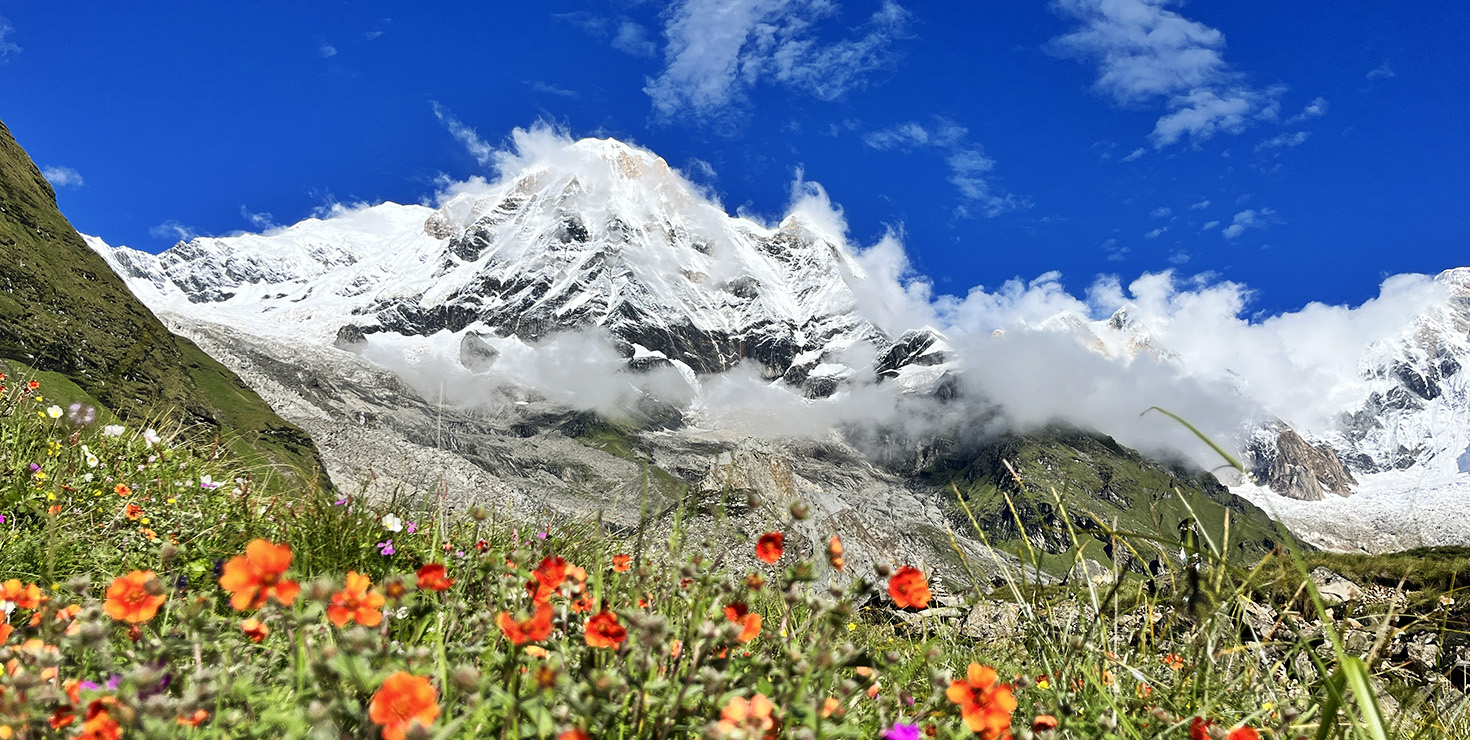
Crowd Free Trekking Routes in Nepal
Walk Where the Trail Still Belongs to You
Nepal has a trekking problem that nobody likes to talk about. Every autumn, thousands of trekkers flood the same handful of routes. Everest Base Camp feels like a queue at a theme park. The Annapurna Circuit has tea houses that run out of beds. You planned a Himalayan adventure, not a guided procession.
Here’s what most people don’t realize: Nepal has over 50 established trekking routes, and most of them see a fraction of the foot traffic. Some of the most spectacular terrain on earth sits completely untouched because travelers stick to what they’ve heard of. That’s their loss, and your opportunity.
But Nepal is enormous. It has dozens of trekking routes that see a fraction of the footfall yet deliver everything that draws people here in the first place: views of the highest mountains on the planet, authentic village life, ancient Buddhist and Hindu culture, rhododendron forests, and the kind of silence that genuinely resets something in you. Many of these routes are perfectly doable in 5 to 10 days, requiring no technical climbing experience, and are accessible to trekkers of most age groups and fitness levels.
This guide covers some of the best crowd free trekking routes in Nepal, with enough detail to help you understand what each trek actually involves, who it suits, and why it’s worth the trip.
Getaway Nepal Adventure specializes in these hidden corridors. Routes where you walk into a village and the children stare because foreign trekkers are still a novelty. Places where the teahouse owner knows your name by dinner and the mountains rise so close you’d swear you could reach them. Below are the routes worth trading the crowded trail for.
Why Choose a Less Crowded Trek in Nepal?
Before diving into the routes, it’s worth understanding what you’re gaining by stepping off the beaten path.
On the popular circuits, infrastructure has expanded to meet demand. That’s convenient, but it also means teahouses that function like budget hotels, trails that feel like commuter routes in October, and villages that have partly reorganized themselves around tourism. It’s still a great experience, but it’s not the Nepal that exists deeper in.
On the routes covered here, you walk for entire days without seeing another foreign trekker. Teahouses are run by the families who live there. Villages feel like villages, not waypoints. Mountain views aren’t framed by a crowd of down jackets. And locals, because they see fewer visitors, tend to be genuinely curious and hospitable rather than professionally courteous.
There’s also the practical upside: availability. You don’t need to book teahouses weeks in advance, guides are easier to arrange, and the trails feel uncongested even in peak season.
1. Mohare Danda Trek (4 to 8 Days)
Best for: Families, beginners, older trekkers, first-time visitors to Nepal
Maximum altitude: 3,300 m (10,827 ft)
Difficulty: Easy to moderate
Region: Annapurna
If the Ghorepani Poon Hill trek is Nepal’s most popular short walk, Mohare Danda is its quieter, more rewarding twin. The trail sits just southwest of Poon Hill, tucked between the Annapurna and Dhaulagiri ranges, and it delivers nearly identical mountain views with far fewer people on the path.
At an altitude of 3,300 m above sea level and protected under the Annapurna Conservation Area, Mohare Danda is an easily accessible viewpoint that offers a unique tapestry of culture and tradition through typical Himalayan settlements including Ghandruk, Bans Kharka, Nangi, and Mohare Danda itself.
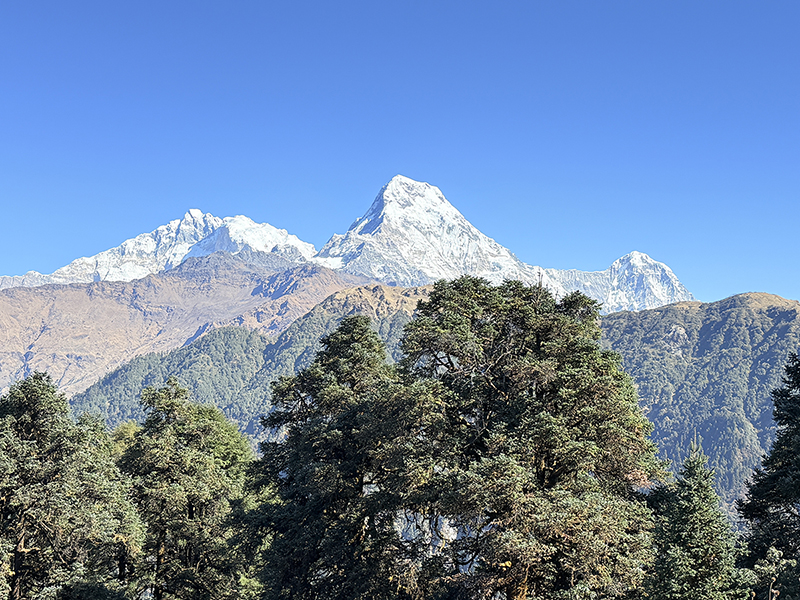
The mountain panorama from the summit is genuinely outstanding. From Mohare Danda there’s a near mirage-like view of giant peaks including Dhaulagiri, Fishtail, Tukuche Peak, Annapurna South, Annapurna I, and Nilgiri. On clear mornings you can see as far as the Manaslu range.
What makes Mohare Danda distinct from other short treks is its community ethos. The trek was initiated by Mahabir Pun, who used wireless technology to foster development in remote Annapurna villages. All lodges are community-based or homestays, and the proceeds support local schools, health posts, and infrastructure. Staying here means your money goes directly into the communities you’re walking through.
The trail passes through Magar and Gurung settlements where traditional culture is very much intact. You’ll encounter trekking through dense forests of rhododendron, pine, and oak, with opportunities to spot barking deer, yellow-throated martens, and Himalayan Langurs along the route.
The trek is suitable for all ages, including beginner and retired trekkers. It can be done in winter since the maximum altitude is only 3,300 m, making it accessible throughout the year.
The shortest version is doable in 4 days out of Pokhara. Extended itineraries of 7 to 8 days incorporate the Ghandruk village loop and Poon Hill, giving you two of the Annapurna region’s best viewpoints in a single trip with almost no overlap with the main crowds.
Practical info: No restricted area permit needed, just a standard Annapurna Conservation Area permit and TIMS card. Trekking agencies in Pokhara can arrange guides at short notice. Costs for a guided 8-day package typically run USD 350 to USD 500 per person.
2. Pikey Peak Trek (6 to 9 Days)
Best for: Everest region seekers, families, moderate fitness trekkers
Maximum altitude: 4,065 m (13,335 ft)
Difficulty: Moderate
Region: Solukhumbu (Lower Everest)
Most people who want to see Everest fly into Lukla and join the well-trodden Everest Base Camp trail. Pikey Peak offers a completely different approach to the same mountain range. It sits in the lower Solukhumbu region of eastern Nepal, accessible by road from Kathmandu, and it offers views that Sir Edmund Hillary himself reportedly called his favorite Everest panorama.
Before dawn on the summit day, you climb to Pikey Peak at 4,065 m to witness one of the most breathtaking Himalayan panoramas available anywhere. As the sun rises, the peaks of Everest, Kanchenjunga, Makalu, Lhotse, and Annapurna glow golden against the morning sky.
The fact that this viewpoint is better than most alternatives on the EBC route, yet sits well below the altitude of Lukla, makes Pikey Peak one of Nepal’s most underrated treks. The trail passes through dense forests, charming villages, and sprawling farmlands, and is relatively easy to complete in five to seven days, making it ideal for both seasoned trekkers and first-timers.
You’ll trek through lush rhododendron forests, visit beautiful Sherpa villages, meet friendly mountain people, and experience breathtaking landscapes with snow-capped mountain views on a less crowded route that still delivers a great trekking experience.
A highlight beyond the summit views is the ancient monastery of Thupten Choling, a significant Buddhist religious site in the Solu region that most EBC trekkers never encounter.
The route typically starts with a long jeep ride from Kathmandu to Dhap (around 7 to 8 hours), then three to four days of trekking to the peak, and a return via Junbesi and Phaplu. The best part of the Pikey Peak Trek is the low-altitude overnight stays, with trekkers spending nights below 4,000 m and making a day hike to the summit, then descending to lower elevations to sleep. This means altitude sickness risk is much lower than on the Everest Base Camp trail.
Practical info: You need a Sagarmatha National Park entry permit and TIMS card. Teahouses normally serve both local and traditional foods. Hiring a guide is not strictly required but is recommended for safety and cultural insight. Total package costs with guide and porter run approximately USD 500 to USD 800 per person for 7 to 9 days.
3. Tamang Heritage Trail (7 to 10 Days)
Best for: Culture seekers, family groups, trekkers based in Kathmandu
Maximum altitude: 3,165 m (10,383 ft)
Difficulty: Moderate
Region: Langtang
The Tamang Heritage Trail is one of the closest multi-day treks to Kathmandu and one of the most culturally rich in the entire country. It runs through the Langtang National Park along the Tibetan border, passing through traditional Tamang villages where the architecture, religion, language, and daily rhythms have been shaped over centuries by both Nepali and Tibetan influences.
The trail blends authentic cultural experiences with pristine natural landscapes. From interacting with villagers to trekking through serene valleys, the journey provides a meaningful and immersive Himalayan adventure that highlights both the heritage and environment of the region.
Key stops on the trail include Gatlang, a stunning stone-house village at 2,238 m considered the cultural heart of the route; Tatopani, famous for its natural hot springs; Thuman, a traditional Tamang village with Tibetan-style houses and ancient monasteries; and Briddim, where homestays allow you to sleep in local homes and share meals with Tamang families.
The region is home to diverse wildlife including leopards, red pandas, musk deer, and black bears. The forest is predominantly rhododendron but also supports a variety of birds and butterflies. One of the highlights is the natural hot spring pool at Tatopani, known for its soothing properties.
The trail is less crowded than the Langtang Valley and Gosaikunda Lake treks. During peak trekking seasons, those two routes carry excessive tourist traffic, but the Tamang Heritage Trek trail remains quiet even in the busy season.
The maximum altitude of 3,165 m at the Nagthali viewpoint means this trail is accessible to trekkers of all fitness levels, including older adults and families with teenagers. The altitude sickness risk is low, and the trail never involves technical terrain.
Since the Tamang Heritage Trail is among the moderately difficult treks, it is also suitable for any family with children and is perfect for those wanting a less crowded trail.
Practical info: Required permits are a Langtang National Park entry permit and TIMS card, both easily arranged in Kathmandu. The trail is accessible year-round, though spring and autumn offer the clearest mountain views. Package costs typically run USD 600 to USD 900 for 8 to 10 days.
4. Tsum Valley Trek (10 to 14 Days)
Best for: Culture and spirituality seekers, experienced trekkers
Maximum altitude: 3,700 m at Mu Gompa (with passes up to 5,093 m for extended routes)
Difficulty: Moderate to challenging
Region: Manaslu (Gorkha district)
Tsum Valley was closed to outsiders until 2008. That’s part of the reason it still feels like a place outside of time. This sacred Himalayan valley in northern Gorkha borders Tibet and is inhabited by the Tsumba people, a community with deep roots in Tibetan Buddhism whose customs, architecture, and spiritual practices have remained largely unchanged for centuries.
Tsum Valley is considered a magnificent and wonderful spiritual land by Buddhists. It is filled with monasteries and chortens reflecting their centuries-old culture, and the area is closely influenced by Tibetan culture, which is visible in prayer flags, stone houses, and the way of life of the local people.
The trail takes you through a series of extraordinary villages and religious sites. Mu Gompa, believed to have been established by Padmasambhava, sits at 3,700 m and serves as the spiritual center of the valley. Milarepa’s meditation cave, ancient mani walls at Dzong and Phurbe, and the nunnery at Rachen Gompa are among the most compelling stops.
Along with beautiful mountain views of Ganesh Himal, Siringi Himal, and Boudha Himal, this hidden and tranquil valley is full of ancient art, cultures, traditions, and religions. The altitude of the trekking trail varies from about 1,903 m at the valley entrance to over 5,000 m at the Nagula pass near the Tibetan border.
No solo trekking is allowed in Tsum Valley as it is classified as a Restricted Area. A licensed trekking guide and at least two trekkers are required for permit approval. The permit requirement keeps crowds down and preserves both the culture and the environment.
There are no specific age restrictions, but trekkers should be in good physical condition. Accommodation includes basic teahouses and lodges, with some homestays available in local villages. Daily walking averages 5 to 6 hours on moderate terrain.
This is not a trek for those in a rush. The depth of the cultural experience comes from time spent in villages, visiting monasteries, and sitting with locals. The best itineraries build in full rest days at key points.
Practical info: Permits required include the Tsum Valley Restricted Area Permit (USD 30 to 40 per week depending on season) and the Manaslu Conservation Area Permit (USD 30 for non-SAARC nationals). Total guided package costs run USD 800 to USD 1,400 for 12 to 14 days.
5. Nar Phu Valley Trek (12 to 16 Days)
Best for: Experienced trekkers, wilderness seekers, those wanting Tibetan cultural immersion
Maximum altitude: 5,320 m at Kang La Pass
Difficulty: Moderate to challenging
Region: Annapurna (Manang district)
Nar Phu Valley was opened to foreign trekkers in 2003 and has remained deliberately restricted ever since, requiring special permits and a mandatory licensed guide. The result is one of the most pristine, crowd-free trekking environments anywhere in the Himalayas. Nar Phu Valley trek offers a rare opportunity to explore wild and unspoiled valleys with a unique mix of raw Himalayan nature and ancient Buddhist culture.
The trail branches off the Annapurna Circuit at Koto and heads north through a narrow, darkening gorge toward an ancient landscape that most trekkers on the main circuit never see. The terrain is relatively gentle on approach but long, with mesmerizing views and increasing elevation. After several hours of trekking through crumbling cliffs and sculpted rock formations, you finally reach Phu Village perched dramatically on a ridge, surrounded by towering peaks and traditional stone houses.
Phu, at 4,250 m, is one of the most remote inhabited villages in Nepal. The village houses ancient Buddhist monasteries, some dating back over a thousand years. Locals wear traditional woolen chubas and intricate Topi hats. Throughout the year, vibrant festivals like Mani Rimdu breathe life into the valley.
From Phu, the trail continues to Nar village before the defining challenge of the trek: crossing Kang La Pass at 5,320 m. Kang La Pass stands as one of the most dramatic and rewarding highlights of the trek. It serves as a natural gateway between the hidden valleys of Nar and the popular Annapurna region. As you approach the top, prayer flags flutter in the wind and an unforgettable panorama of Himalayan giants unfolds: Annapurna II, Gangapurna, Tilicho Peak, Pisang Peak, and the surrounding Damodar Himal.
The Kang La crossing connects to the main Annapurna Circuit near Ngawal, making it possible to combine Nar Phu Valley with a partial Annapurna Circuit for a truly comprehensive Himalayan journey.
About 300 people live in the Nar Phu Valley and are dependent on cattle. In contrast to many other Tibetan-influenced communities whose trading patterns changed significantly after Nepal closed its border with Tibet, the residents of Nar and Phu were among the least affected by this development, maintaining a more intact traditional way of life.
Practical info: The restricted area permit costs USD 100 per week in peak season (September to November) and USD 75 from December to August, plus the Annapurna Conservation Area permit and TIMS card. A minimum of two trekkers and a licensed guide are required. Package costs run USD 650 to USD 1,250 depending on services. Prior high-altitude trekking experience is strongly recommended.
6. Ruby Valley Trek (7 to 10 Days)
Best for: Moderate trekkers, gem and geology enthusiasts, those wanting Tamang and Gurung culture Maximum altitude: 3,850 m at Pansang La Pass Difficulty: Moderate Region: Ganesh Himal (Rasuwa and Gorkha districts)
The Ruby Valley Trek is an isolated and less-known trekking destination in the Ganesh Himal Region. Named after the precious stones found in the area, the trek offers stunning views of the Ganesh Himal, Langtang, and Manaslu ranges. This moderately challenging trek includes a mix of terraced forests and mountain ridges. You’ll trek through lush green valleys and climb to Pansang La Pass for panoramic views.
The Ganesh Himal lies directly between the Manaslu and Langtang ranges and is one of the great unknowns of Nepalese trekking. With stunning mountain scenery, attractive and welcoming villages, hot springs, waterfalls, and a genuine sense of being well off the beaten track, the Ganesh region has a bit of everything except crowds of other trekkers.
The trail passes through traditional Tamang and Gurung villages where the culture has been shaped by both Tibetan Buddhist tradition and indigenous Nepalese customs. Gatlang village, also a key stop on the Tamang Heritage Trail, appears on this route as well, providing warm community hospitality and a window into local life.
What makes Ruby Valley particularly compelling is the geology. The area around Ganesh Himal contains deposits of ruby and other gemstones, and the landscape itself reflects this with dramatic colorful rock formations and high alpine terrain that feels genuinely remote.
A handful of homestays and trekking lodges have started to open in the Ganesh region, but for now the trails are still largely empty. This is a trek that rewards those who get there before it becomes well-known.
The maximum altitude of 3,850 m at Pansang La Pass is manageable for trekkers with moderate fitness and no prior high-altitude experience, though some physical preparation before arrival is always worthwhile.
Practical info: Standard permits (TIMS and Langtang National Park or local area permits) are required. This route can be arranged as a camping trek or, increasingly, as a teahouse trek since lodges are developing along the trail. Package costs run USD 600 to USD 900 for 7 to 10 days.
Best Time to Trek These Routes
Spring (March to May) and autumn (September to November) are the standard best seasons for trekking in Nepal. Spring brings rhododendron forests in full bloom and manageable temperatures. Autumn delivers the clearest mountain views, crisp air, and stable weather.
For crowd-free treks specifically, autumn is the stronger choice. Even on less popular trails, spring draws more trekkers because it coincides with the global trekking calendar. October and November in particular offer the best combination of clear skies and cool temperatures.
Winter trekking (December to February) is viable on lower-altitude routes like Mohare Danda and the Tamang Heritage Trail. Trails are very quiet, mountain views can be exceptional on clear days, and accommodation costs drop. The trade-off is cold temperatures, occasional snow on higher sections, and some teahouses closing.
Monsoon (June to August) is generally not recommended for most of these routes due to slippery trails, leeches at lower altitudes, and restricted mountain visibility. Nar Phu and the Trans-Himalayan routes above the main Himalayan range, however, receive less monsoon precipitation and can be trekked in summer.
Permits and Regulations: What You Need to Know
Permit requirements vary significantly across these routes. Here’s a quick summary:
Mohare Danda and Pikey Peak require only standard permits (ANNAPURNA Conservation Area or Sagarmatha National Park permit, plus TIMS card), which are affordable and easy to obtain in Kathmandu or Pokhara.
The Tamang Heritage Trail requires a Langtang National Park permit and TIMS card, both straightforward to arrange.
Tsum Valley and Nar Phu Valley are restricted areas. Both require special restricted area permits obtainable only through registered trekking agencies, and both mandate a minimum group of two trekkers and a licensed guide. This is what keeps these trails genuinely crowd-free, and why they remain so well-preserved.
Ruby Valley sits in an intermediate category requiring standard plus some local permits depending on the exact route taken.
All permits for restricted areas must be arranged before you leave Kathmandu. Any reputable trekking agency will handle this as part of their package.
Practical Tips for Crowd Free Trekking in Nepal
Book through a local agency. For restricted area treks especially, a registered Nepali trekking agency is legally required and practically essential. Local guides also provide a depth of cultural knowledge that’s impossible to replicate with a guidebook.
Hire a porter. A porter carries your load, earns a meaningful income, and genuinely changes your experience on the trail. Most trekkers who hire one say they’d never go without one again.
Pack a water purification system. On remote routes, clean water may not be available for purchase. A filter bottle or purification tablets are essential.
Carry cash. ATMs don’t exist on any of these trails. Bring enough Nepali rupees for your expected expenses plus a reasonable buffer. Teahouses increasingly accept cards at lower-altitude starting points, but cash is still king on the trail.
Get travel insurance that covers high-altitude evacuation. For any trek above 4,000 m, helicopter evacuation insurance is non-negotiable. It’s inexpensive relative to what an emergency evacuation actually costs.
Start your fitness preparation early. You don’t need to be an athlete for any of these treks, but regular walking with a loaded pack for several weeks before departure will significantly improve your enjoyment on the trail.
Why Now Is the Right Time to Book
Nepal’s trekking infrastructure is growing steadily. Routes that are genuinely crowd-free today won’t stay that way forever. Nar Phu Valley, Ruby Valley, and Tsum Valley in particular are at a stage where teahouses are improving, trail conditions are well-maintained, and visitor numbers are still very low. These are the conditions that define the ideal window for an off-the-beaten-path trek: accessible enough to be comfortable, remote enough to feel real.
The Pikey Peak and Mohare Danda trails are further along in their development, which means slightly more infrastructure and easier logistics, but still a fraction of the foot traffic on the main circuits.
All six routes offer something the Everest and Annapurna crowds can’t: the sensation of walking through a landscape that hasn’t arranged itself around you. The villages, the people, the rhythms of daily life, they all continue as they would whether or not you arrived. That’s the experience that brings people back to Nepal again and again, and it’s still very much available if you know where to go.
Why Book with Getaway Nepal Adventure
Nepal’s restricted and remote routes require more than booking a flight and showing up. Permits take time to organize, and on the lesser-known trails, the difference between a good guide and a great one isn’t just navigation. It’s the family that feeds you a proper home-cooked meal in Tsum. The shortcut through the canyon in Nar Phu that only locals know. The monastery in Dolpo that isn’t on any map but stays open for a group who arrives with respect.
Getaway Nepal Adventure has operated these routes for years. The team knows which teahouses are worth a rest day and which passes are best crossed at dawn before the wind picks up. They handle every permit, every logistical detail, so you arrive at the trailhead thinking about nothing except what’s ahead.
The crowds on Everest Base Camp and the Annapurna Circuit aren’t going anywhere. But the trails above are yours to take. Get in touch with Getaway Nepal Adventure and go where the mountains still feel like they’re waiting for you.
Recent Posts